Scum Frog Launch Frog: the frog built to walk the dog
The right lure in the wrong spot still catches nothing. CarnaFish spots the zone that works, from a single photo.
Walking a frog is a question of attitude. A frog that floats flat needs a firm rod stroke to start every zigzag, and twenty metres later your wrist is cooked for three sloppy turns. A frog that floats nose up pivots almost on its own: the snout clears the water, the rear acts as a pivot, and all it takes is a nip on the line with the rod tip. The Scum Frog Launch Frog is built entirely around that second logic.
Two weights, two materials, two separate jobs
This is the part worth understanding, because it is rare for a frog to declare two of them.
The first is a tungsten weight system the maker calls a "parasite", fitted with integrated locking tabs. Its particularity is that it attaches to the shank of the hook, not inside the body. The maker explains that this placement secures proper weight distribution, and claims two benefits from it: longer casts and consistent performance from one cast to the next. Tungsten is not picked at random — for a given mass it takes up less volume than lead, so it disturbs the inside of a hollow body less.
The second is a brass button weight placed in the tail. Combined with a wide body, that is what produces the nose-up attitude. Brass is lighter than tungsten for the same volume, which suggests this is a trim counterweight rather than a casting weight: it is not there to carry the lure, it is there to tilt it. And that is exactly what the maker puts forward, saying this attitude makes walking the dog extremely easy.
The published dimensions, with no ambiguity
The description carries a proper table, with a class column — which spares you any guessing:
- length 7 cm / 2.75 in,
- weight 17.7 g / 0.625 oz,
- class floating.
Seven centimetres is a middle format in the frog world: bulky enough to push water across a mat, compact enough not to spook an average fish. And 17.7 g is heavy for the size, which confirms the long-casting orientation of the lure and calls for a rod that can absorb it.
Working it: rhythm before force
The description is explicit about the method: successive twitches of the rod tip on semi-slack line. That detail is not decoration. With a tight line, every twitch drives the frog forward in a straight line instead of pivoting it; with a completely dead line, the twitch dies before it reaches the lure. The useful window is narrow, and it is what you hunt for in the first few metres.
Setting the tempo
Start with a wide, slow zigzag, roughly one twitch a second, over the openings between two mats. If fish follow without committing, tighten it up: two quick twitches, a one-second stop, then two more. It is during the stop that the silicone skirt — forty strands, according to the maker — flares open and closes again, and that passive pulse is often what triggers the strike.
Over a pad field, do not try to walk the frog everywhere. Zigzag it through the openings and pull it straight across the dense parts. A frog walking in the wrong place is mostly a lure wasting time not fishing.
The hardware: a 5/0 Owner double in a body that collapses
The maker states a red Owner double frog hook in size 5/0, and that is a big hook: the frog double range rarely goes higher. The point is not the size for its own sake, it is the gap between the two points, which increases the purchase when the mouth closes.
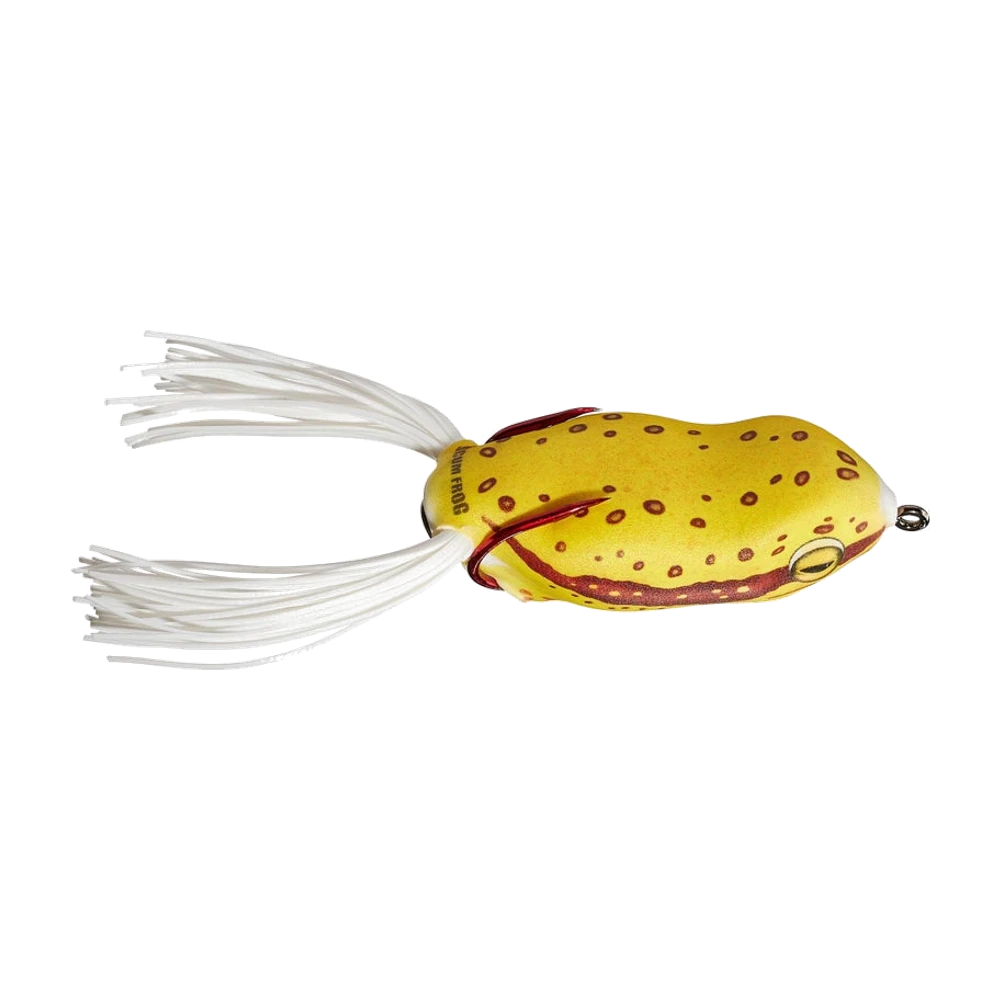
But a big double is useless if the body does not get out of the way. That is why the description insists on a super soft, high compression body: on the hookset, the plastic crushes and frees the points instead of holding them. In the photo the two points lie flat along the back, the standard position for a hollow frog — points sheltered horizontally, ready to lift once the material gives.
The hookset, where everything is decided
Never set on the sound. On a surface strike the fish misses one time in two, and a hookset into thin air rips the frog off the spot. Wait until you feel weight in the rod, count a beat, then sweep low and long with braid. A heavy rod and non-stretch braid are not about comfort on this kind of lure: they are the two conditions for the body collapse to be worth anything.
Not sure what to tie on?
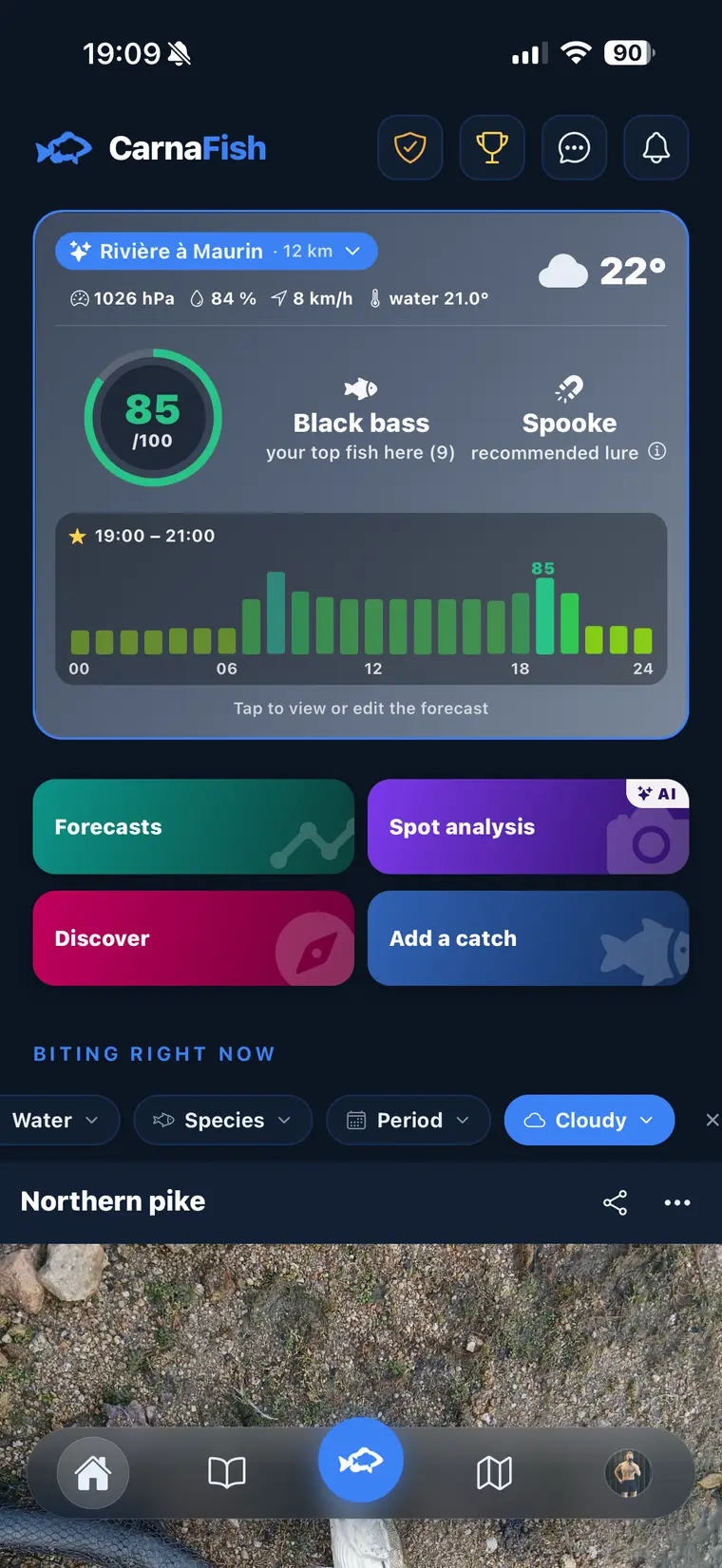
Photograph your spot: CarnaFish reads the scene, cross-checks the conditions and gives you the zone, the lure and the retrieve. Free on iOS and Android.
Colours by light
- Stained water or low light: the spotted yellow of the sample in the photo, digitally printed according to the maker, with its brown ocelli and dark red lateral band. On a broken surface, a pale belly stays visible longer.
- Living grass, green water: a frog pattern in greens, which blends into the vegetation and does not advertise the lure to a fish that has already been worked over.
- Hard backlight, dawn and dusk: black. On the surface the fish looks up at the sky: only the outline counts, and black gives it best.
Knowing when a frog belongs on the line
A frog only fishes inside a window: warm water, fish high in the column, usable vegetation or edge. The rest of the time it stays in the box. That is exactly the question CarnaFish settles from a photo of the spot: zone, depth and lure family consistent with the conditions of the moment. To build the method around it, our guide to getting started on bass lays the foundations. If you want a comparison with a frog designed to walk but with no declared weight system, the Scum Frog Scum Dog Walker plays on hull shape, while the Booyah Pad Crasher remains the benchmark for crossing dense mats.
Key takeaways
- Two separate weights: a tungsten block locked on the hook shank for distance, a brass button in the tail for the nose-up trim.
- The maker's table is clear: 7 cm / 2.75 in, 17.7 g / 0.625 oz, floating class. No deduction needed.
- The walk happens on semi-slack line, neither on a tight line nor on a dead one.
- The 5/0 Owner double only works if the body collapses on the hookset: braid and a heavy rod are mandatory.
FAQ
What size is the Launch Frog exactly?
The maker's table gives 7 cm / 2.75 in for 17.7 g / 0.625 oz, in the floating class. That is a middle format for a frog, with a high weight for its size, consistent with the long-casting orientation claimed for the weight system.
What is the tungsten weight on the hook for?
The maker presents it as a system with locking tabs that attaches to the shank of the hook rather than sitting in the body. It claims proper weight distribution, longer casts and consistent performance from cast to cast.
Why does the frog float nose up?
Because of the combination of a wide body and a brass button weight placed in the tail. That attitude is what lets the lure pivot in place on every twitch, and therefore walk without you forcing the rod tip.
Which hook comes fitted?
A red Owner double frog hook in size 5/0, according to the description. That is a substantial size, chosen for the gap between the points as much as for penetration.
Do you need braid for this frog?
Yes. The body has to crush on the hookset to free the points, and a stretchy line absorbs exactly the energy that crushing requires. Non-stretch braid and a heavy rod are the baseline.
Can it be fished in very dense mats?
Yes, that is the natural ground for a hollow frog with points lying flat. Walking the dog, though, only works on open water or in the gaps: on a compact mat, settle for a steady pull and save the zigzag for the edges.
The full bass lure guideSeason-by-season strategy: which family of lure, when, and why.Go from theory to fish
CarnaFish reads your spot from a photo and gives you the game plan: zone, lure, retrieve. Free on iOS and Android.