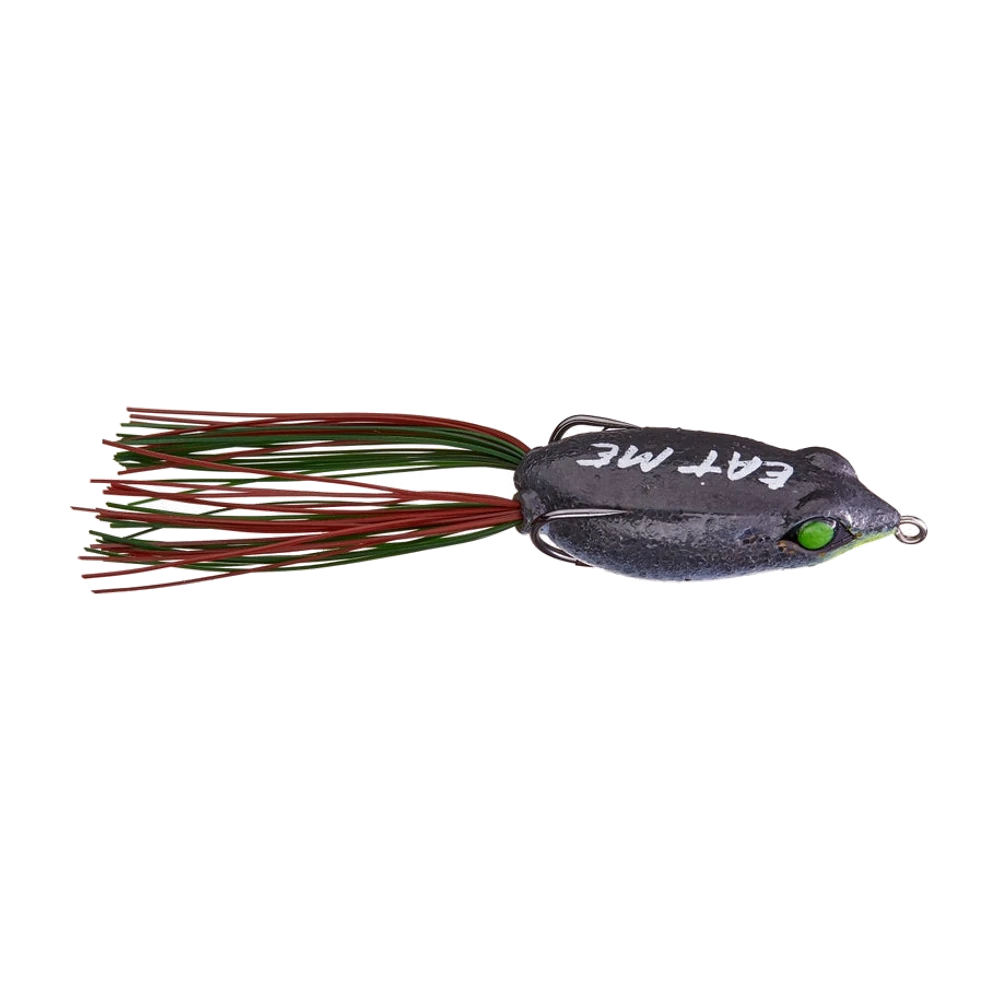
Googan Filthy Hollow Body Frog: the weighted frog built for the slop
The right lure in the wrong spot still catches nothing. CarnaFish spots the zone that works, from a single photo.
There's a moment in high summer when the edge of a pond becomes unfishable. The pads touch each other, duckweed covers everything, and no normal lure survives three metres of retrieve. That's exactly the ground a hollow body frog is made for — and Googan's Filthy Frog is advertised for the worst of it: the slop a serious fish has gone to sit under.
Two versions, and a deliberate weight
The manufacturer's table gives two lines, and they're worth pausing on:
- Filthy Frog 2 in, that is 5.1 cm, at 1/4 oz, that is 7.1 g, rated Floating.
- Filthy Frog 2.5 in, that is 6.4 cm, at 5/8 oz, that is 17.7 g, also Floating.
Look hard at the second line. 17.7 g for 6.4 cm is very heavy for a hollow body frog — plenty of competing models of the same length sit around 12 to 14 g. It isn't a catalogue error: Googan explicitly states a heavier internal weight than the market average, precisely to gain distance and casting accuracy. Table and description say the same thing, which is reassuring.
That choice has a direct effect on tackle. Those 17.7 g go out with a flick of the wrist under a branch at fifteen metres, which is exactly what you want from a frog, but they call for a heavy rod able to handle the hookset. The 5.1 cm, 7.1 g version is far gentler and suits small waters and average-sized fish better.
The pointed nose, judged on the third cast
Most frogs have a rounded or flat nose, inherited from popper designs. The Filthy has a narrow body ending in a point, and Googan gives two reasons: presenting a credible frog profile seen from below, and above all slipping through dense cover without building muck up at the front.
The second reason is the one that counts on the water. A wide nose pushes duckweed and vegetation ahead of it: after two metres you're winding in a clump of weed with a frog somewhere in the middle, and the fish has nothing usable to look at. A pointed nose splits and passes. You can't see the difference in the shop; you see it on the third cast into a dirty area.
If your frog still picks up vegetation, the problem is almost always your rod angle. Fish with the tip high, around forty-five degrees: the nose rides slightly up and skates over the weed instead of ploughing it. Rod low, even the best frog turns into a plough.
Walk, stop, start again
The Filthy's balance is built for walking the dog, and the manufacturer stresses one point: it's done on a slack line. That's the mistake everyone makes at first. As long as your braid is tight, every rod stroke pulls the frog straight towards you. Leave thirty centimetres of slack, give short sharp strokes close together, and the bait swings left then right while barely moving forward. In a square metre of open water between two weed beds you can keep the frog dancing on the spot for five or six seconds.
The pause is the other half of the job. The rubber legs keep opening and closing slowly while the bait sits still, and that's often when the strike comes. Googan also notes that the legs are fastened from inside the body rather than simply pushed in, which fixes the classic fault of this lure family: strands pulling out one by one as fish come in.
The classic mistake: setting too early
A frog strike is violent and visual, and that's exactly the trap. In a weed mat the fish often takes as much vegetation as lure, and needs a second to close down. Set on the sound and you rip the bait out of its mouth. The rule is simple: wait to feel weight in the rod, then set hard and sideways, and keep winding without ever giving slack. With a hollow body, it's the jaw crushing the lure that frees the double hook points — hence heavy braid, 40 to 50 lb, tied straight to the eye with no leader.
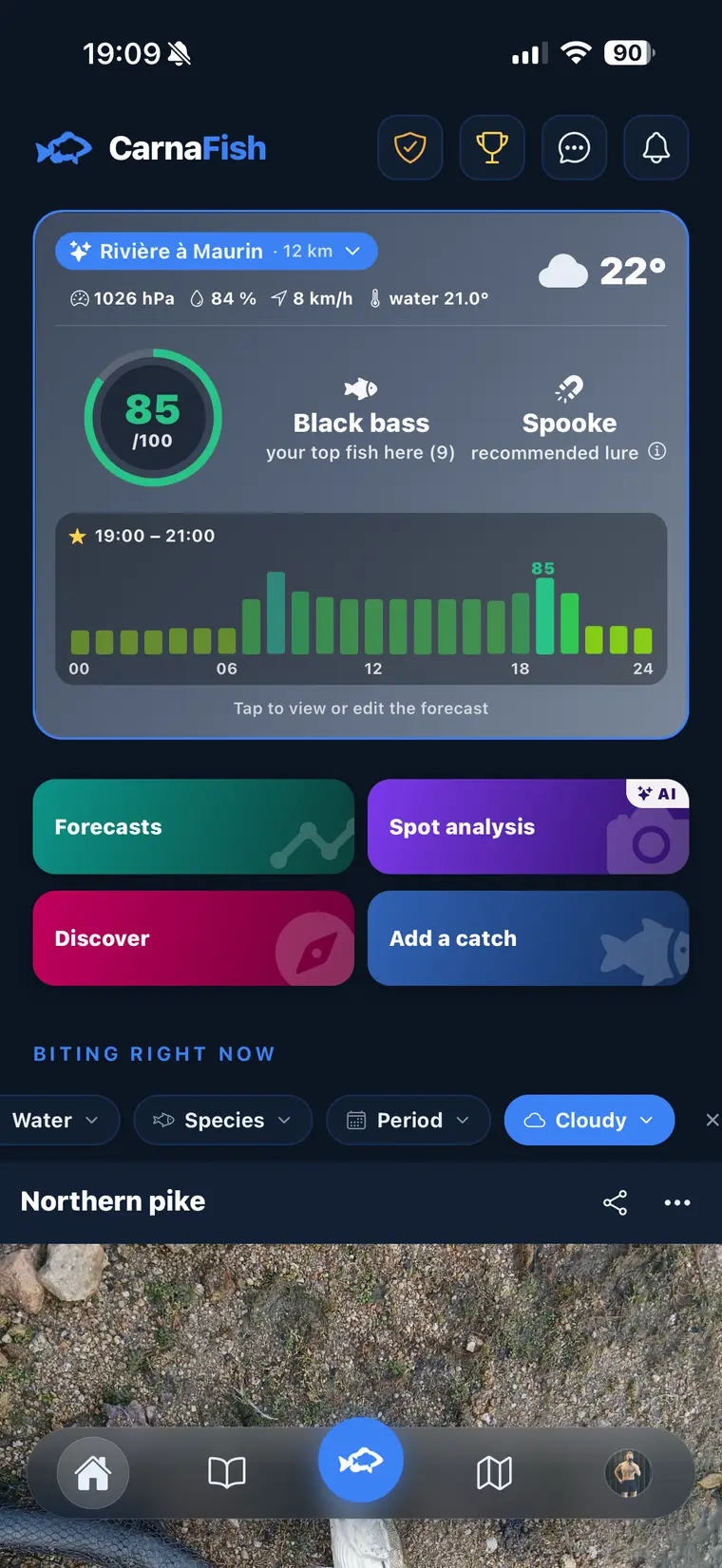
Not sure what to tie on?
Photograph your spot: CarnaFish reads the scene, cross-checks the conditions and gives you the zone, the lure and the retrieve. Free on iOS and Android.
Bass, but not only
The manufacturer's description explicitly names pike among the species concerned, and that squares with European practice: a pike sitting under a mat of pads in August attacks a frog exactly like a bass does. That changes the leader question, since a frog is normally fished on bare braid. The common compromise is to accept the cut-off risk on bass-dominated water, and to switch to a short titanium leader as soon as you know the spot holds pike.
Compared with a SPRO Bronzeye Frog, the historical benchmark of the segment, the Filthy leans less on a wide profile and more on penetration and distance. For lighter fishing on small waters, the Molix Frog or a soft toad such as the Zoom Horny Toad occupy a different niche — continuous retrieve rather than working on the spot.
Colour by cover and light
- Backlight, thick mat, dark water: a dark back like the colour photographed here. From below a frog is only a black silhouette on the sky, and the detail on the back is for the angler.
- Open water, grey skies: a white or bone back, far easier to track by eye, which helps you avoid setting on the wrong explosion.
- Sparse pads, full sun: a natural green and yellow that blends into the cover without creating harsh contrast.
The real work in this kind of fishing is spotting the holes, edges and transitions in the mat — not choosing the frog. That's what CarnaFish does: a photo of the spot, and the app suggests the zone to work and the presentation suited to the day's conditions. For bass fundamentals, tackle and spots, our beginner's guide to bass fishing is a good starting point.
Key takeaways
- Two versions on the table: 5.1 cm at 7.1 g and 6.4 cm at 17.7 g, both floating.
- The 17.7 g of the big version is deliberate: a heavier internal weight for long, accurate casts, at the cost of needing a heavy rod.
- The pointed nose mainly keeps vegetation from piling up ahead of the bait, which shows from the first casts in dirty water.
- You set on felt weight, never on sound, with heavy braid tied straight through.
FAQ
What are the sizes and weights of the Filthy Frog?
The manufacturer's table gives two versions: 2 in (5.1 cm) at 1/4 oz (7.1 g), and 2.5 in (6.4 cm) at 5/8 oz (17.7 g). Both are listed as floating.
Why is the big version so heavy?
It's deliberate. Googan states a heavier internal weight than the market average, to gain casting distance and accuracy, and the dimension table confirms that choice with 17.7 g for 6.4 cm. The trade-off is that you need a heavy rod.
What line and setup for frog fishing?
40 to 50 lb braid tied straight to the eye, no fluorocarbon leader, and a fast-action heavy rod. You have to both drive the hooks through a hollow body on the set and pull the fish out of the vegetation before it can wrap up in it.
Why do I miss so many fish?
Because you're setting on the sound. In a mat the fish often takes weed along with the lure and has to close its mouth. Wait to feel weight in the rod, then set hard and sideways, keeping tension throughout.
Does a frog work on pike?
Yes, the manufacturer names pike among the species concerned, and a pad field in summer often holds both. Consider a short titanium leader in that case, since a frog is normally fished on bare braid, directly exposed to teeth.
How do I make the frog walk on the spot?
By slackening the line. Leave about thirty centimetres of slack and give short, sharp, closely spaced rod strokes: the bait swings one way then the other without advancing. With tight braid it goes straight and you lose the whole point of the technique.
The full bass lure guideSeason-by-season strategy: which family of lure, when, and why.Go from theory to fish
CarnaFish reads your spot from a photo and gives you the game plan: zone, lure, retrieve. Free on iOS and Android.