Scum Frog Scum Dog Walker: the frog that walks almost by itself
Not sure this lure fits YOUR spot today? CarnaFish tells you in 10 seconds, from a photo.
In theory, walking the dog is open-water work with a hard stickbait. The trouble is that bass spend the summer under matted vegetation, exactly where a treble-hooked lure comes back wearing salad after two metres. The Scum Frog Scum Dog Walker answers that conflict: a frog body that crosses the mat, and a hull architecture that lets it walk like a stickbait the moment it reaches open water.
The hull, not the tail
On a hard stickbait, the zigzag comes from rear weight and the shape of the nose. On a hollow frog there is no lip and no cupped face: the body has to pivot on its own. The maker explains it comes from two combined elements — a belly shaped like a hull and weighting placed at the rear — and that this architecture lets the lure pivot easily in the water.
The reasoning holds. A keeled belly reduces the surface gripping the water and creates a central pivot point; rear weight brings the centre of rotation closer to the tail. The result: every twitch turns the nose around the back instead of dragging the whole lure forward. It is the same principle as a Megabass Giant Dog-X, transposed into a soft body that compresses.
The retrieve, and the only thing that truly matters
The description is precise here and deserves reading word for word: successive twitches of the rod tip, on semi-slack line. Neither a tight line nor a dead one.
That is the hardest setting to find for an angler new to topwater. On a tight line, every twitch sends all its energy forward and the lure runs straight without ever pivoting. On a completely slack line, the twitch eats the slack and never reaches the lure. The right place is between the two: enough slack for the lure to be free to turn, enough tension for the impulse to arrive.
Finding your tempo in ten casts
Cast to medium range, rod tip down and slightly to the side. Give two short, crisp twitches, not sweeping ones, taking up just the line you need between them. If the lure runs straight, you have too much tension: give back ten centimetres. If it stays put wobbling limply, you have given back too much. Ten casts are enough to lock that setting in, and it holds for the session.
The rule nobody tells you in the shop: the zigzag is useless in the middle of a mat. Walk the lure through the openings and along the two metres of open water that border the vegetation, and settle for a steady pull when you are over the thick stuff. Walking is an edge technique, not a crossing technique.
A body that gets out of the way of the points
The description insists on a super soft plastic construction and speaks of excellent collapsibility, which exposes the Owner hooks it describes as super sharp. That is the classic mechanism of a hollow frog, but it deserves to be understood rather than endured.
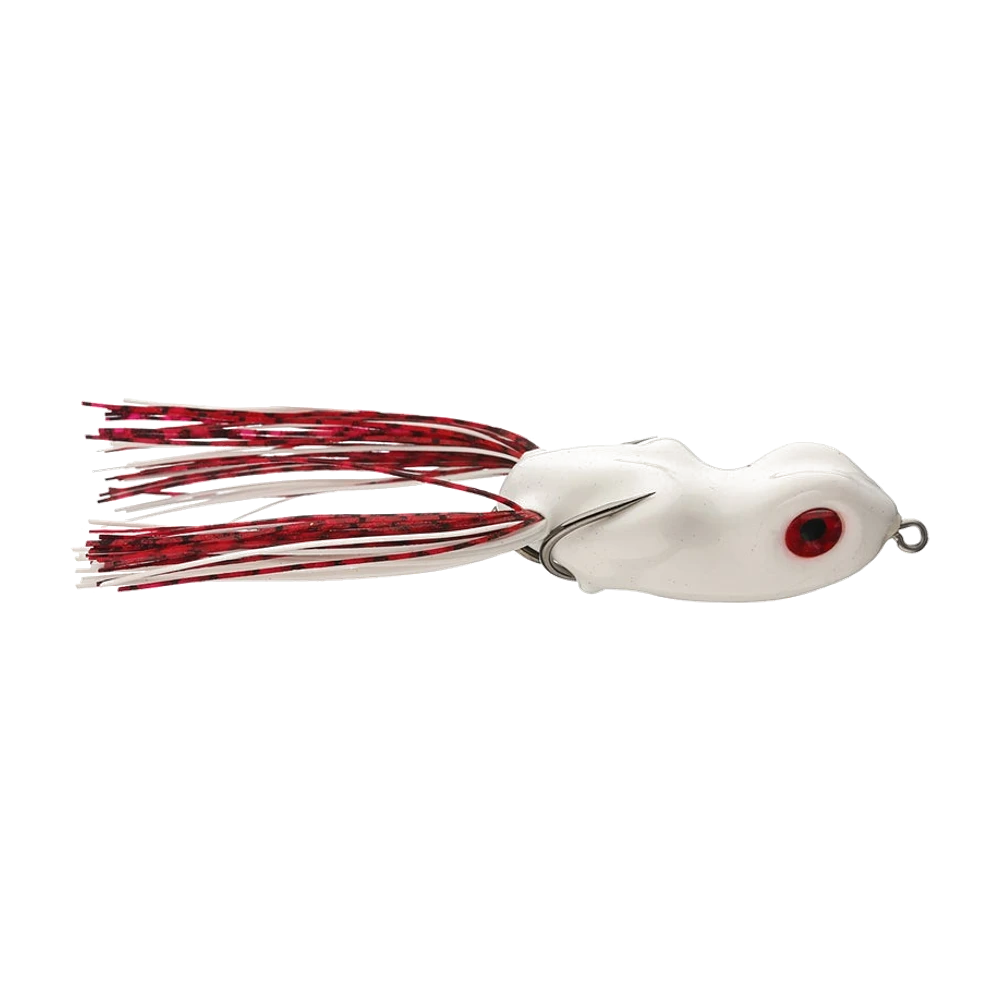
In the photo the double hook lies along the back, points to the rear, in bare steel. As long as the body keeps its volume, the points stay sheltered and the lure travels through vegetation. When the fish closes its mouth, the body crushes and the points come clear. The whole question is whether the energy of your hookset actually gets that far.
The mistake that costs fish
Setting on the sound. On a surface strike in vegetation, one blow-up in two is a miss, and a hookset into thin air rips the lure out of the zone and ends the activity. Wait until you feel weight, count a beat, then sweep low and long. Braid is mandatory: a stretchy line absorbs exactly the energy the body needs to collapse.
What the maker does not publish
Unlike the Scum Frog Launch Frog, whose description carries a proper table, the Scum Dog Walker's has none. No length, no weight, no buoyancy class. The text describes a topwater lure, but it never writes the word floating, and we are not going to write it on its behalf.
In practice that means two things. First, ask the retailer for the length if you are building a rod and braid combination around this lure. Second, judge its buoyancy yourself on the first cast, before settling on a rhythm: a surface lure that sinks slightly on the pause is not fished like one that stays put.
Not sure what to tie on?
Photograph your spot: CarnaFish reads the scene, cross-checks the conditions and gives you the zone, the lure and the retrieve. Free on iOS and Android.
Colours by light
- Stained water, overcast sky: the white body with the red and white skirt of the sample in the photo. A pale belly stays readable on a broken surface, and the skirt adds a point of colour at the back of the lure, where the mouth closes.
- Living grass: a frog pattern in greens, which does not advertise the lure on heavily fished water.
- Backlight, dawn and dusk: black, because on the surface the fish sees an outline against the sky and nothing else.
The right lure at the right moment
A walking frog has a narrow window: warm water, fish high, and vegetation that leaves usable gaps. On a completely closed mat, a pure crossing design such as the Booyah Pad Crasher still makes more sense. To know what your spot offers before you choose, CarnaFish reads a photo and returns the zone, the depth and the lure family that fit the conditions. And to learn how to decode an edge before tying anything on, our guide to reading a fishing spot sets out the method.
Key takeaways
- The zigzag comes from the hull-shaped belly and the rear weighting, not from a tail or a lip.
- Everything hangs on semi-slack line: too tight and the lure runs straight, too loose and the twitch is lost.
- The very soft body frees the Owner double on the hookset, provided you fish braid and set on weight rather than on sound.
- No size table in the description: no length, no weight, no stated buoyancy class.
FAQ
How big is the Scum Dog Walker?
The maker description gives no figure, and it publishes no size table. That is something to ask the retailer, especially since it drives the choice of rod and braid on a topwater lure.
Does the Scum Dog Walker float?
The maker's text describes a topwater lure fished in and around matted vegetation, but it publishes no buoyancy class. Check it yourself on the first cast, because a lure that settles slightly on the pause is not worked at the same rhythm.
How do you get a regular zigzag?
With short, closely spaced twitches of the rod tip, on semi-slack line, tip pointing down. If the lure runs straight, give a little line back; if it stays put wobbling limply, take a little up.
Can it be walked over a dense mat?
No, and it is not worth trying. Walking needs open water: save it for the gaps and the strip of water bordering the vegetation, and pull the lure straight through when you cross the thick stuff.
Is braid necessary?
Yes. The body has to compress on the hookset to free the points of the Owner hook, and a stretchy line absorbs exactly the energy that compression requires. Pair it with a heavy rod.
How does it differ from the Launch Frog of the same brand?
The Launch Frog gets its nose-up attitude from two declared weights, in tungsten and brass, and its description publishes length, weight and class. The Scum Dog Walker plays on the hull shape of the belly and rear weighting, with no published dimensions at all.
The full bass lure guideSeason-by-season strategy: which family of lure, when, and why.Go from theory to fish
CarnaFish reads your spot from a photo and gives you the game plan: zone, lure, retrieve. Free on iOS and Android.