Snag Proof Zoo Pop: the hollow popper that floats and clears weed
Not sure this lure fits YOUR spot today? CarnaFish tells you in 10 seconds, from a photo.
Late summer on a closed-up pond, the big frog crossing the mat again and again without triggering a thing, and yet you can see two rises along the edge. The fish are there, they are feeding, but they are refusing the volume. That is exactly where the Zoo Pop belongs: a popper noticeably smaller than a standard frog, but built on the same hollow-body, buried-hook logic, so you can cast it to precisely the same places.
A hollow popper, which is rarer than it sounds
Almost every popper on the market is a hard shell hung with two or three trebles. They make a crisp noise, they hook well, and they become unusable the moment the surface closes over. Conversely, weedless baits are nearly all frogs, meaning hollow bodies that slide across without really making noise.
The Zoo Pop fills the empty slot between the two. Snag Proof describes a soft hollow body that produces a distinct popping motion, paired with a hook design integrated into the body, and claims buoyancy at rest — written plainly in the description, unlike other models in the range where that information only appears in a spec-table column. On this particular model the spec table carries just two columns, length and weight: the floating claim comes from the prose, not from a classification.
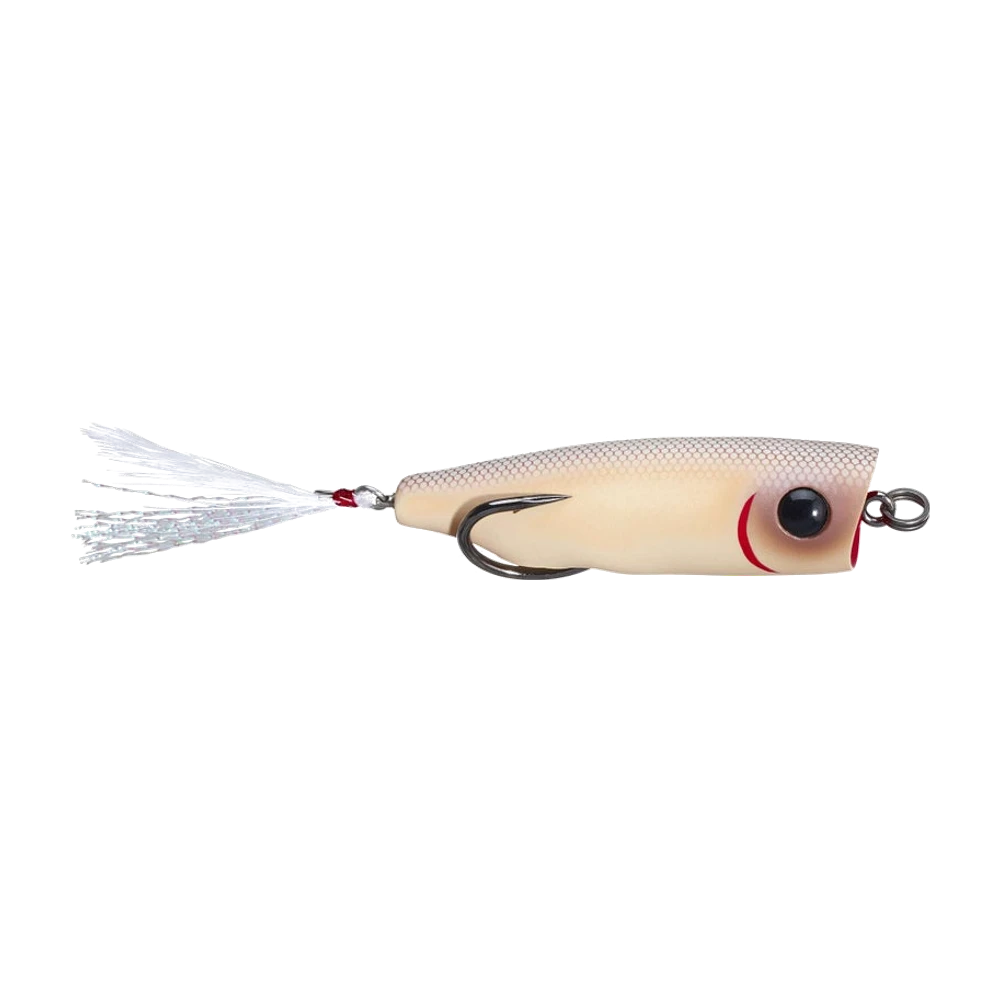
The product photo shows a pearly cream body with printed scales, a red gill line, a big black eye, a split ring at the nose and a single double hook lying along the body. At the tail, a tuft of white hair mixed with silver tinsel is mounted on a split ring. These are observations from a product photo, not specifications: the front face is not visible in profile, so we will not describe the exact shape of the cup.
Seven centimetres for 10.6 g: density that earns its keep
The stated figures are 2.75 in and 3/8 oz, so about 7 cm for 10.6 g. For its size that is a dense bait, and deliberately so: you need to cast it far and accurately on a powerful rod loaded with heavy braid, the tackle the ground imposes. A 7 cm hard-shell popper would weigh half as much and become impossible to place properly with that outfit.
The Zoo Pop is not fished like a frog. A frog you walk continuously across the mat. This one you drop into a hole in the weed, let it float for two seconds, give it one pop, and wait again. The strike almost always comes during the stillness that follows the noise, not during the noise.
Working it: the pause matters more than the sound
The sharp pop
Rod tip down, a short flick of the wrist, and the front face throws a spray of water with a brief crack. That is the long-range call, the one that turns the head of a fish holding several metres away. Two or three pops in a row are enough; beyond that you tire the spot more than you work it.
The rolled pop
Same gesture, softer, rod tip higher: the hollow body slides along pushing water ahead of it instead of cracking. The signal is more discreet and it carries better when the water is flat and the fish is wary. It is also the version to use when crossing a patch of weed, because it brings less vegetation up onto the bait.
The pause that closes the deal
Between moves, let it float for three to five seconds, noticeably longer than you would with a conventional popper. The hollow body sits motionless and the outline, seen from below, looks like prey resting on the surface. That is the sequence that converts the fish drawn in by the first pop.
When to pick it over a big frog
The manufacturer positions the Zoo Pop as a bait for fish that are ignoring bigger frogs. In practice three situations match that: midsummer afternoons when pressure builds, heavily fished waters where the fish have seen every large silhouette go by, and periods when the forage is small.
Conversely, when the vegetation is genuinely dense and the fish want volume, a SPRO Bronzeye Frog still makes more sense: bigger, tougher when forced through cover, and with a body that pushes more water. The Zoo Pop is a tool for nuance, not for brute searching.
To cover ground walking a clear bank, a treble-hooked popper such as the Rapala Skitter Pop will do better: it weighs less, it hooks better, and it asks for no delayed hookset. Again, the Zoo Pop is justified only by the cover.
Not sure what to tie on?
Photograph your spot: CarnaFish reads the scene, cross-checks the conditions and gives you the zone, the lure and the retrieve. Free on iOS and Android.
Rigging, rod and hookset
Braid of 30 to 40 pound test, tied direct or through a snap. You can come down slightly compared with a big frog because the bait is smaller and you are often fishing the holes rather than the solid mat, but do not drop into fine monofilament: a fish hooked on a weed edge buries itself in a second.
The hookset demands the same discipline as on a frog. The integrated hook only comes clear once the hollow body collapses, so you wait until the weight loads the rod before pulling. On this smaller bait the urge to strike instantly is even stronger because the attack is easier to see. Resist it.
The classic mistake
Stringing pops together with no pause, out of conventional popper reflex. The Zoo Pop does not get its effectiveness from repeated noise but from the contrast between the noise and the stillness that follows. An angler working it continuously covers more water and catches fewer fish on this particular bait. Second mistake: using it over open water, where a conventional treble-hooked popper hooks twice as well for the same number of attacks.
Colours by light and water
Snag Proof does not publish a detailed colour chart for this model, so we reason in families of tones rather than catalogue names.
- Clear water, strong light: a pearl bone like the one in the product photo, understated, which throws no hard flash while the bait sits still on the pause.
- Weed mat, stained water: a classic frog green, consistent with what the fish is used to seeing pass overhead in that environment.
- Backlight, dawn and dusk: a black back. On top it is the density of the silhouette that counts, not the actual shade.
Knowing whether the fish are on the mat, on the edge, or already back out deeper changes everything before you even pick a colour. That is exactly what CarnaFish makes easier: a photo of the spot, and the AI suggests the zone, the depth and the lure family that fit the day's conditions. To lay down the tackle and location basics, our guide to getting started with bass fishing remains a good way in.
Key takeaways
- A hollow-body popper with an integrated hook: it can be cast where a treble-hooked popper would snag instantly.
- Figures confirmed by the manufacturer: 7 cm / 2.75 in for 10.6 g / 3/8 oz, a density that makes accurate casting possible on a powerful rod.
- Buoyancy at rest is stated in the description, and it is what makes the long pause possible.
- Pop, then pause three to five seconds: the bite comes in the silence, not in the noise.
FAQ
Does the Zoo Pop really float at rest?
Yes, the manufacturer's description says so explicitly. Worth noting: this model's spec table has only two columns, length and weight, with no floating or sinking classification column. So the information comes from the text, where it is clear.
What size is it exactly?
The manufacturer states 2.75 in and 3/8 oz, so about 7 cm for 10.6 g. That is noticeably smaller than a standard frog, which is precisely its argument when the fish are refusing big profiles.
Can it be fished in heavy vegetation like a frog?
Over floating weed and lily pads, yes, thanks to its hook integrated into the body. But on a genuinely compact mat, a bigger and tougher frog such as the SPRO Bronzeye Frog goes through more easily and offers a better purchase on the hookset.
Do you need a delayed hookset like on a frog?
Yes, absolutely. The hook stays flat against the body for as long as that body does not collapse under the pressure of the jaws. Wait until you feel the weight in the rod before pulling, or you will tear the bait away before the points have come clear.
How many pops between pauses?
Two or three, rarely more. The point of this bait lies in the contrast between the noise and the long pause that follows, not in a continuous sequence. Three to five seconds of stillness between series is a good starting point.
How does it differ from the Zoo PUP in the same range?
The Snag Proof Zoo PUP is a walking bait: it zigzags horizontally and keeps covering ground. The Zoo Pop stays put and works through occasional sound calls. Two different answers to the same weed problem.
The full bass lure guideSeason-by-season strategy: which family of lure, when, and why.Go from theory to fish
CarnaFish reads your spot from a photo and gives you the game plan: zone, lure, retrieve. Free on iOS and Android.