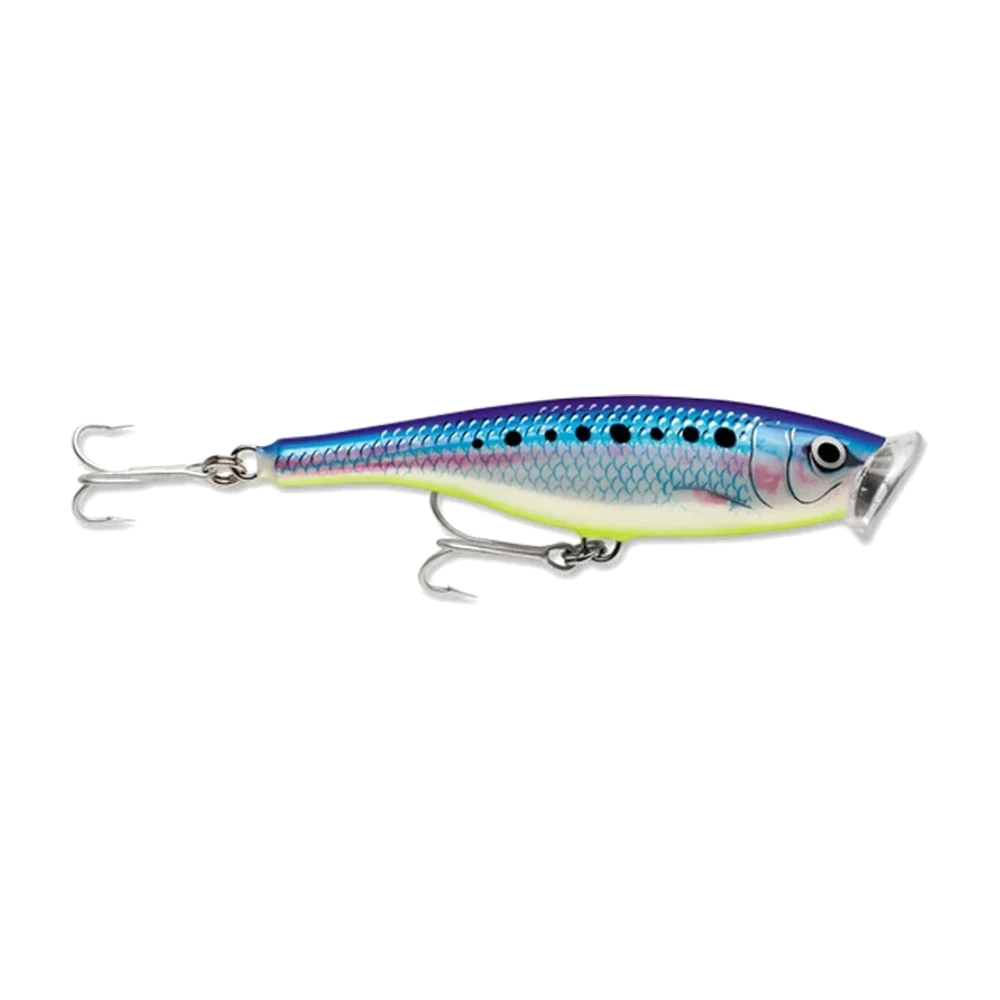
Rapala Skitter Pop: the popper that also knows how to walk
Not sure this lure fits YOUR spot today? CarnaFish tells you in 10 seconds, from a photo.
You arrive at a topwater spot and you do not yet know what the fish want. They may be feeding in open water, visibly, and a strong signal will pull them in from a distance. Or they are there, settled, wary, and the slightest extra noise will make them back off. The classic reflex is to carry two lures — a popper and a stickbait — and switch when one stops working. Except that between two changes you lose ten minutes and the feeding spell is over.
The Skitter Pop solves that problem simply: its cupped mouth is pronounced enough to pop cleanly, but its body is slim enough and its float flat enough to walk the moment you drop the rod tip. This is not a soggy compromise, it is a lure that genuinely changes behaviour according to how you hold your rod.
What follows is how to move from one action to the other without changing lure, and above all how to know which one to use.
Two actions, one difference: the angle of the rod tip
The Skitter Pop's mouth is cut on a slant, not straight. When you pull upwards, it bites into the water and throws a spray. When you pull down and sideways, it slides instead of biting, and the lure pivots.
In practice:
| Rod tip position | Movement | Result |
|---|---|---|
| Up, 45° | Sharp pull, 20 cm of travel | Clean pop, spray and noise |
| Up, short | Fast micro-pulls | A string of small splashes |
| Towards the water, almost vertical | Rhythmic 10 cm wrist snaps | Surface zigzag, little noise |
| Towards the water + continuous winding | Steady pull | A nervous wake, feather quivering |
Switching from one mode to the other takes a second, without lifting the lure out of the water. That is exactly what you need when a fish follows without committing: you pop three times to call it, then drop the tip and go straight into a walking action. That change of register mid-retrieve triggers far more than a uniform action.
The three-cast search protocol
On an unknown spot, do not hunt for the right action at random. Test it in a fixed order, always the same, and you will know in three casts what the fish want.
- First cast, loud mode. Three clean pops a second apart, then five seconds of pause, and repeat all the way in. That is your long-range call: you cover the spot and see if anything reacts.
- Second cast, mixed mode. Two pops to announce yourself, then rod tip to the water and ten continuous zigzags. You go from a signal to a fleeing prey. Most of the takes come in the first three zigzags after the last pop.
- Third cast, quiet mode. Walking action only, rod tip low, not a single pop. That is what is left when the fish are there but the noise bothers them.
If none of the three produces anything, the problem is not the action: either the fish are not near the surface, or they are not there at all. Move spots or go below the surface rather than persisting.
On the water: when a fish misses the lure, do not on any account drop it back in the same place. Carry on the retrieve for two metres of walking action, then hold a full three-second stop. A fish that has missed almost always comes back on the restart, not on an immediate second attack — dropping the lure back on its head makes it leave.
The rear feather, and why you keep it wet
The rear treble carries a feather. On a popper that is not cosmetic: it is what occupies the pauses. During the three to five seconds when the body is still, the fibres keep opening and closing, and that is the only perceptible movement at that moment.
Two practical consequences.
Do not trim it. A feather shortened "to hook better" costs you exactly the most productive phase of the lure. If you are missing takes, the problem is almost always the hookset, not the length of the feather.
Soak it before your first cast. A dry feather clumps together and does not move. Ten seconds in the water before you start, and it breathes properly from the first spot.
In saltwater, the feather loads with salt and stiffens within one session. A rinse in fresh water and drying it flat is enough to restore its volume.
Sizes and targets: do not take the biggest by default
The model runs from around 5 to 9 cm. The reflex of taking the biggest size "to cast further" often costs bites.
- The middle size, around 7 cm, is the most versatile: heavy enough to cast properly, small enough not to spook a wary sea bass in clear water. That is the one to have if you only take one.
- The small size takes over when fish are feeding on tiny fry and refuse anything bigger. It needs a light rod and becomes unusable as soon as there is wind.
- The big size is only justified over big windy expanses, or when you are only after big fish. It causes more refusals than it converts on average fish.
On line, 0.25 to 0.30 mm fluorocarbon straight through is enough in freshwater. In the sea, braid with a one-metre leader gives more distance and a far cleaner hookset, provided you keep some slack between each pull.
Not sure what to tie on?
Photograph your spot: CarnaFish reads the scene, cross-checks the conditions and gives you the zone, the lure and the retrieve. Free on iOS and Android.
Where it is the right call, and where it is not
It excels along rocky saltwater margins on a rising tide, when the bass move up to feed over shallow ground and you have to cover water fast. It is also very effective over weedy freshwater flats, above 50 cm to 1.5 m of weed, where a diving lure snags on every cast.
It is unsuited in three cases:
- Very rough water or big swell: its spray is lost, and a heavier, louder lure will do the job better.
- Cold water, below around 12 °C: the fish no longer come up, and no adjustment of the action will compensate for that.
- Spots cluttered with deadwood: the two trebles catch everything, and a weedless frog is more relevant.
Skitter Pop or a specialist popper
Against a compact, discreet popper such as the Megabass Pop-X, the Skitter Pop is louder and faster to search with, but less convincing on genuinely educated fish in clear, calm water. The Pop-X wins on precision, the Skitter Pop wins on covering ground.
Against a wide, loud popper such as the Rebel Pop-R it is the other way round: the Skitter Pop pops a little less hard but it is the only one of the two that can walk cleanly. If you can only carry one topwater for a session where you do not know the fish's mood, that is a serious argument.
And if you want pure walking action over long distances, the Heddon Super Spook will stay wider and carry much further — but it will never pop. Our guide to sea bass fishing with lures places these three families relative to one another. And if you are unsure which topwater to pick when you get to the bank, CarnaFish analyses a photo of the spot and answers.
Key takeaways
- Rod tip high = clean pop, rod tip low = walking action: one lure, two presentations.
- Search in three casts in a fixed order: loud, mixed, quiet.
- The rear feather occupies the pauses — do not trim it, and wet it before you start.
- The middle size around 7 cm is by far the most versatile.
- Pointless in cold water, in heavy chop or on a very cluttered spot.
FAQ
How do you walk the dog with the Skitter Pop?
Point the rod tip at the water, almost vertically, and give short 10 cm wrist snaps at a steady cadence. Take up the slack with half a turn of the handle between each snap. If the lure runs straight, your line is too tight.
What size Skitter Pop should you choose for sea bass?
The middle size around 7 cm covers the great majority of situations: it casts properly and does not put off wary fish. Keep the biggest version for large windy expanses and the smallest for fish feeding on fry.
Should you strike as soon as you see the attack?
No. Wait until you feel the weight of the fish in the rod. Striking on sight almost always tears the lure out of the mouth, especially with braid, which forgives no anticipation.
Can you fish the Skitter Pop in freshwater for bass?
Yes, and it is one of its best grounds, particularly over submerged weed in less than a metre and a half. Favour natural tones in clear water and a walking action rather than heavy pops.
What do you do when fish follow without attacking?
Change register mid-retrieve: two or three pops to call, then an immediate switch to a walking action with the rod tip low. It is the break in rhythm that decides them, far more than lure colour.
What line should you use with this popper?
0.25 to 0.30 mm fluorocarbon straight through is simple and works well in freshwater. In the sea, prefer braid with a metre of fluorocarbon leader: you gain casting distance and the hookset becomes much cleaner.
The full sea bass lure guideSeason-by-season strategy: which family of lure, when, and why.Go from theory to fish
CarnaFish reads your spot from a photo and gives you the game plan: zone, lure, retrieve. Free on iOS and Android.