Snag Proof Zoo PUP: the soft walking bait in a downsized format
One lure, endless conditions. CarnaFish reads your spot from a photo so you are not just guessing.
Downsizing on top is a well-established reflex with hard baits: when the fish follows without committing, you drop from the full-size stickbait to the junior model. With weedless baits that reflex barely exists, because hollow bodies are almost all one-size frogs. The Zoo PUP fills that gap: a hollow-body walking bait, so able to go into cover, but in a format that sits in the palm of your hand.
A smaller format that keeps its weight
Snag Proof presents the Zoo PUP as the downsized version of a larger model — the Snag Proof Zoo Dog, whose description gives no length at all. The PUP's figures are clear: 3.5 in and 1/2 oz, so 8.9 cm for 14.2 g.
That ratio is worth pausing over. A 9 cm hard stickbait usually weighs 10 to 12 g; here you get 14.2 g for the same length. The bait is dense, and that density is the key to its usefulness: it lets you cast a small profile far and accurately with the powerful rod and heavy braid that fishing cover imposes. That is exactly what a conventional junior stickbait cannot do on that tackle.
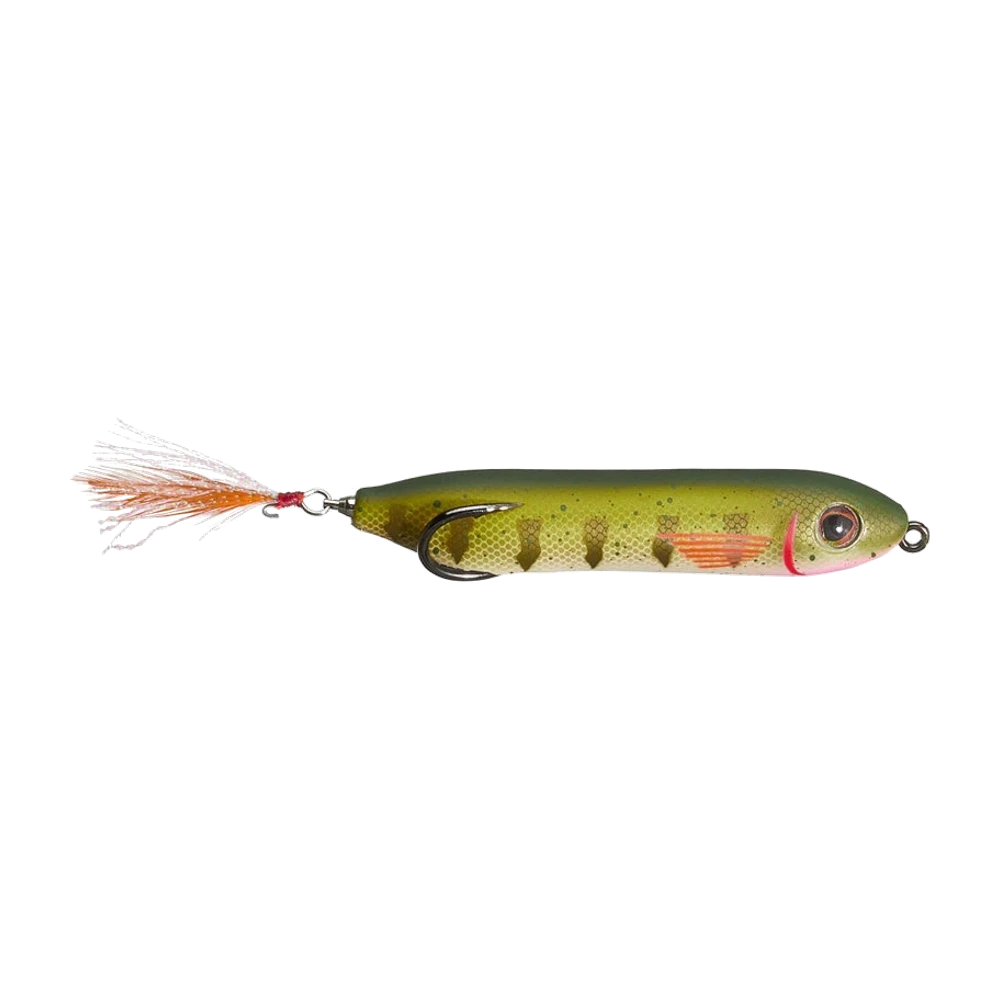
The product photo shows a slim body with an olive-green back and scaled chartreuse flanks barred with dark, a pink gill, a copper eye ringed in silver and a nose ring. A single double hook lies along the body, points up, and a white and orange tuft is mounted on a split ring at the tail. These are observations from a product photo, not specifications: the description gives neither the hook size nor the make-up of that tail dressing.
An ultra-soft body: what it changes in the water
The manufacturer stresses the extreme softness of the hollow body, and that is the point which separates this bait from a rigid stickbait. Two concrete consequences.
The first is the zigzag. A soft body absorbs part of the energy of the pull, so the bait answers with a slight delay and less regularity than a hard shell. Geometrically it is less tidy, but it is more believable: a struggling prey item does not zigzag to a metronome.
The second is the hookset. A very soft body collapses more readily under pressure, which helps free the points of the double. In exchange it also deforms faster in use: after a dozen fish and as many trips through the weed, the flanks keep the marks and the body sometimes holds a little water. That is the price of softness, and it is worth knowing before you buy.
The one adjustment that changes everything on this bait is the amount of slack. Always keep 20 to 30 cm of slack between the rod tip and the bait while working it: that slack is what lets the nose pivot freely and creates the width of the zigzag. Under tension the Zoo PUP tracks almost straight, and the bait gets blamed unfairly.
Two cadences, and the ground between them
The wide walk
Soft pulls half a second apart, rod tip low, reel taking up slack only. The bait sweeps wide and covers little ground. This is the cadence for flat water, for early morning, for a fish rising slowly to inspect before deciding.
The short zigzag
Shorter, more closely spaced pulls: the body has no time to finish its travel and breaks into tight little darts. This version triggers rather than seduces, and it is the one to use when a fish has followed without touching, or when the surface ripples up.
Switching between them
The manufacturer's description specifically claims this ability to tailor the cadence. The most productive sequence is often to alternate: three wide pulls, two tight ones, a one-second pause, and start again. The change of rhythm draws more strikes than either cadence taken on its own.
Where this format belongs
The Zoo PUP is made for light to moderate cover: weed edges, brushy tangles, scattered pads, flooded wood. On a genuinely closed mat, a bulkier and louder bait such as the Snag Proof Zoo Kick will be more visible and easier to keep on the surface.
Over open water the question changes: a Heddon Super Spook Jr of comparable size hooks distinctly better with its trebles. The Zoo PUP's reduced format is therefore justified only when both constraints stack up — cover, and fish that are refusing big profiles.
In Europe that combination shows up mostly on late-summer ponds and gravel pits holding bass, when the weed is high and fishing pressure has made the fish wary.
Not sure what to tie on?
Photograph your spot: CarnaFish reads the scene, cross-checks the conditions and gives you the zone, the lure and the retrieve. Free on iOS and Android.
Rigging, rod and hookset
Braid of 30 to 40 pound test. You can drop a notch compared with a big frog because you are fishing edges rather than solid mat, but no lower: a good bass hooked in a brush tangle wraps up in a second.
A loop knot or a small snap noticeably improves the width of the zigzag by leaving the nose free. For the rod, medium-heavy power with a slightly progressive tip: enough reserve to extract the fish, enough give to let the hollow body collapse at the moment of the hookset.
The classic mistake
Setting the hook the instant the water explodes. On a hollow body the hook is not clear yet at that moment. Wait a second, until you feel the weight load the rod, then set wide. Second, subtler mistake: working the bait with a tight line, which blocks the nose from pivoting and turns the walk the dog into a soft straight retrieve. If your Zoo PUP will not zigzag, that is almost always why.
Colours by light and water
Snag Proof does not publish a detailed colour chart for this model, so we reason in families of tones rather than catalogue names.
- Lightly stained water: a chartreuse perch pattern barred with dark, like the one in the product photo. The internal contrast stays readable as visibility drops.
- Backlight, dawn and dusk: a frankly dark back. Seen from below, the fish reads a silhouette before a colour.
- Clear water, strong light: pale, low-gloss flanks, which avoid the hard flash each time the bait rolls onto its side.
Knowing which edge to work, and at what time of day, counts for more than the colour choice. That is what CarnaFish makes easier: a photo of the spot, and the AI suggests the zone, the depth and the lure family that fit the day's conditions. To pin down the periods when topwater really produces, our guide to predator fishing season by season gives the useful markers.
Key takeaways
- 8.9 cm / 3.5 in for 14.2 g / 1/2 oz: a small profile but a dense one, castable far with the heavy tackle cover demands.
- An ultra-soft body as advertised: a less regular zigzag than a hard shell, but easier collapse on the hookset.
- Keep slack in the line, or the nose will not pivot and the walk the dog disappears.
- Over open water a treble-hooked stickbait of the same size hooks better: this bait is justified by the cover.
FAQ
What is the difference with the Zoo Dog?
The Zoo PUP is presented by the manufacturer as the downsized version of a larger model. Its figures are known — 8.9 cm for 14.2 g — whereas the description of the Snag Proof Zoo Dog gives no length, only a stated weight of about 17 g.
Does the Zoo PUP float at rest?
The manufacturer does not say. This model's spec table has only two columns, length and weight, with no floating or sinking classification, and the text does not mention buoyancy at rest. So it cannot be asserted, unlike the Snag Proof Zoo Pop, whose description states it explicitly.
Why will my Zoo PUP not zigzag?
In the vast majority of cases because the line is tight while you work it. Leave 20 to 30 cm of slack between the rod tip and the bait and give your pulls into that slack. Check too that you are not working it too fast: a soft body needs more time than a hard shell.
Should it be fished like a frog?
Not exactly. A frog is slid and walked across the mat; the Zoo PUP is a walking bait and works better along the edges of cover and in the openings than in the middle of a closed mat, where its slim outline is less visible.
Is it suitable for pike?
It can take one along a weed edge, but that is not its purpose: at 8.9 cm the profile is small for a pike, and a double held flat on a soft body hooks a bony jaw less well. If pike is the target species, a bulkier bait makes more sense.
Is it fragile?
Like any very soft hollow body it marks with use: tooth scars, deformation after several fish, sometimes a little water inside. That is normal for this family of baits, but it should be budgeted for rather than hoped away.
The full bass lure guideSeason-by-season strategy: which family of lure, when, and why.Go from theory to fish
CarnaFish reads your spot from a photo and gives you the game plan: zone, lure, retrieve. Free on iOS and Android.