SPRO KGB Chad Shad 180: the 68 g glide bait that swings wide
The right lure in the wrong spot still catches nothing. CarnaFish spots the zone that works, from a single photo.
There is a specific moment on a big clear lake when you have already tried everything. The crankbait has combed the breaks, the Texas rig has picked through the weed, and all you have met are average fish. That is when tying on a seventeen-centimetre lure weighing nearly seventy grams becomes a rational decision: you stop looking for fish and start looking for one fish. The KGB Chad Shad 180 belongs to the family of baits that never produce numbers but that trigger strikes in a different class.
What the spec table says, and what it leaves out
SPRO's table fits on a single line: KGB Chad Shad, seven inches, 2.4 ounces, rate of fall 3 to 4 feet. In metric that works out to 17.8 cm for 68 g - the equivalent of five mid-size crankbaits hanging off the end of your line. The fall figure deserves an honest caveat: the column gives 3 to 4 feet, roughly 0.9 to 1.2 m, but it never states the time unit. US convention almost always expresses that figure per second, and that order of magnitude matches a bait of this density. Take one metre per second as your starting reference and recalibrate on your first cast by counting until the slack line goes tight.
One point leaves no room for doubt, though: the Chad Shad sinks. The table carries no buoyancy column, but a published rate of fall settles the question on its own. That drives everything about how you fish it: depth is not set by a lip or by speed, but by how long you let the bait drop before you start reeling.
The glide, and what controls it
SPRO presents the Chad Shad as a bait that takes every cadence, from a super slow retrieve to a full burn, producing both lazy wide glides and short choppy cuts. That is a manufacturer claim rather than a measurement, but it does describe the logic of the format: on a glide bait the lure does not pick its own amplitude - you do.
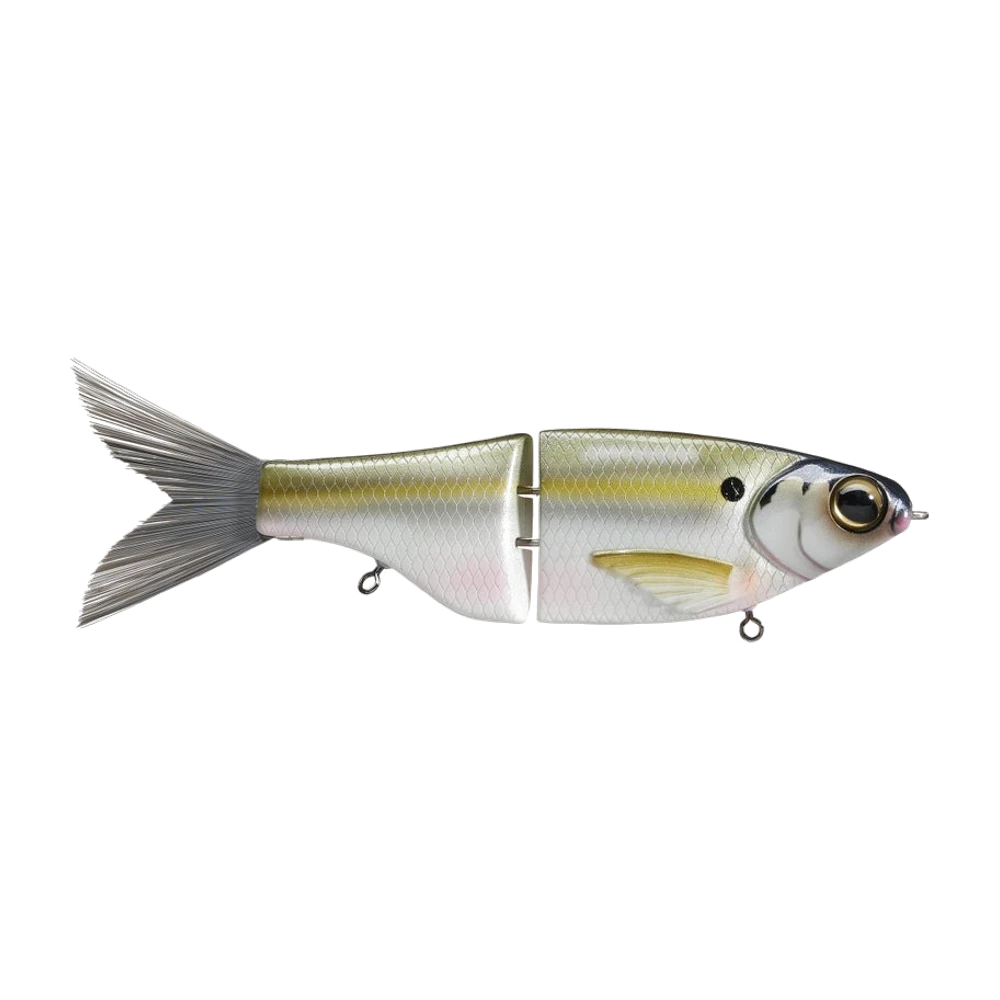
The product photo shows a body built in two sections joined by a visible centre hinge. That is an observation from a product photo, not a published specification. The joint is what lets the rear section keep running when the front changes direction, turning a simple pull into a hard turn. The slower and steadier your retrieve, the further the bait travels sideways before coming back; the harder you reel, the tighter the S becomes, until the swim is almost a straight line.
The wide S, your default cadence
Slow steady reeling, rod tip low, no input from the rod at all. The bait runs left, stalls, tips over, runs right. On a fish holding along a break, that trajectory moving away then re-entering its field of view is exactly what pulls it off the structure. You cover very little water, but you stay in the zone a long time.
Short cuts, when the fish follows without committing
As soon as a fish escorts the bait without deciding - it happens often, and in clear water you see it - switch to short sharp wrist twitches with the reel slowed down. The bait breaks its trajectory instead of gliding cleanly, and that interruption converts far better than an acceleration. It is the difference between a bait being inspected and a bait getting away.
Always keep two or three turns of handle in reserve at the end of the retrieve. On this format, half the fish that follow strike right under the rod, just as the bait starts its last turn before leaving the water. If you have already wound the lure up to the tip, you have no travel left to set the hook.
The countdown is your only depth control
A sinking glide bait does not swim down - it goes down when you let it. Count after the splashdown, then start the retrieve. Five seconds already puts you around five metres down if the published order of magnitude holds, which is a lot over average structure. That is why most anglers stay on two- to four-second counts over a break and only push to eight or ten to reach a fish marked on the sonar.
The bait rises slightly during the retrieve. If you want to hold a constant depth, alternate: two turns, a short pause while it drops back, two turns. That sawtooth rhythm outfishes a perfectly linear retrieve and multiplies the chances of a strike on the sinking phase.
Not sure what to tie on?
Photograph your spot: CarnaFish reads the scene, cross-checks the conditions and gives you the zone, the lure and the retrieve. Free on iOS and Android.
Rigging, hooks and leader
SPRO advertises premium hardware without naming the hook size or brand in its description. In the product photo the bait is shown bare: the two belly hook hangers are plainly visible, but no treble is fitted to either. Do not assume your unit will arrive armed the way you picture it - check when you open the box, and plan on heavier trebles if you fish tight to laydowns.
On tackle, 68 g is not something a standard bass rod throws. You need a swimbait rod, heavy power, generous length, paired with a high-capacity baitcasting reel. On 0.30 mm braid or heavy fluorocarbon, the setup absorbs both the cast and the leverage of a long lure hanging well away from the tip.
The classic mistake
Fishing this bait as a search lure. The Chad Shad is not built for two hundred casts an hour: it is built to be shown to a fish you already suspect is there. The anglers who give up on it after one session are almost always the ones who cast it everywhere instead of saving it for three or four identified spots. If you want a searching tool, a more compact format like the SPRO KGB Lil Guy 120 or a River2Sea S-Waver answers better.
In Europe this format regularly runs into pike, which like exactly the same silhouette. In that case a titanium or wire leader is not optional: a lure at this price disappears in a second against that set of teeth.
Colour by water clarity
- Clear water: the olive-gold back with pearly flanks seen in the photo, reproducing a freshwater baitfish livery without excess flash.
- Lightly stained water: a chrome finish, trading natural tone for a stronger light return at distance.
- Low light or dark water: a solid dark tone, which relies on a clean backlit silhouette rather than on a colour the fish actually perceives.
SPRO states its finish range is matched to common American forage species. On a European water, think in terms of contrast rather than exact imitation of a local baitfish.
A lure in this class never replaces reading the spot: cast in the wrong place, it only tires your arm. That is exactly what CarnaFish makes easier - a photo of the spot, and the app suggests the zone, the depth and the type of presentation suited to the day's conditions. To fit this format into a complete strategy, our beginner's guide to bass fishing covers the fundamentals worth having before investing in big baits.
Key takeaways
- 17.8 cm and 68 g as published by SPRO: a lure to save for identified spots, not for covering water.
- The table gives a 3 to 4 foot rate of fall with no time unit; the bait sinks, and depth is set purely by the countdown.
- The S glide tightens when you speed up and widens when you slow down: amplitude is on you, not on the lure.
- Photographed bare, the belly hook hangers are empty - check the hardware when it arrives.
FAQ
Does the KGB Chad Shad 180 float or sink?
It sinks. SPRO's table has no buoyancy column, but it does publish a rate of fall of 3 to 4 feet, which leaves no doubt about what the bait does at rest.
What rod do you need to cast a 68 g lure?
A heavy-power swimbait rod matched with a decent-capacity baitcasting reel. A standard bass rod handles repeated casts of this weight badly, and comfort collapses after an hour.
How long should the countdown be before retrieving?
Two to four seconds is enough to work over a break. Past eight seconds you are getting genuinely deep, which only makes sense if you have marked a deep fish on the sonar.
Is the Chad Shad 180 suitable for pike?
Yes, the silhouette and the size match what a pike looks for in Europe. Fit a titanium or wire leader without exception, or you will lose the bait on the first serious hit.
How does it differ from the Lil Guy 120 in the same range?
The SPRO KGB Lil Guy 120 applies the same glide logic in a far more compact package you can throw on standard tackle. The 180 targets bigger fish and demands a dedicated setup.
Should the stock hooks be replaced?
The description advertises premium hardware without giving a reference, and the product photo shows the lure with no trebles fitted. Check what is actually in your box, and move to heavier trebles if you fish in contact with wood.
The full bass lure guideSeason-by-season strategy: which family of lure, when, and why.Go from theory to fish
CarnaFish reads your spot from a photo and gives you the game plan: zone, lure, retrieve. Free on iOS and Android.