River2Sea S-Waver: the S-swim of a jointed glide bait
Rather not fish it blind? Photograph your spot — CarnaFish cross-checks the conditions and points you the right way.
A glide bait is not fished like an ordinary hard bait: you are not trying to make it swim, you are trying to make it slide. On every input the lure takes off to one side, travels a few dozen centimetres in a straight line, stops, then leaves the other way on the next input. The River2Sea S-Waver is one of the glide baits that produce that S very legibly, including for an angler meeting the family for the first time.
Where the S comes from
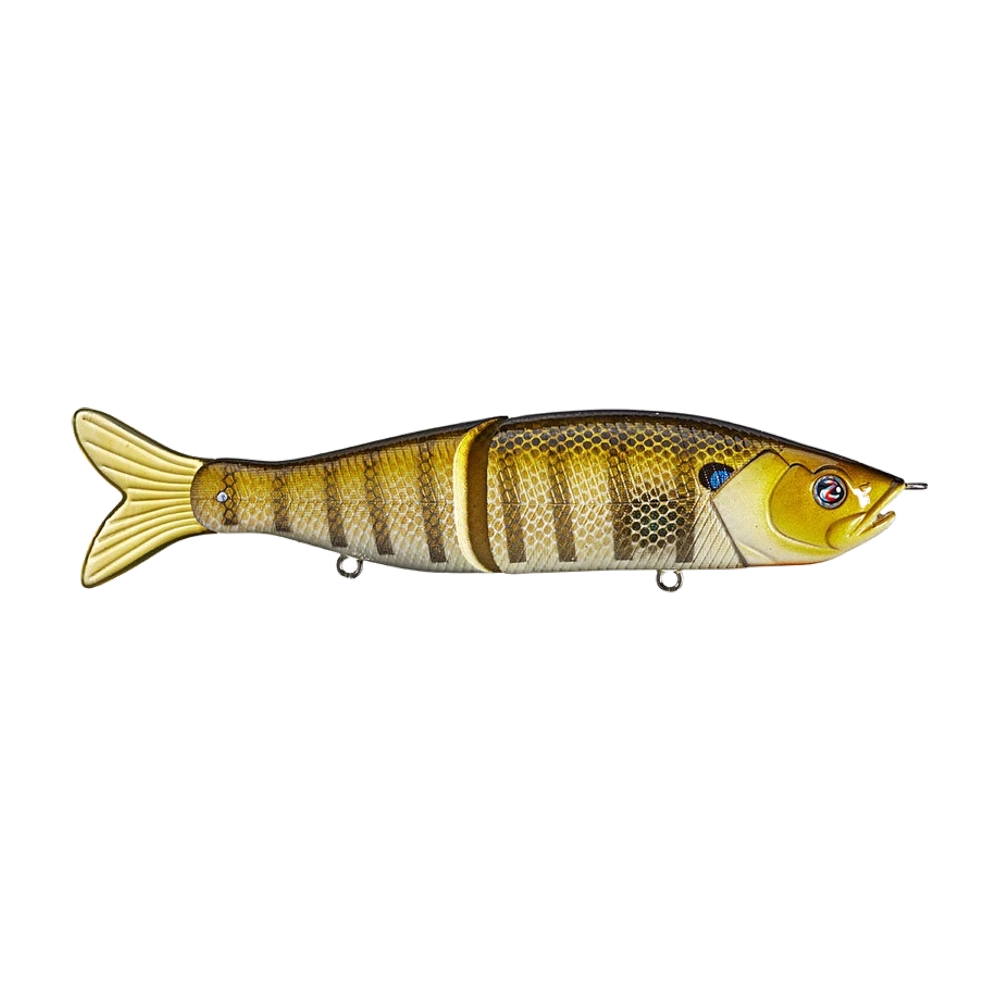
River2Sea credits the S-swim to two specific parts: a pin and tenon hinge the brand describes as its own, and a soft PVC tail. In the photo on this page, the junction between the two segments is almost flush — no visible link, no bulky external eyelet — and the cream tail fin is clearly moulded from a different material than the body. Those are observations from a product photo, not specifications, but they match what the maker states.
Mechanically, a tight hinge with little play gives a lure that slides a long way on each input instead of folding in half and stopping dead. The soft tail very slightly brakes the rear of the bait at every direction change: that braking is what pivots the body rather than letting it run straight on, and it is also what keeps quivering through the pause.
Floating or sinking: read the table properly
This is the point that deserves the most attention, because it gets misread half the time. The spec table rates all three S-Waver sizes as sinking, without exception. Yet the maker's description explains that holding the rod tip high makes the bait work on top and leave a wake, and that letting it sink slowly keeps the S-swim going underwater.
The two statements do not contradict each other: this is a sinking bait that you hold at the surface with rod position. Tip high and a continuous retrieve, it wakes the top; tip down or a pause, it drops. The depth given in the table, 0 to 30 cm or 0 to 1 ft, is the band where it works on a normal retrieve, not the deepest it can reach if you let it sink for a while. In short, you pick the storey, and that is exactly what makes this lure versatile.
The sink rate of a sinking bait is something you count, not something you guess. Cast, let it fall on a free line and count the seconds until the line stops leaving the spool. You end up with a counting table valid for this lure on this water, and you can then target 1 m, 2 m or 3 m instead of fishing blind.
Three sizes, three programmes
The maker lists three versions, and the numbers read better once you put them back into their original unit. The S-Waver 120 measures four and three-quarter inches, or 12.1 cm, for fifteen-sixteenths of an ounce, roughly 26.6 g. The 168s measures six and three-quarter inches, or 17.1 cm, for one and five-eighths ounces, roughly 46.1 g. The 200 measures eight inches, or 20.3 cm, for three and a half ounces, roughly 99.2 g. Those sixteenths and eighths give the game away: the bait was drawn in millimetres — the names 120, 168 and 200 are its lengths — and the ounces are only a transcription. Keep the orders of magnitude: about 27 g, 46 g and 99 g.
The 120 is the only one you can cast on an ordinary bass setup: a medium-heavy casting rod throws it without complaining. The 168s already calls for a light swimbait rod. As for the 200, at close to 100 g it is a big-fish hunting tool that demands dedicated gear and forgives no shortcuts: a rod that is too soft will not set the hook, a reel that is too small runs hot.
Working it without killing the glide
The basic retrieve
Rod low, reel turning slowly and steadily, and nothing else. Many glide baits, this one included, already produce their S on a simple slow straight retrieve, provided you do not speed up. Reel too fast and the lure stops gliding and starts rolling onto its side — a sign to slow down, not a sign that it is badly tuned.
The forced S
For a wider S, add short sharp rod-tip twitches, one per handle turn, leaving half a second of slack after each. The bait then travels far further sideways and holds still for a fraction of a second at the end of its run. That stillness is where most strikes happen, exactly as on a suspending jerkbait.
The surface wake
Tip high, slow steady retrieve: the back of the lure breaks the film and traces a V on the surface without ever leaving the water. This is a low-light approach, at dawn or under cloud, along shallow banks. It is loud visually rather than acoustically — a fish that refuses a popper will sometimes come up on that discreet wake.
Not sure what to tie on?
Photograph your spot: CarnaFish reads the scene, cross-checks the conditions and gives you the zone, the lure and the retrieve. Free on iOS and Android.
Hooks and leader
In the photo, the S-Waver is shown with two bare split rings under the belly and no trebles fitted: what you see there are the attachment points, not the fishing hardware. A glide bait this size needs strong trebles, sized not to open on a braid hookset, but not oversized either: a treble that is too wide touches the body on every glide and kills the swim.
On the line side, braid is more or less compulsory above the 120, because you have to set a big hook at distance with no stretch. Add a heavy fluorocarbon leader, 0.40 to 0.60 mm, which acts as a shock absorber and as abrasion protection. In Europe, on water where pike are present, supple wire or titanium is not a comfort measure: a bait this size triggers precisely the fish capable of cutting through fluorocarbon.
The classic mistake
Fishing a glide bait as a search lure. An S-Waver is not there to cover a long bank quickly: it is there to work an identified zone at length — a point, a drop-off, a weed edge — and force a big fish to make up its mind. Twenty well-placed casts beat two hundred random ones, all the more so because the lure tires your arm fast.
Colours by water clarity
- Clear water: a golden finish barred with brown like the one in the photo, which imitates pale-flanked baitfish and stays believable under bright light.
- Stained water: a dark back over a white belly, which gives a clean contrast seen from underneath without chasing bright colour.
- Low light, cluttered back of a creek arm: solid pearl white, which stays visible from a distance as the light drops.
One useful note before you buy: River2Sea itself flags that the colour named I Know It may show slight shade variation from one bait to another. That is not a manufacturing fault, it is a consequence of the finishing process, and it is worth knowing if you order remotely counting on a precise shade.
A glide bait never makes up for misreading a spot, and at this size you have no margin: you will not make two hundred casts in a day. That is exactly what CarnaFish makes easier — a photo of the spot, and the AI suggests the zone, the depth and the kind of presentation that fit the conditions. And if you plan to swing the 168s or the 200 on pike water, our complete pike lure guide places the glide bait among the other families worth knowing. To compare two takes on gliding, the Westin Swim Glidebait and the Savage Gear 3D Bleak Glide Swimmer are both worth a look.
What to remember
- All three sizes are rated sinking: surface work comes from rod position, not from the lure's buoyancy.
- The pin and tenon hinge and the soft PVC tail are the two parts the maker names as responsible for the S-swim.
- Count the sink on every cast so you fish a real depth instead of guessing.
- From the 120 to the 200 you go from about 27 g to about 99 g: these are not three sizes of one lure but three different tackle requirements.
FAQ
Does the S-Waver float or sink?
The maker's table rates all three sizes as sinking. The description adds that holding the rod tip high works it on the surface with a wake, and that letting it drop keeps the S-swim going underwater. So it is a sinking bait held on top by rod position.
How deep can you fish it?
The maker lists a 0 to 30 cm band on a normal retrieve. Since the lure sinks, nothing stops you from letting it drop lower before you start reeling: the working depth then depends on how long a fall you allow it.
Which size should I start with?
The S-Waver 120, 12.1 cm / 4.75 in for about 26.6 g. It is the only one of the three that casts comfortably on an ordinary medium-heavy casting setup, with no dedicated swimbait gear.
Do I need a wire leader?
On bass-only water, a 0.40 to 0.60 mm fluorocarbon leader is enough. As soon as pike share the spot, move to supple wire or titanium: a lure this size attracts precisely the fish able to cut fluorocarbon.
Why does my S-Waver roll onto its side?
Almost always because you are retrieving too fast. A glide bait has a narrow speed window, beyond which it loses its grip on the water and tips over. Slow down until the S sweep comes back, then note that speed as your reference.
How does it differ from a multi-jointed swimbait?
A multi-segment swimbait undulates continuously throughout the retrieve. The S-Waver instead alternates straight glides and sharp direction changes, with a dead stop in between. That dead stop is what makes up the mind of a fish following without striking.
The full bass lure guideSeason-by-season strategy: which family of lure, when, and why.Go from theory to fish
CarnaFish reads your spot from a photo and gives you the game plan: zone, lure, retrieve. Free on iOS and Android.