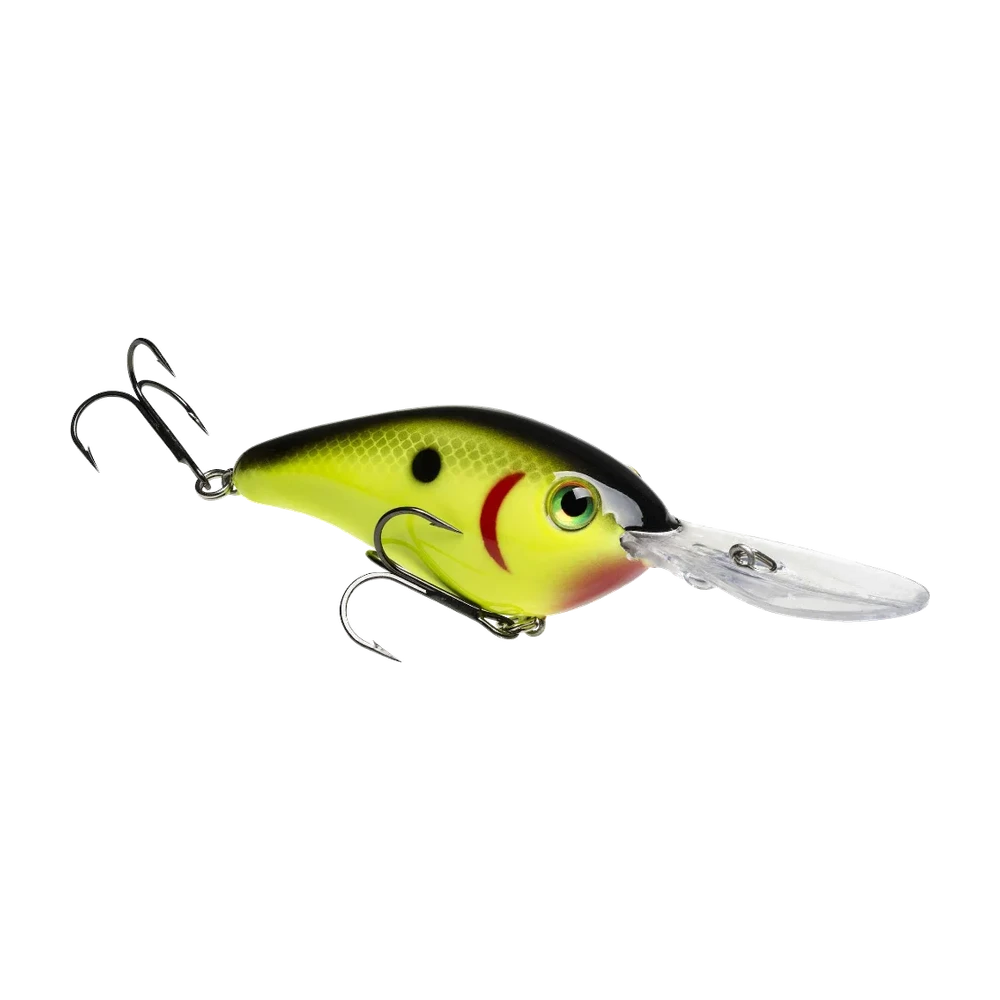
Strike King 6XD: the deep crankbait that gets down without special tackle
This lure shines under specific conditions. CarnaFish tells you in 10 seconds if today is one of them.
Getting down to five metres with a cast lure sounds simple on paper. In practice most crankbaits top out around three metres, and those that go deeper often demand dedicated tackle and considerable physical effort. Strike King's 6XD is designed to cross that barrier without a special rod: its long, wide lip drives the lure down fast, and its compact body reduces the resistance you feel on the retrieve.
Why it gets so deep
Three elements work together:
- A long, angled lip, which catches the water flow and pushes the lure down within the first few metres of the retrieve.
- A compact, heavy body, which allows long casts. That is decisive: a diving crankbait only reaches its maximum depth if you give it the distance to do so. A short cast costs you two metres.
- Positive buoyancy, which floats it back up as soon as you stop reeling — useful for freeing the lure when the lip snags.
Line diameter matters too, more than people think. Thin fluorocarbon offers less resistance in the water and lets the lure run markedly deeper than thick line. Going from 0.35 to 0.25 mm can gain close to a metre.
Bottom contact is not an accident
This is the most important point, and the least intuitive for anyone starting with deep cranking: the lure has to touch bottom.
A crankbait swimming freely in mid-water catches little. A crankbait that strikes a rock, deflects sharply off its path, then resumes its action, triggers reflex attacks. That unpredictable deflection is exactly what a fish reads as prey that has just collided or panicked.
The lip plays a double role here: it drives the lure down, and it shields the hooks by hitting the obstacle first.
Field rule: if you never feel the bottom with a deep crankbait, you are fishing above the fish. Cast further or drop a line diameter.
The retrieve: steady, and that is all
The 6XD is not twitched. It works on a straight retrieve at a medium, constant speed.
- Cast far. Distance determines the depth reached.
- Reel at a steady speed until you feel the bottom.
- Keep going in contact, letting the lure knock into obstacles.
- On a snag, stop dead: positive buoyancy floats the lure up and frees it most of the time.
One useful variant: after a solid contact with an obstacle, pause briefly. The lure rises a little, then sets off again — and that is often the moment the take comes.
Tackle, without overdoing it
The 6XD is designed to be less tiring than most deep crankbaits, but it still pulls.
- A rod with parabolic action, fairly long, which absorbs head shakes without shedding the fish. A stiff rod loses a lot of fish on this kind of two-treble lure.
- A reel with a moderate ratio. A high ratio makes you retrieve too fast and tires your wrist for nothing.
- Fluorocarbon in 0.25 to 0.30 mm, the compromise between depth reached and abrasion resistance over rock.
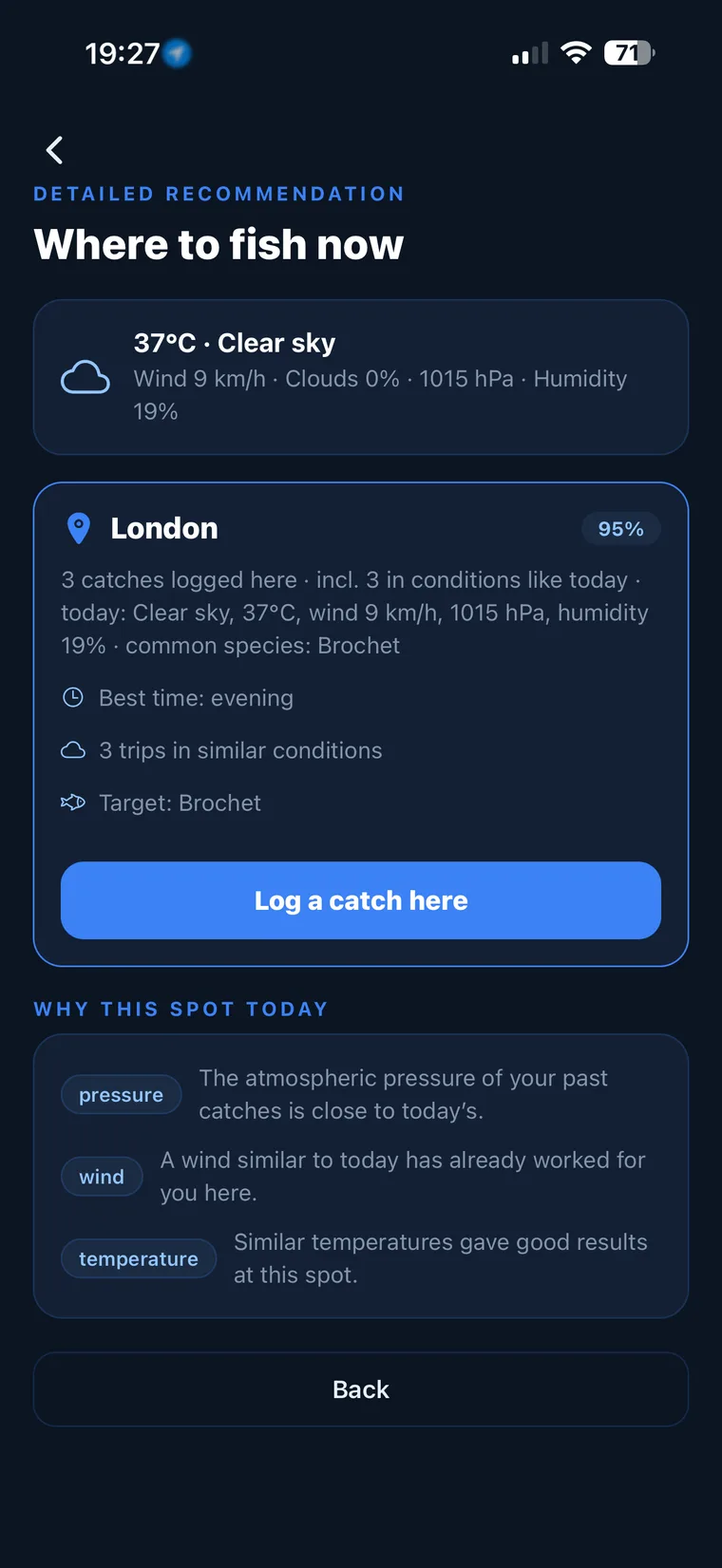
Not sure what to tie on?
Photograph your spot: CarnaFish reads the scene, cross-checks the conditions and gives you the zone, the lure and the retrieve. Free on iOS and Android.
Where and when
- Drop-offs and submerged flats between 4 and 5.5 m, typically in summer when fish leave the margins.
- Hard bottoms: gravel, rock, stumps. That is where contact produces the deflections that trigger takes.
- Zander over hard bottom: less classic than bass, but effective, particularly on a slow straight retrieve along a drop-off.
Over soft, silty bottom the lure ploughs without producing any useful deflection — and comes back covered in mud.
6XD or a deep soft lure
A shad on a jig head reaches the same depth with far less effort and lets you fish slowly. The 6XD takes the lead on one precise point: it covers ground far faster. On a hundred-metre drop-off, you will cover it ten times quicker with a crankbait than with a soft lure.
So it is a locating lure: you find the fish with the 6XD, then work them with soft plastics if needed. Our beginner's guide to bass fishing covers that logic. And on unfamiliar water, CarnaFish analyses a photo and points you to the zone and depth to attack.
Key points
- Long lip plus compact body plus long cast = 4.5 to 5.5 m without special tackle.
- Thinner line gains you close to a metre of depth.
- Bottom contact is the heart of the technique, not a fault.
- Straight retrieve only, never a twitch.
- Parabolic rod so you do not shed fish.
FAQ
How deep does the 6XD really run?
Between 4.5 and 5.5 m, provided you cast far and use thin line. A short cast or thick fluorocarbon can cost it more than a metre.
Do I really have to hit the bottom?
Yes. The sharp deflection caused by contact with a rock or stump is the main trigger on this kind of lure. Without contact, you are fishing above the fish.
How do I free the lure when it snags?
Stop reeling dead and leave the line slack. The lure's positive buoyancy floats it up and frees it most of the time with no further action.
What rod for deep cranking?
A long rod with parabolic action, which absorbs head shakes. A stiff rod sheds many fish on a lure carrying two trebles.
Is the 6XD suitable for zander?
Yes, over hard bottom and along drop-offs, on a slow straight retrieve. It is a less common use than bass but genuinely effective.
Why does my crankbait not run deep enough?
Two main causes: casts that are too short, and line that is too thick. Lengthen the distance and drop a diameter before changing lure.
The full bass lure guideSeason-by-season strategy: which family of lure, when, and why.Go from theory to fish
CarnaFish reads your spot from a photo and gives you the game plan: zone, lure, retrieve. Free on iOS and Android.