Strike King Pro Model 8XD: the deep crankbait that tires you less
Before tying this one on, it helps to know if the spot actually calls for it. CarnaFish reads the scene from a photo.
A six-metre flat in the middle of summer, fish glued to the bottom that will not rise an inch, and two hours of soft plastics for nothing. That is exactly the ground of the deep-diving crankbait: a bait that goes down to find the fish where it lives, bangs the substrate and triggers by aggression rather than persuasion. The Pro Model 8XD is the middle size of Strike King's XD series, and its whole point comes down to a question of size and effort.
What it fills between the 6XD and the 10XD
Strike King presents the 8XD as an answer to anglers who like the action of the 6XD but do not enjoy the torque of the 10XD. Put another way: the 10XD is a tiring lure. Its bill is so big that every turn of the handle becomes a pull on the wrist, and a full day at that pace leaves a shoulder out of service. The 6XD is comfortable but does not get deep enough once you pass four metres.
The 8XD fills that gap. It invents nothing and claims to invent nothing: it completes a range where a size was missing. That is tackle-box logic, not a breakthrough, and it is rather reassuring from a manufacturer who could have dressed it up. The tournament-winning characteristics mentioned in the description are a Strike King sales argument, not something we can verify.
The published specs, and how to read them
The table attached to the description has four columns — the model name, then length, weight and depth — and a single row. You have to notice that the first column carries the name of the bait and not a measurement, otherwise everything shifts by one.
The published length is 5-1/2 in, written as a fraction, so about 14 cm. The published weight is 1.3 oz, roughly 37 g: this is firmly a big crankbait, not an all-round bait you lob with a mid-range outfit. The published depth is 20 ft, 6.1 m, and it matches the prose of the description, which gives the same figure. Nothing contradicts itself here, which is not always the case.
One useful caveat: a running depth announced by a manufacturer assumes ideal conditions, meaning a long cast, thin line and a constant retrieve. On thick fluorocarbon and a short cast, take a metre off without hesitation.
Torque, or why your tackle matters more than usual
A 37 g bait with a bill that size is not fished on just anything. You want a long rod, 2.10 m minimum, with a parabolic action: it absorbs the torque of the bill, cushions the jolts when the lure hits rock and keeps you from pulling hooks during the fight, since trebles only hold on two or three millimetres of skin. A low-ratio reel, around 5.4 to 1, does the rest of the work for you.
Line also affects the depth reached. Fluorocarbon of 30 to 35 hundredths slows the dive slightly but takes the abrasion of the bottom, which counts on a lure whose whole principle is scraping the substrate. Avoid braid tied direct: it does not stretch, and on a big-billed crankbait the little give in fluorocarbon is exactly what keeps the fish pinned.
What the product photo shows
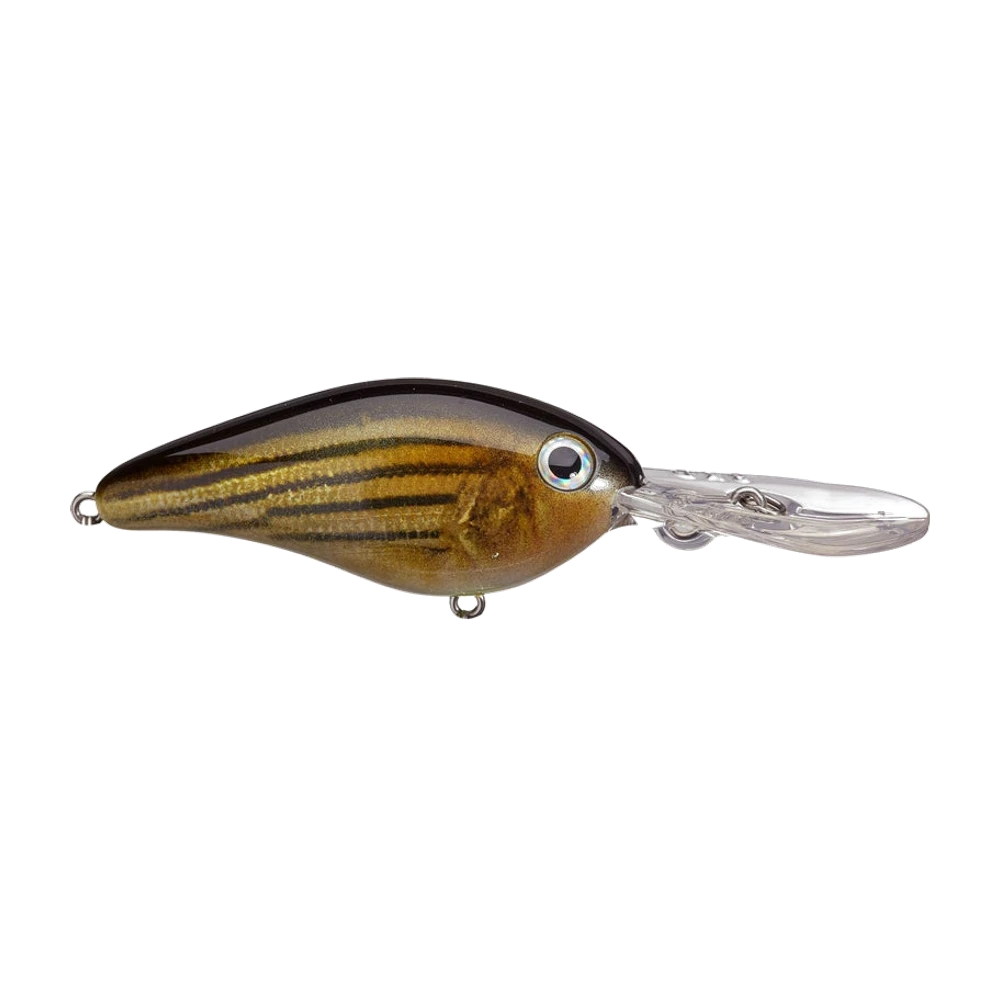
The example photographed has a black back, gold flaked flanks marked with dark vertical bars and a big eye with a holographic silver iris — a pattern that reads as a gill or a perch. The bill is long, wide, rounded at the end and translucent, and the line tie is not on the nose but set into the bill itself, the signature of this family of deep divers.
An important point: the bait is photographed without its hooks. You can see an empty split ring under the belly and a plain wire loop at the rear, the two intended positions, but no treble is fitted. These are observations from a product photo, not specifications: the description gives neither size nor brand for the trebles supplied, and the retailer actually offers to replace them. Check the hooks on the one you buy rather than trusting the image.
Not sure what to tie on?
Photograph your spot: CarnaFish reads the scene, cross-checks the conditions and gives you the zone, the lure and the retrieve. Free on iOS and Android.
Fishing it: bottom contact above all
Making the bait work against the substrate
A deep crankbait is not retrieved through open water, or you may as well fish something less tiring. Cast long, drop the rod towards the water for the first turns of the handle to help the dive, then wind at a constant speed until you feel the bill hit bottom. From there the real work begins: every contact with a rock or a stump knocks the bait off its path, and that break is what triggers the strike, not the steady swim.
The classic mistake: working it with the rod
With a bait of this size, the urge to twitch is counterproductive. The bill already does all the work, and every rod stroke disrupts the swim without adding anything. The only useful input is a one-second pause right after a solid bottom contact: the bait rises slightly and rights itself, and that is where a good share of the bites happen.
When your 8XD snags a stump, stop everything and give it three seconds of completely slack line. The bait floats and rides up along the obstacle instead of burying itself further. That reflex recovers the large majority of wood snags, and it costs less than a lure retriever.
Colour by water
- Clear water over hard bottom: the gill or perch pattern in the photo, with dark vertical bars. At six metres the light is already filtered, and a contrasted natural pattern stays readable.
- Stained water: chartreuse with a black back, the deep-crankbait classic once visibility drops below a metre.
- Low light or heavy water: a very dark back, betting on silhouette rather than colour.
Alongside the other XDs
The logic of the range is simple and worth spelling out: the Strike King 5XD covers mid depths, the Strike King 6XD is the comfort size, the 8XD gets lower without the fatigue of the Strike King 10XD, which remains the deep-water pick when you are willing to pay for it in effort. If you want the same bottom-contact philosophy in a far lighter package, a Rapala Shad Rap does the job over two to three metres. In Europe a crankbait this size comes out mainly on big reservoirs, where it also interests zander holding on deep flats in summer.
What remains is knowing whether the fish really are at six metres that day, because a lure like this forgives no mistake about the water layer. That is exactly what CarnaFish makes easier: a photo of the spot, and the app suggests a zone, a depth and a type of presentation suited to conditions. To pick your tackle without overpaying, our guide to predator fishing gear on a budget gives the useful benchmarks.
Key takeaways
- The 8XD exists to fill a gap between the 6XD and the 10XD, not to replace either of them.
- Published specs: about 14 cm, about 37 g, a stated depth of 6.1 m, in a table whose first column is a model name.
- A long parabolic rod and a low-ratio reel are not a luxury on a bait with this much torque.
- Everything happens on bottom contact: it is the deflection off an obstacle that triggers, not the steady swim.
FAQ
How deep does the 8XD really run?
Strike King states 20 ft, 6.1 m, and the figure appears twice in the source, in the text and in the table. That value assumes a long cast and thin line: on 35-hundredths fluorocarbon with a short cast, count on five metres instead.
What is the difference with the 6XD and the 10XD?
The 6XD runs shallower but fishes effortlessly, the 10XD goes deeper at the cost of punishing torque over a full day. The 8XD is the compromise announced by the manufacturer itself, which presents it explicitly as an answer to those two limits.
What outfit do I need for this bait?
A rod of at least 2.10 m with a parabolic action, a low-ratio casting reel around 5.4 to 1, and fluorocarbon of 30 to 35 hundredths. The outfit has to absorb the torque of the bill rather than pass it to your wrist.
How much does the 8XD weigh?
The manufacturer states 1.3 oz, about 37 g. That weight rules out light tackle and explains why this bait is thrown on casting gear rather than spinning.
Does the lure come with hooks?
It is photographed without trebles, with only the hanger rings visible, and the description gives neither size nor brand for the hooks supplied — the retailer even offers to replace them. Check the hooks in the shop before buying.
Does it take anything other than bass?
It is a bass bait by design. In Europe, on big reservoirs, a crankbait this size also interests zander holding on deep flats in summer, and occasionally a big pike — with a suitable leader in that last case.
The full bass lure guideSeason-by-season strategy: which family of lure, when, and why.Go from theory to fish
CarnaFish reads your spot from a photo and gives you the game plan: zone, lure, retrieve. Free on iOS and Android.