Strike King Bitsy Shad: the 3.5 g lipless that sinks flat
Rather not fish it blind? Photograph your spot — CarnaFish cross-checks the conditions and points you the right way.
Late October, on a gravel pit where the perch have pinned a ball of fry against a rocky point. You can see the surface breaking, you throw a 14 g lipless, and it sails straight through without a single follow: too big, too fast, too loud for fish feeding on prey barely an inch long. That is exactly the gap a 3.5 g lipless like the Bitsy Shad fills — heavy enough to carry on the cast, small enough to stay believable inside a bait ball.
A Red Eyed Shad taken down a size
Strike King presents the Bitsy Shad as a compact version of the Strike King Red Eyed Shad, reproducing, according to the manufacturer, the same shape and the same action. That is not a throwaway marketing line: on a lipless bait, the body silhouette and the position of the dorsal tow point entirely dictate the swimming attitude and the vibration frequency. Scaling down a proven profile avoids the usual trap of generic mini-lipless baits, which buzz feebly because their body simply has not got enough surface to bite into the water.
The manufacturer states three concrete things about the hardware: size 8 trebles, three-dimensional eyes, and free-floating rattles inside the body. Free-floating rattles, as opposed to a single fixed knocker, produce a more disorganised, less metronomic sound — which matters a lot when you make several passes over the same stretch. Strike King also says the bait carries the brand's best-selling paint schemes, a commercial claim taken for what it is: the maker describing its own range.
What the spec sheet says, and what it leaves out
The retailer's size chart gives two pieces of information, for a single size: 3.5 g (1/8 oz) and the class sinking. The length column is simply blank for this model — no figure is published, in millimetres or in inches. I would rather tell you that than line up a number I made up: if you need an exact dimension, measure one in the shop. The order of magnitude can be guessed from the weight and the hardware — a dense body hung with size 8 trebles stays firmly in the small-lipless bracket — but that is an inference, not a specification.
The sinking class, on the other hand, is explicit, and it is the single most useful line on the sheet. A sinking lipless weighing 3.5 g drops slowly and flat, already vibrating on the way down. That modest sink rate is an advantage in shallow water: on a six-foot pond you can let the bait fall for three or four seconds without burying it in silt.
Three retrieves that cover most situations
Start with the straight retrieve. Cast, count the bait down to the depth you want, then wind at a steady, moderate pace. The vibration should register continuously in the tip: if it stops, you are either too slow or you have picked up a strand of weed.
The yo-yo retrieve makes better use of the bait's density. Two or three fast turns of the handle, then a dead stop with a slightly tight line while the bait falls back. At only 3.5 g the descent is slow enough to stay inside the field of view of a following fish. The large majority of bites come during that falling phase, and they usually show up as the line simply going slack rather than as a solid thump.
Count the bait down once, then remember the number
Before the first drift, cast out and count until the bait touches bottom. Do the arithmetic in your head: if contact comes at eight, then four seconds puts you at mid-depth. That number is your reference for the day, and it changes the moment you move to another stretch or the wind gets up. It is a habit worth keeping with every sinking bait, but it pays off even more on a light one, whose sink rate is far too slow to be guessed by feel.
Not sure what to tie on?
Photograph your spot: CarnaFish reads the scene, cross-checks the conditions and gives you the zone, the lure and the retrieve. Free on iOS and Android.
Where to throw it, and on what tackle
Anywhere small baitfish gather: gravel flats in late autumn, reed edges, docks, the mouths of small feeder streams. The manufacturer mentions ponds and creeks as readily as large lakes, which fits a profile designed to imitate a fry rather than an adult baitfish.
On the tackle side, the constraint is the weight. At 3.5 g a medium-heavy cranking rod is unusable: you will load nothing on the cast and you will straighten the size 8 trebles on the hookset. A light to medium-light rod of 1.90 to 2.10 m (6 ft 3 in to 7 ft), light braid and a 0.18 to 0.22 mm fluorocarbon leader work far better. A clean direct knot or a small snap is all you need: unlike a billed crankbait, a lipless ties on the back and has no lip to restrict.
Keep a spare treble in the box and replace the belly hook before the tail one. On a lipless fished close to the bottom, the belly treble is the one that grinds against rock, opens slightly, and starts losing fish without you ever working out why.
The classic mistake: fishing it like a full-size lipless
Anglers used to 14 or 21 g lipless baits reach instinctively for the violent rip through grass — a hard sweep to tear the bait free and trigger the strike on the release. With 3.5 g and fine wire trebles, that stroke does not work: the bait has not got the mass to free itself, and the whole load lands on the hooks. On this size you stay with measured movements and pick less cluttered ground. If ripping grass is what you want, take a heavy model such as the Cotton Cordell Super Spot and keep the Bitsy for gravel and rock.
Colours by water clarity
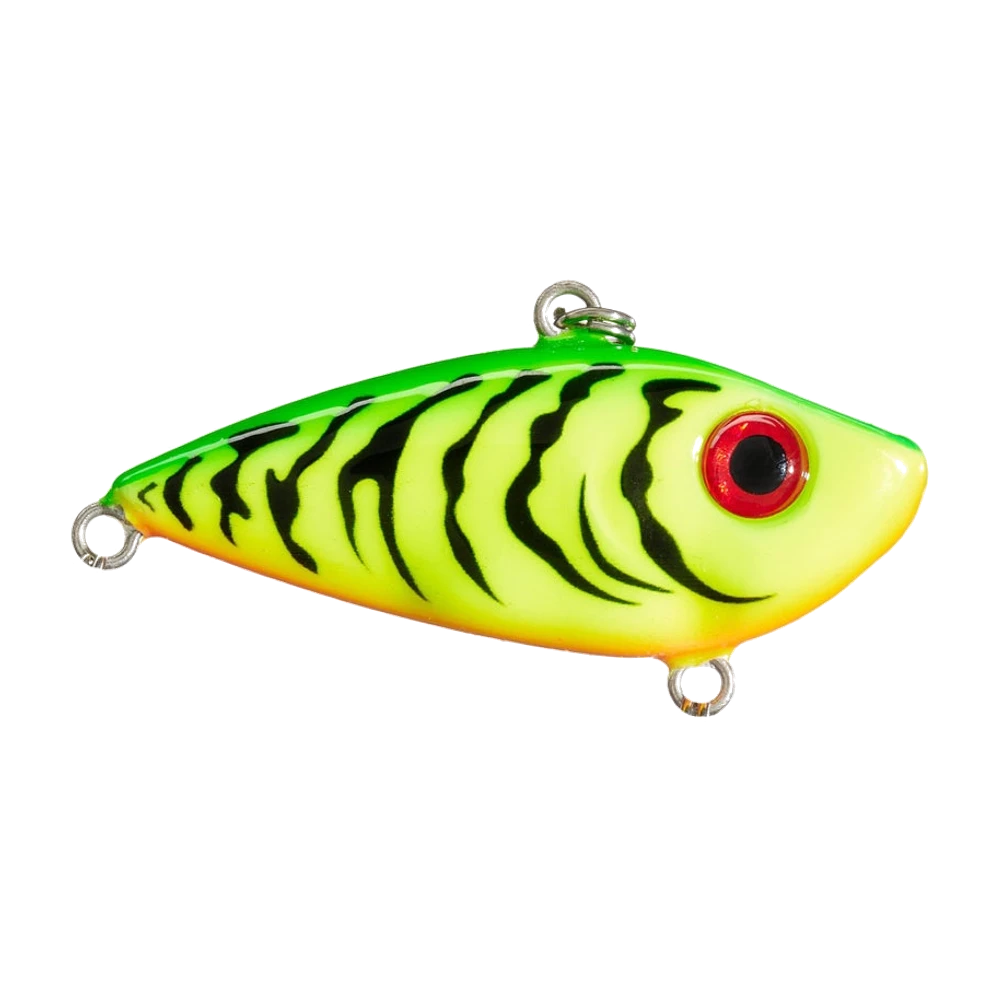
- Lightly stained water: a firetiger-type pattern, the one in the photo, with a green back, yellow flanks barred in black and an orange belly. The contrast of the bars stays readable down to about a metre of visibility.
- Coloured water or low light: chartreuse-dominant, or a solid black silhouette over dark bottoms. You are after contrast, not realism.
- Clear water: a natural roach or bleak tone, silver with a dark back, which does not over-expose the bait in front of perch that have already seen plenty.
A lipless is not chosen on colour alone: it is chosen on the depth of the spot and on how much forage is actually there. That is exactly what CarnaFish does — one photo of the spot, and the AI suggests the zone, the depth and the lure family that match the day's conditions. For the rest of the approach on this fish, our guide to perch fishing with lures covers the other families worth carrying.
What to remember
- One weight in the catalogue, 3.5 g, and a stated sinking class: this is a slow-falling bait, not a fast search lipless.
- The length is not published by the manufacturer, so do not trust improvised equivalences with other models in the range.
- Most bites come during the sinking pause, not during the straight retrieve.
- A light rod is mandatory: size 8 trebles will not survive the hookset of a cranking rod.
FAQ
How long is the Bitsy Shad exactly?
That figure is not published: the size chart for this model gives only the weight, 3.5 g (1/8 oz), and the sinking class. The bait sits in the small-lipless bracket, but no official length in millimetres or inches is given.
Does the Bitsy Shad float at rest?
No, it is listed as sinking. At rest it drops back flat while still vibrating, and that falling phase is precisely where most of the bites happen.
Can you catch perch on it?
Yes, and in Europe that is arguably its best use. The reduced profile and the size 8 trebles match the prey size perch are hunting when they herd fry.
What rod handles a 3.5 g bait?
A light to medium-light rod of 1.90 to 2.10 m (6 ft 3 in to 7 ft) with light braid. A standard cranking rod is too stiff: it will not load on the cast and it opens the hooks on the strike.
Does the Bitsy Shad replace the Red Eyed Shad?
No, it complements it. The Strike King Red Eyed Shad remains the choice when you need to cover water fast and far; the Bitsy takes over when the forage is small and the fish are cautious.
Do you need a wire leader with a lipless this size?
Only if the water holds pike. On a perch and bass spot in clear water, a 0.18 to 0.22 mm fluorocarbon leader stays more discreet and handles the bites perfectly well.
The full bass lure guideSeason-by-season strategy: which family of lure, when, and why.Go from theory to fish
CarnaFish reads your spot from a photo and gives you the game plan: zone, lure, retrieve. Free on iOS and Android.