Strike King Bitsy Splash: the 5 cm popper that spits and walks
One lure, endless conditions. CarnaFish reads your spot from a photo so you are not just guessing.
Late on an August evening, on a pond that has already seen ten anglers since morning. The bass are sipping under the low branches, but they refuse anything over three inches: they have watched the same stickbaits go past all week. That is the classic situation where a two-inch popper turns the day around — not because it is better in absolute terms, but because the fish has not seen it yet.
A scaled-down KVD Splash, and what that implies
Strike King presents the Bitsy Splash as the miniature version of the Strike King KVD Splash, whose surface action it reproduces according to the brand. Three behaviours are claimed by the manufacturer for this model: spitting, walking the surface, and chugging. That is a lot for a bait this size, and it needs one clarification: none of those three comes out on its own, your rod stroke is what selects them.
The size chart is unusually clear here: 5 cm (2 in), about 3.7 g, class floating. The stated weight, 0.13 oz, is a slightly odd rounding — it is practically an eighth of an ounce, or 3.5 g. Take the order of magnitude: you are somewhere between 3.5 and 3.7 g, in a bracket where every tenth of a gram counts towards casting distance.
A floating popper of that weight pops straight back up after every stroke, which lets you pause for as long as you want. That is the fundamental difference from a weighted topwater bait that sinks the moment you leave it alone. The flip side is casting range: with 3.7 g and a short body that catches the wind, you will not clear twenty metres into a breeze, where a nine-centimetre popper comfortably reaches thirty-five. So this is a bait you fish close in, by approaching the spot, not by bombarding it from the middle of the pond.
Metering the pop: three strokes, three signals
A sharp downward snap with the rod low makes the bait spit: the cupped mouth throws a jet of water ahead of it and the bait travels barely four inches. That is the stroke for cautious fish, the one that makes noise without pulling the bait out of the strike zone.
Two small snaps in quick succession, rod at mid-height, send the bait into a zigzag. At two inches that surface walk is short and tight — you are nowhere near the amplitude of a four-inch stickbait. This is the stroke for covering a few metres of bank.
The chug, finally, needs a longer and slower pull with the rod horizontal: the bait makes a dull plop and shifts more water. Keep that one for stained water, or for a fish that ignored the first two.
The pause, and why it is longer than you think
The most common popper mistake is popping too often. On a two-inch bait, count three to five seconds between bursts — long enough for the rings to close completely. Bass rarely come up for the noise itself: they come up for the stillness that follows, when the supposed prey is catching its breath. If you never have the patience to let the water go flat again, you miss half the available bites.
When a fish misses the bait in the blow-up, do not strike and do not move anything for five full seconds. Nine times out of ten it comes back, and that second attack is far cleaner than the first.
The feathered rear treble is not decoration
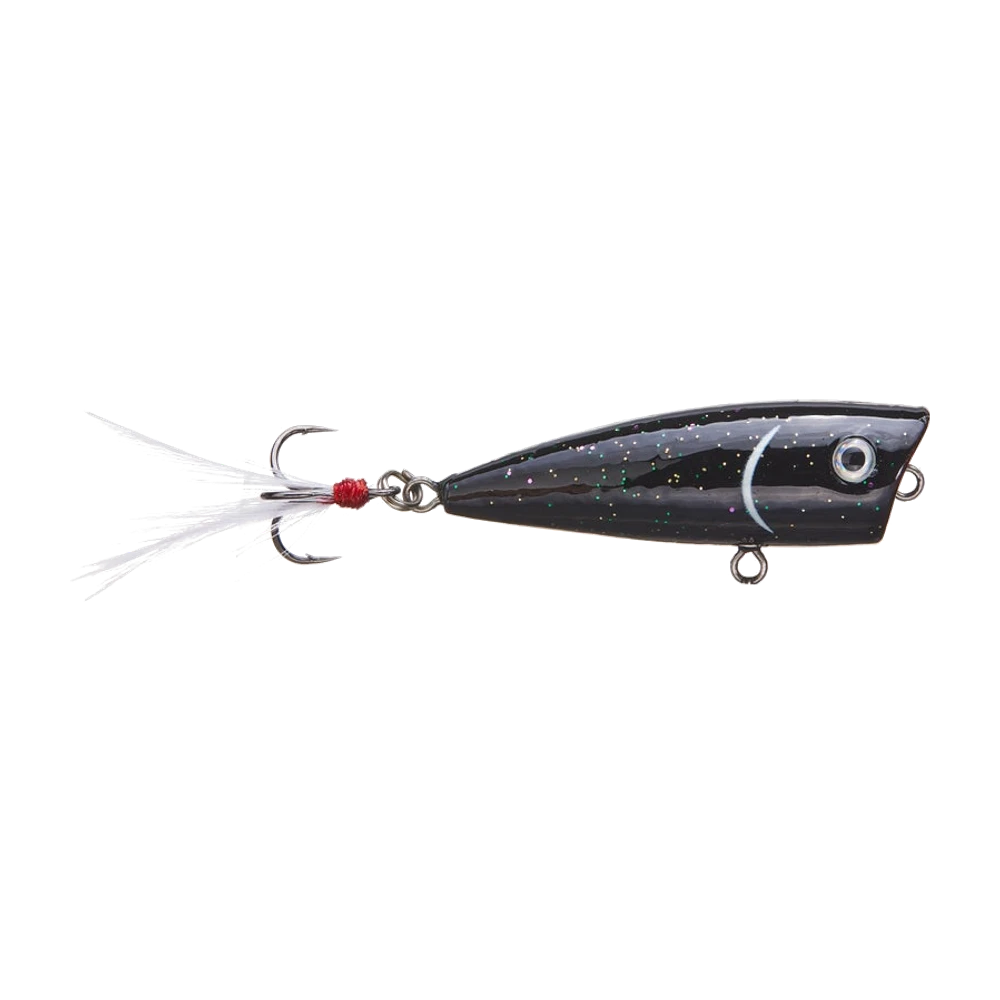
The manufacturer states a hand-tied feathered treble. On the product photo it is indeed the only hook fitted: a dark treble with white feathers and a red thread wrap, joined to the body by two split rings. The belly eyelet is bare in that shot — an observation from a product photo, not a rigging specification.
The feathers do two real things. During the pause they breathe, giving a micro-movement to a motionless bait and stretching the illusion beyond the end of the noise. During the retrieve they drag slightly on the rear of the bait, which helps keep the nose up so it spits cleanly. Swap that treble for a bare one and you lose both: the action changes, and not for the better.
Not sure what to tie on?
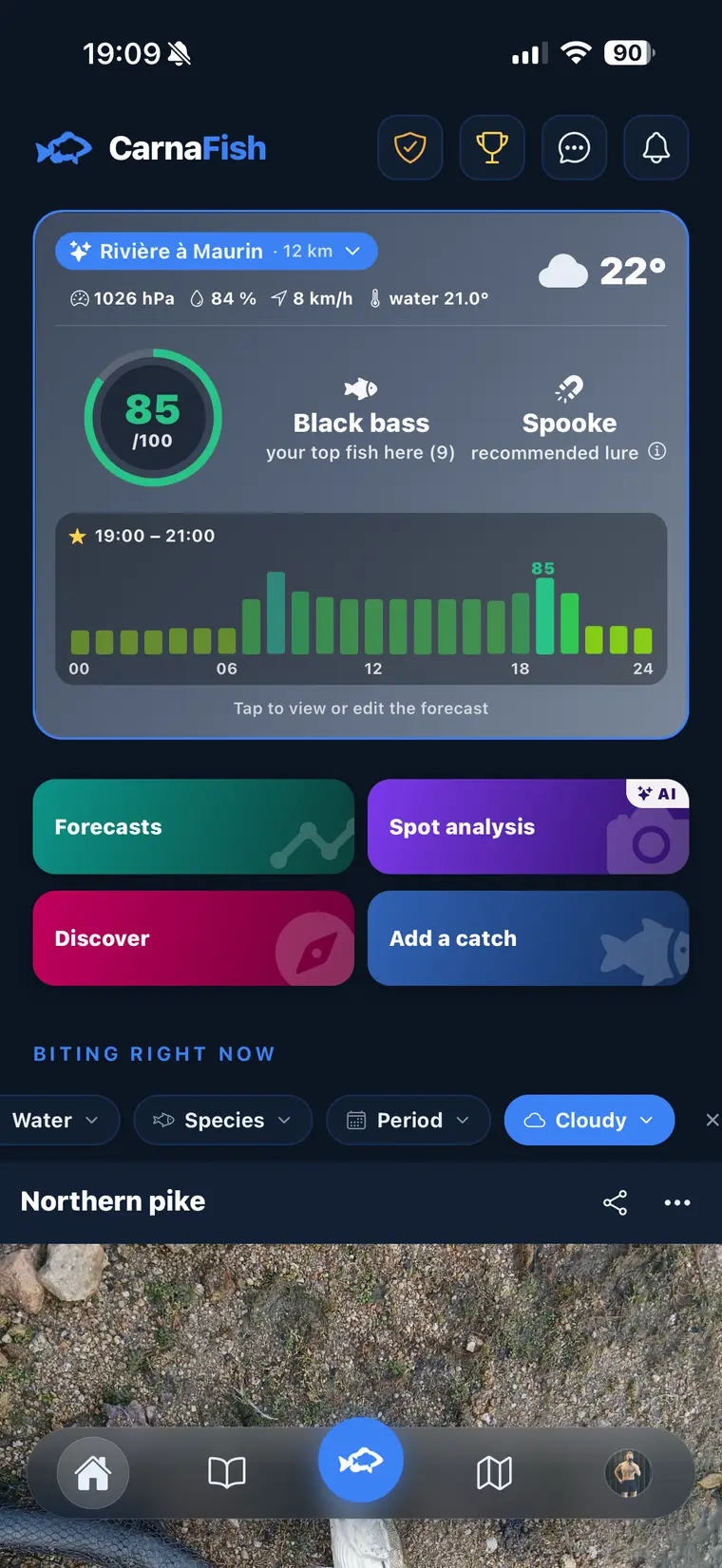
Photograph your spot: CarnaFish reads the scene, cross-checks the conditions and gives you the zone, the lure and the retrieve. Free on iOS and Android.
Where and when a popper this size earns its place
Three situations where it beats a big topwater: heavily fished waters, where the fish have memorised the usual silhouettes; small-forage areas in late summer, when the year's fry reach exactly this size; and tight lies — under a branch, against a dock, in a square metre of open water between two lily pads — where a short bait lands more precisely.
On tackle, 3.7 g rules out a power rod. A light to medium-light rod, a fine floating braid and a short fluorocarbon leader are enough. Keep the knot free: a loop knot or a small snap lets the nose of the bait tip up, and that tipping is what produces the spit. Tied tight, the Bitsy Splash chugs but spits badly.
In Europe this size also interests perch, which will happily come up for a small popper on calm late-summer mornings. If the feeding is too scattered for surface work, a sinking bait such as the Strike King Bitsy Shad takes over in the water column.
One honest limit to finish on: on water rippled by wind, a two-inch popper disappears. The noise is lost in the chop and the silhouette no longer stands out against the sky. As soon as the surface stops being flat, change family rather than persist — a bigger popper, or a subsurface bait altogether. The Bitsy Splash is a calm-conditions tool, and calm conditions are exactly where big topwaters fail.
Colours by light
- Overcast skies, dawn, dusk: the black glitter of the photo. On the surface a fish sees a backlit silhouette before it sees a colour, and black gives the sharpest outline.
- Clear water and bright sun: chrome with a blue or green back, throwing short flashes and imitating a silver fry.
- Stained water: chartreuse or an orange head, paired with the chugging stroke rather than the discreet spit.
Working out whether the surface is even the right layer to fish that day means reading the spot before choosing the bait. That is what CarnaFish does: one photo of the spot, and the AI suggests the zone, the depth and the lure family that match the conditions. To build the whole approach on this fish, our beginner's guide to bass fishing covers the other families worth knowing.
What to remember
- A floating 5 cm popper weighing about 3.7 g: the size that gets bites when fish refuse the usual silhouettes.
- Three actions claimed by the manufacturer — spit, walk, chug — and it is your rod stroke, not the bait, that selects them.
- The three to five second pause matters more than the noise itself; popping too often is the most common error.
- The feathered rear treble is part of the action: replacing it with a bare treble changes how the bait behaves.
FAQ
Does the Bitsy Splash float at rest?
Yes, the manufacturer lists it as floating. It returns to the surface immediately after every stroke, which allows long pauses without it sinking.
How is it different from the KVD Splash?
It is the same concept scaled down to 5 cm (2 in). The Strike King KVD Splash moves more water and casts further; the Bitsy trades that for discretion on pressured fish.
How long should you wait between pops?
Three to five seconds, long enough for the rings to close completely. Bites come far more often during the stillness after the noise than during the noise itself.
Should you replace the factory feathered treble?
Not without a reason. The feathers breathe during the pause and help keep the nose up during the retrieve: a bare treble changes the bait's action.
What rod casts 3.7 g on the surface?
A light to medium-light rod with a fine braid. A power rod will not load at that weight and makes the precise snap the spit requires impossible.
Can you catch perch on the Bitsy Splash?
Yes, especially on calm late-summer mornings when perch herd fry at the surface. A 5 cm profile matches the prey size they are hunting at that moment exactly.
The full bass lure guideSeason-by-season strategy: which family of lure, when, and why.Go from theory to fish
CarnaFish reads your spot from a photo and gives you the game plan: zone, lure, retrieve. Free on iOS and Android.