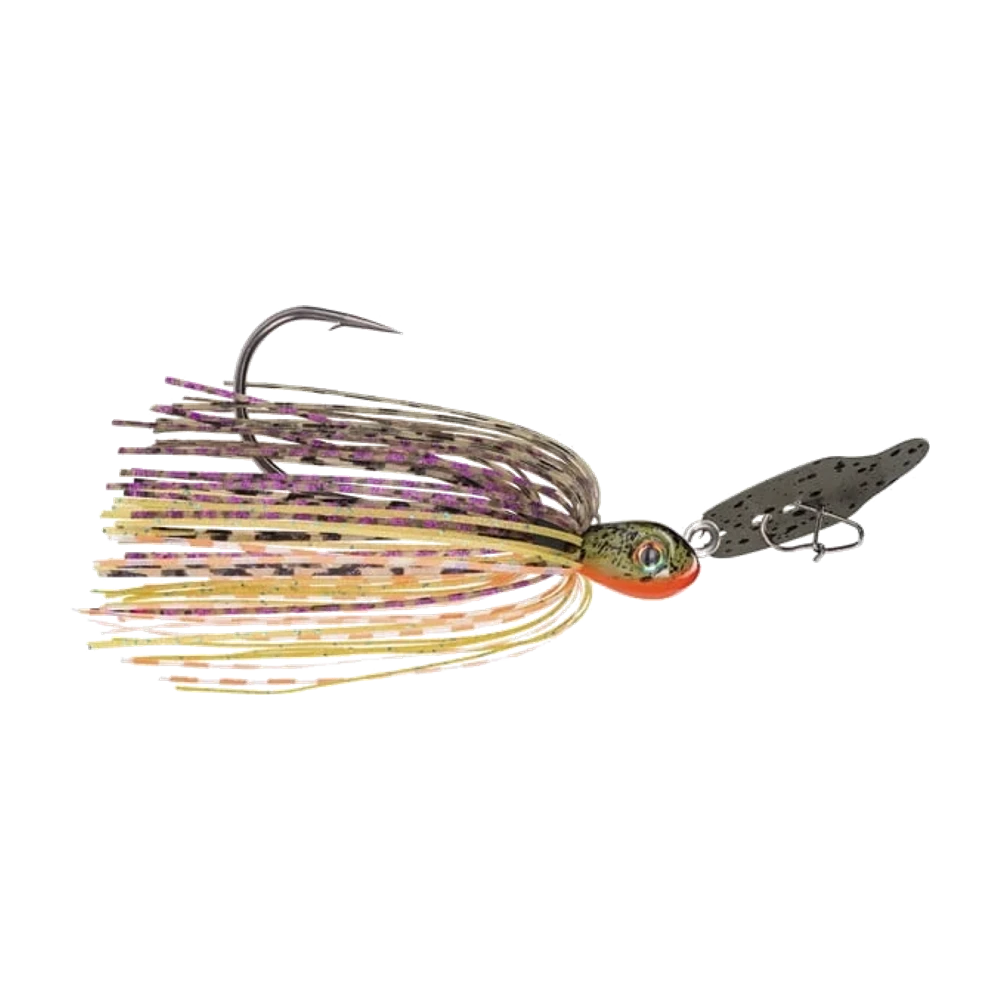
Strike King Thunder Cricket: the chatterbait that starts on the first turn
Before tying this one on, it helps to know if the spot actually calls for it. CarnaFish reads the scene from a photo.
A badly designed chatterbait has one precise flaw: you cast it, wait for it to sink, then wind in a yard or two before the blade starts vibrating. On a short spot — along a jetty, at the edge of a weed bed — those wasted couple of yards are exactly where the fish was sitting.
The Thunder Cricket was drawn to remove that dead time. The blade bites from the first turn of the handle, and that changes the way you fish tight spots.
What a chatterbait actually does
A chatterbait is a jig head fitted with a hexagonal blade attached straight to the line tie. As you retrieve, the blade swings and knocks against the jig head on every beat.
That produces two distinct signals:
- A strong, irregular vibration, different from the steady thump of a spinnerbait. The irregularity is what triggers: it reads more like a prey item in trouble than a mechanical object.
- A metallic knock on every swing, which carries far and works particularly well in stained water.
Unlike a spinnerbait, a chatterbait rises very little on the retrieve. It holds its depth band, which lets you fish a constant depth along a drop-off.
The trailer is not an accessory
A chatterbait without a trailer does not work properly. The soft plastic rigged behind it does three jobs: it lengthens the profile, it stabilises a lure that would otherwise roll, and it adds movement of its own during the pauses.
Your trailer choice noticeably changes the behaviour:
| Trailer | Effect |
|---|---|
| Paddle-tail shad | Maximum vibration, stable action, all-round choice |
| Curly-tail grub | More movement, more drag, slows the lure down |
| Creature bait with appendages | Maximum signal in very stained water |
| Fluke with no built-in action | Subtle profile, for clear water and educated fish |
On the water: if the chatterbait rolls over on itself instead of vibrating true, your trailer is too big or badly threaded. It has to sit perfectly straight on the hook, with no twist.
The retrieves
The slow straight retrieve, keeping just enough speed to feel the vibration. That is the baseline and it catches most of the fish.
The contact retrieve. Deliberately bump the weeds, a stump, a rock. The chatterbait frees itself well, and that abrupt release after a light snag draws a huge number of strikes.
The yo-yo. Two turns of the handle, then let it drop back on a semi-tight line. Effective in cold water or on inactive fish, over 2 to 4 m of depth.

Not sure what to tie on?
Photograph your spot: CarnaFish reads the scene, cross-checks the conditions and gives you the zone, the lure and the retrieve. Free on iOS and Android.
Chatterbait or spinnerbait
The two cover neighbouring roles, but not identical ones.
The spinnerbait rises on the retrieve, gives more visual flash, and slips through branches better thanks to its V-shaped wire. It suits fast searching near the top and clear water.
The chatterbait holds its depth better, vibrates harder, and puts out a more aggressive sound signal. It takes the lead in stained water, over 1 to 3 m, and when fish refuse the flash of a blade.
On pike, the Thunder Cricket works well provided you run a heavy fluorocarbon or titanium leader: the takes are savage and the lure body is short.
Where it excels
- Stained or coloured water, where the vibration signal matters more than the visual one.
- Weed bed edges and sparse vegetation, thanks to how well it frees itself.
- Short spots where the lure has to be working the instant it lands.
- Spring and autumn, when fish are hunting actively along the margins.
Our beginner's guide to bass fishing sets out the periods when this kind of lure takes over. And if you are torn between a chatterbait and a spinnerbait on a given spot, CarnaFish analyses a photo and points you in a direction.
Key takeaways
- The blade bites from the first turn: no dead zone after the lure lands.
- The trailer is mandatory and strongly changes the behaviour — start with a paddle-tail shad.
- Bump cover on purpose: the release is what draws the strike.
- It holds its depth band, unlike a spinnerbait which climbs.
- It takes the lead in stained water and over 1 to 3 m.
FAQ
Do I really need a trailer on a chatterbait?
Yes. Without one the lure rolls over instead of vibrating true, and the profile is too short. A paddle-tail shad is the most versatile starting point.
What is the difference between a chatterbait and a spinnerbait?
The spinnerbait rises on the retrieve, gives more flash and slips through branches better. The chatterbait holds its depth, vibrates harder and adds a knocking sound: it is better in stained water and between 1 and 3 m.
My chatterbait spins on itself, why?
The trailer is probably too bulky or badly threaded. It must sit perfectly straight on the hook, with no twist. Dropping down a trailer size fixes it in most cases.
What weight should I choose?
From 10.5 g for margins and shallow water, up to 21 g for fishing deeper or casting into wind. The 14 g covers most freshwater situations.
Does it work for pike?
Yes, and the takes are savage. Always run a heavy fluorocarbon or titanium leader: the lure body is short and the teeth reach the line easily.
How fast should I retrieve?
Just fast enough to feel the vibration in the rod, no more. A chatterbait is a slow lure; speeding up makes it climb and cuts your presentation time.
The full bass lure guideSeason-by-season strategy: which family of lure, when, and why.Go from theory to fish
CarnaFish reads your spot from a photo and gives you the game plan: zone, lure, retrieve. Free on iOS and Android.