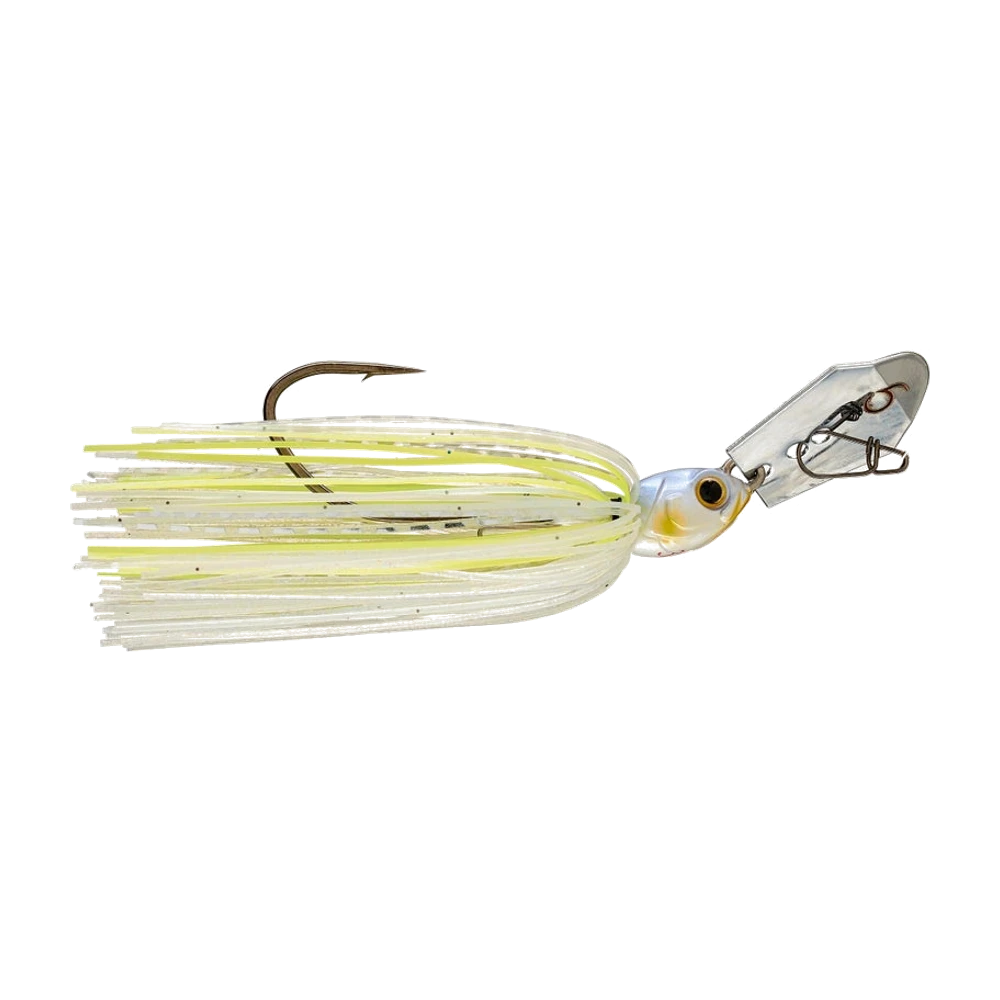
6th Sense Fixed Jig Saw: the bladed jig that vibrates from turn one
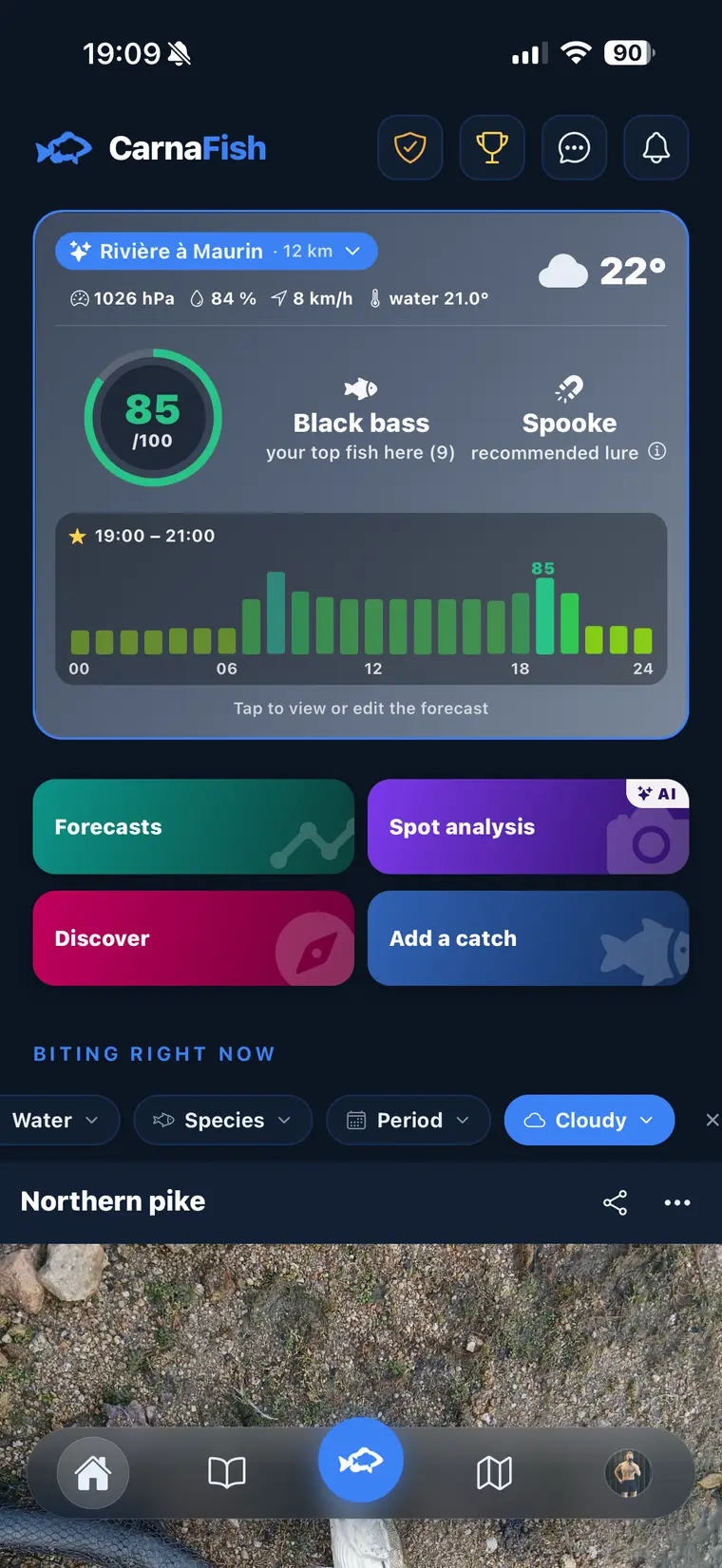
This lure shines under specific conditions. CarnaFish tells you in 10 seconds if today is one of them.
There is one precise moment on a chatterbait where the cast is won or lost: the first two metres after it lands. If the blade takes three turns of the handle to get going, you have already crossed the useful water — the reed edge, the shade line under the dock, the stump top — without the bait vibrating once. The 6th Sense Fixed Jig Saw is built around that detail, with a deliberately very thin blade calibrated to start vibrating on the first turn.
A thin blade, and what it actually changes
Blade thickness is the single parameter that drives a bladed jig's whole behaviour. A thick blade needs speed to switch on, but it takes impacts better and holds a steady rhythm. A thin blade like this one starts almost instantly and puts out a more nervous, higher-frequency vibration.
The second effect is less intuitive. The thinner the blade, the more it breaks out of rhythm. And that is precisely what you want. Instead of beating left and right like a metronome, the bait regularly falls out of its own axis, darts sideways, then catches itself. That erratic behaviour — what American anglers call hunting — is the real trigger on bass. A chatterbait that vibrates perfectly evenly catches fewer fish than one that makes mistakes.
On that score the Jig Saw sits close to a Z-Man ChatterBait Jack Hammer and a long way from an entry-level bladed jig, whose blade is too stiff to do anything beyond tremble.
The tapered head and getting through cover
The Jig Saw's head is drawn out and pointed rather than stubby. That is a choice aimed squarely at cover: submerged branches, lily stems, dead timber, rush edges. A tapered head slides between two obstacles instead of butting into them, and when it does butt into something, it tends to slip off to the side rather than wedge.
In practice that lets you fish contact fairly aggressively. You deliberately run the bait into things. Every impact breaks the blade's rhythm, forces a dart, and that is very often the instant the bite comes. A chatterbait reeled through the middle of an empty pond is not doing much for you.
Hunt for contact instead of avoiding it. Shave the piling, tap the stump, scrape along the reed line. The imbalance a collision causes produces more bites than any speed variation you can manage on an open-water retrieve.
A retrieve speed that forgives
The other claim, and one you can verify through the rod, is how consistent the action stays across the whole speed range. You can reel very slowly, slow rolling a few centimetres off the bottom, without the blade stalling out. You can also burn it just under the surface to trigger a fish on an active bait school. In both cases the lure stays coherent.
That opens two very different fisheries with the same bait. In cold water, in spring before the spawn or in autumn, the 14 or 21 g version crawled near the bottom becomes a big-fish presentation. In summer, the 7 or 10.5 g reeled fast just under the surface along the banks covers a lot of ground. And for pike, a 21 g slow rolled along an autumn weed edge is a seriously effective way to fish, and a good deal easier to master than a big swimbait.
Hook, keeper and choosing a trailer
The hook is an O'Shaughnessy pattern, 4/0 on the 7, 10.5 and 14 g versions and 5/0 on the 21 g. The O'Shaughnessy shape has a straight shank and a wide bend, so it penetrates slightly slower than an inturned-point hook, but it holds far better through a long fight and bends less when you have to drag a fish out of a clump of vegetation.
The twin-wire keeper deserves a mention. Two wires instead of one is what stops the trailer pivoting on the shank and sitting crooked after ten casts. A crooked trailer kills the bait's balance and you end up fishing dead without noticing.
Which trailer to run
The rule is simple: the trailer sets the fall rate and the vibration amplitude, not the other way round.
- A soft shad with a slim paddle like a Keitech Swing Impact 4" adds a clean swim and barely slows the bait. That is the default choice for covering water.
- A big-paddle trailer amplifies the vibration but slows the whole package down, which is useful in murky water and a handicap if you want to burn it.
- A creature bait with flat appendages brakes hard and makes the bait glide. Save that one for cold water in spring, when you want the chatterbait to stay in the zone as long as possible.
The classic mistake
Reaching for an oversized trailer by reflex, on the assumption that more bulk means more visibility. Too wide a trailer on a thin blade smothers the vibration and kills the side darts — which is exactly what you bought this bait for. Always start with the most discreet trailer in the box, and only go bigger if the fish refuse to react.
Not sure what to tie on?
Photograph your spot: CarnaFish reads the scene, cross-checks the conditions and gives you the zone, the lure and the retrieve. Free on iOS and Android.
Colours by water and forage
- Clear water, silver forage: a silver white, skirt and trailer matched. That is the most natural combination when fish are feeding on small roach or bleak.
- Lightly stained water, fish on the banks: a green pumpkin shaded with blue, which reads as a panfish — a prey item bass know extremely well along covered edges.
- Murky water or low light: black and blue, for a hard silhouette. In genuinely dirty water, step up to a heavier version as well so you keep contact.
Where it shows its limits
A chatterbait is not a finesse bait and the Jig Saw is no exception. In very clear, cold water, on fish holding deep and barely feeding, continuous vibration starts to look suspicious — a standard jig or a slow-rigged soft plastic will do better. It also struggles in truly matted weed, where the blade loads up with vegetation. A Strike King Thunder Cricket does no better there: that is a limit of the whole family, not of this model.
Knowing which lure to tie on depends first on what is actually in front of you, and that is exactly what CarnaFish lets you settle quickly: photograph the water and the AI suggests the zone, the depth and the lure type that match the conditions of the moment. If you want to push the subject further on pike, our guide to choosing a pike lure puts the chatterbait back in context among the other families.
Key takeaways
- The very thin blade starts on the first turn of the handle and produces erratic side darts, which are the real trigger.
- The tapered head is made for contact with cover, not for open-water retrieves.
- The action stays coherent from a dead crawl to a burn, which makes it a bait you can use all year.
- The trailer sets the fall rate and the vibration amplitude, so start small before going bigger.
FAQ
Which weight should I start with on a chatterbait?
The 10.5 g covers most bass situations between 50 cm and 2 m of water. The 7 g is for very shallow banks, while the 14 and 21 g are for deep slow rolling and for pike.
What does Fixed mean in the name?
The blade is held by a solid clip in a fixed position relative to the head, rather than being free to swing widely. The result is a more direct transmission of the vibration, and an immediate start.
Do I absolutely need a trailer on a chatterbait?
It is not compulsory, since the hand-tied skirt already provides bulk, but the trailer adds profile and above all sets the fall rate. Without one the bait sinks faster and becomes harder to hold at a constant depth.
Is this bait any good for pike?
Yes, especially the 21 g reeled slowly along autumn weed edges. Plan on a thin steel or titanium leader, because a pike hits a chatterbait hard and the blade sits right in front of its teeth.
Why has my blade stopped vibrating properly?
Check the trailer first, since a trailer that has pivoted on the shank and sits crooked breaks the balance. Then check that the blade has not been bent by an impact against a stump or a rock, because even a slight deformation is enough to lose the erratic behaviour.
Chatterbait or spinnerbait along a covered bank?
The chatterbait puts out a tighter vibration and comes through dense cover better thanks to its tapered head. The spinnerbait stays better in very murky water and on extremely slow retrieves, because its blade keeps turning when it is barely moving forward.
The full bass lure guideSeason-by-season strategy: which family of lure, when, and why.Go from theory to fish
CarnaFish reads your spot from a photo and gives you the game plan: zone, lure, retrieve. Free on iOS and Android.