Z-Man Original Chatterbait: the blade that created a family
One lure, endless conditions. CarnaFish reads your spot from a photo so you are not just guessing.
You are working a reed edge, the water is stained, nothing is showing on top and the crankbait gets refused. You cast a Chatterbait, retrieve at a steady pace, and the rod starts knocking — a dull, uneven beat that has nothing to do with the smooth hum of a spinnerbait. Then the rod stops dead. That is roughly the story of everybody's first Chatterbait.
What the blade actually does
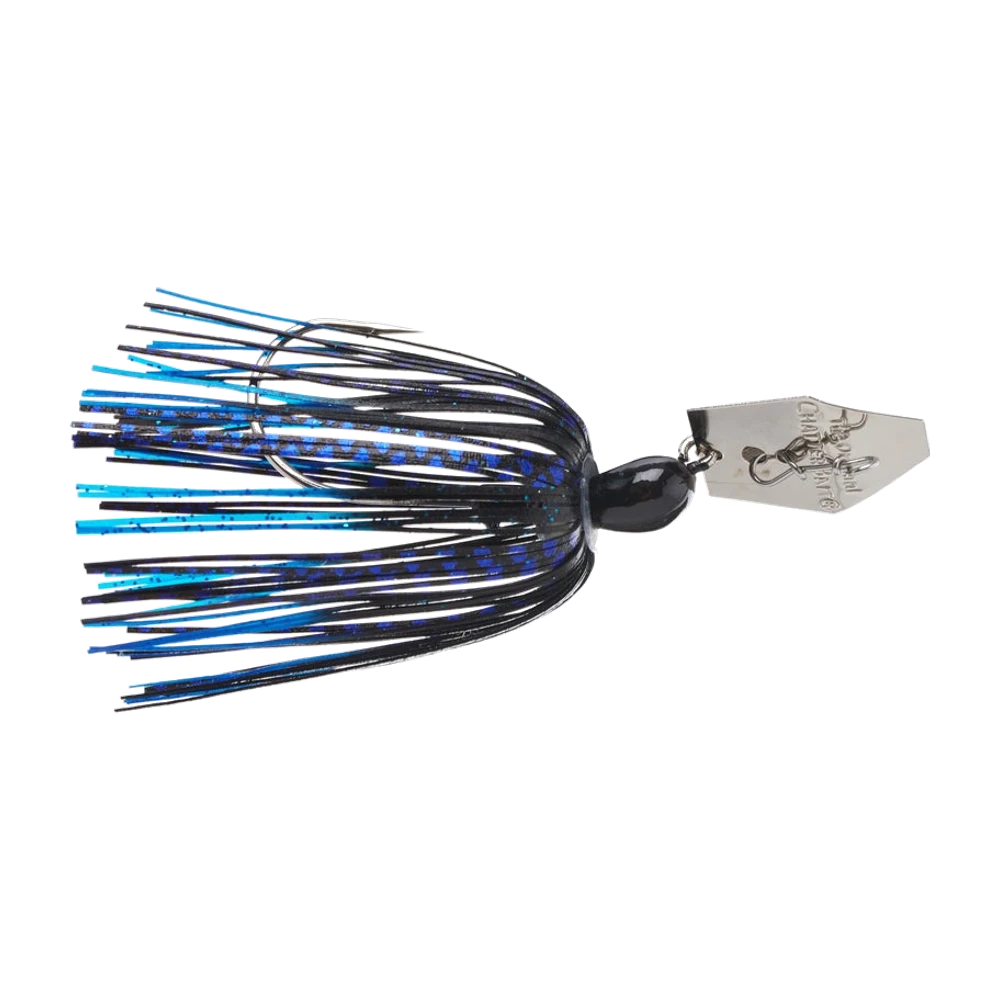
The whole principle of the Original Chatterbait sits in one part: a hexagonal steel blade attached straight to the head ring of the jig, with no clevis and no wire arm in between. As the lure moves, that blade does not spin like a spinnerbait blade: it stalls against the water, kicks out to one side, comes back, kicks out the other way. The head is dragged along with it, and the whole lure sets off in a short lateral zigzag.
Z-Man sums up its own lure by saying it combines the flash of a spinnerbait, the vibration of a crankbait and the snag resistance of a jig. That is a sales line, but it describes the outcome fairly. The difference that counts on the water lies elsewhere: a Chatterbait's vibration is irregular. The blade occasionally stalls, resets and starts again. It is that apparent flaw — a vibration that is never perfectly steady — which triggers reaction bites, where too clean a signal eventually gets ignored by a pressured fish.
What Z-Man does not tell you, and you need before buying
Let us be blunt: the technical data for this reference contains no spec table at all. No weight, no hook size, no stated length. That is unusual for a lure with this much name recognition, and it means checking the packaging before you pay, especially when buying at a distance.
Two more things worth reading properly on a product page of this type. A color flagged as a retailer special run is not manufacturer information: it is a distribution exclusive that will disappear. And the list of replacement skirts or trailers you find at the foot of the page is a cross-sell suggestion, not a spec of what comes in the pack. Finally, the phrase about a patent being pending has been hanging around in the copy since the original launch: the Chatterbait dates from the mid-2000s, and that wording no longer means anything.
The first thing to set up on a new Chatterbait is the clearance between the blade and the ring. If it is too tight, the blade never stalls and all you get is a soft hum. Open the ring very slightly with fine-nosed pliers until the blade moves freely, and go back and check after two or three good fish.
The trailer is not an option
A bare Chatterbait works, but it is only half a lure. The trailer — the soft plastic threaded on the hook behind the skirt — does three things at once: it lengthens the silhouette, it adds lift that slows the fall, and it changes the frequency of the blade. A bulky paddle-tail trailer brakes the lure and widens the kick; a thin soft jerkbait lets the blade run free and allows a faster retrieve.
Z-Man suggests several routes that genuinely deserve a try. Stripping the skirt off and keeping only a soft jerkbait gives a minimal profile that is very good over a school feeding in open water. The opposite move, adding a soft craw or a creature bait, bulks up the silhouette and lets you work near the bottom in hops, like a conventional jig but with vibration on top.
Choosing the trailer for what you want
For a fast straight retrieve over grass, take a slim compact shad: the Z-Man Minnowz is a good example of that format. To slow down and hold a precise layer, move to a bulkier soft plastic that brakes the fall. A trailer that is too big for the head weight, on the other hand, chokes the blade completely: if you can no longer feel anything in the rod, that is almost always the reason.
Where and when it takes over
The Chatterbait is a cover lure. Because the hook rides point up, it goes through sparse vegetation, tracks along a laydown or scrapes a lily pad edge without hanging up every cast. Those are exactly the spots where it beats a crankbait, which cannot get through, and a spinnerbait, whose smoother vibration carries less far in dirty water.
Its home ground is stained water, from spring to early autumn. It works mid-water as well as near the bottom: you simply count the sink down before starting the retrieve. In Europe it has long outgrown the bass fishing it was drawn for — pike respond very well to vibration in coloured water, and perch will follow lighter versions on a small trailer. As soon as pike are on the spot, a wire or titanium leader is not negotiable: a single hook does nothing to protect your mainline.
The classic mistake: retrieving too fast
The beginner's reflex is to speed up until the blade thumps hard. That is counterproductive: at excessive speed the lure climbs out of its layer, the blade stabilises instead of stalling, and you lose the irregularity that does the work. Retrieve at the slowest speed that still lets you feel the beat, and slip in one-second stops. The bite very often comes right after you start again.
Not sure what to tie on?
Photograph your spot: CarnaFish reads the scene, cross-checks the conditions and gives you the zone, the lure and the retrieve. Free on iOS and Android.
Colors by water clarity
The lure photographed here is black and blue: a skirt of black strands with blue flake mixed with light blue strands, black jighead, unpainted polished steel blade.
- Stained water or dark bottom: exactly that black and blue combination. The silhouette stays readable and the blade flash is the only bright element of the rig.
- Clear water: skirts in natural tones, grey-green or shad, with a discreet trailer. In transparent water, too contrasty a skirt makes fish peel off in the last metre.
- Dirty water, flood or dawn: chartreuse and white, to maximise visible volume at short range.
A whole family born from this blade
The Original is the baseline, and Z-Man built a full range around it. The Z-Man ChatterBait JackHammer refines the blade geometry for a tighter vibration and a steadier track at speed; the Z-Man ChatterBait Elite plays on the hook and the finish. Among competitors, the Molix Chatter Bait offers the same idea in a format aimed at European waters. The Original remains the logical entry point: it is the one you learn to feel the blade on.
A good lure in the wrong zone catches nothing, and that is what CarnaFish sets out to fix: one photo of the spot, and the AI suggests the zone, the depth and the type of presentation that fit the moment. If you are after pike with this lure, our guide to choosing a pike lure places the bladed jig among the other families.
Key takeaways
- The hexagonal blade produces a deliberately irregular vibration: it is the stall that triggers, not the raw power of the signal.
- No weight and no hook size in the technical data for this reference: check the packaging.
- The trailer is not an accessory, it sets the blade frequency and the sink rate.
- Retrieve at the slowest speed where you still feel the beat, with short stops, rather than fast and hard.
FAQ
What weight should I pick for an Original Chatterbait?
Z-Man gives no mass in the technical data for this reference, so you have to read it off the packaging. In practice the lighter versions suit shallow water and smaller fish, the heavier ones hold a deeper layer or cast into wind.
Do I have to fit a trailer?
Not strictly, but it is strongly advised. The trailer lengthens the silhouette, brakes the fall and changes the blade frequency. Without one the lure loses a good part of its bulk and its versatility.
Why has my blade almost stopped vibrating?
Two causes cover nearly every case: the head ring is too tight and locks the blade's play, or the trailer fitted is too bulky for the head weight. Check the blade clearance first.
Does the Chatterbait work for pike?
Yes, very well, especially in stained water in spring and autumn. Fit a wire or titanium leader without exception: the single hook does nothing to keep teeth off your mainline.
Can you fish a Chatterbait in grass?
In sparse to moderate vegetation, yes: the hook rides point up and the lure pushes a good share of the strands aside. In a dense closed mat, a hollow-body frog remains the better tool.
What is the difference with a spinnerbait?
A spinnerbait spins a blade on a V-shaped wire, which gives a smooth steady vibration with plenty of flash. A Chatterbait makes a flat blade kick directly on the head ring: less flash, but a heavy irregular vibration that carries better in dirty water.
The full bass lure guideSeason-by-season strategy: which family of lure, when, and why.Go from theory to fish
CarnaFish reads your spot from a photo and gives you the game plan: zone, lure, retrieve. Free on iOS and Android.