V&M The Blade Jig: the bladed jig that fires up in the first metre
The right lure in the wrong spot still catches nothing. CarnaFish spots the zone that works, from a single photo.
There is one situation where the bladed jig has no real competitor: the edge of a submerged grass bed, water with half a metre of visibility, and three hundred metres of bank to cover before the light goes. A spinnerbait gets through but does not vibrate enough, a crankbait fouls, a Texas rigged swimbait is too slow. The bladed jig does all three jobs at once. This one carries the name of Cliff Pace, the 2013 Bassmaster Classic champion, and it was built around a single goal: get the blade started immediately.
Why a chatterbait starts badly, and how this one avoids it
The recurring flaw of a budget bladed jig is the dead zone. You cast, you start reeling, and for a metre or two the blade stays flat against the head without kicking. On a thirty metre cast that costs nothing. On a precision pitch against a dock, it is exactly where the fish is sitting.
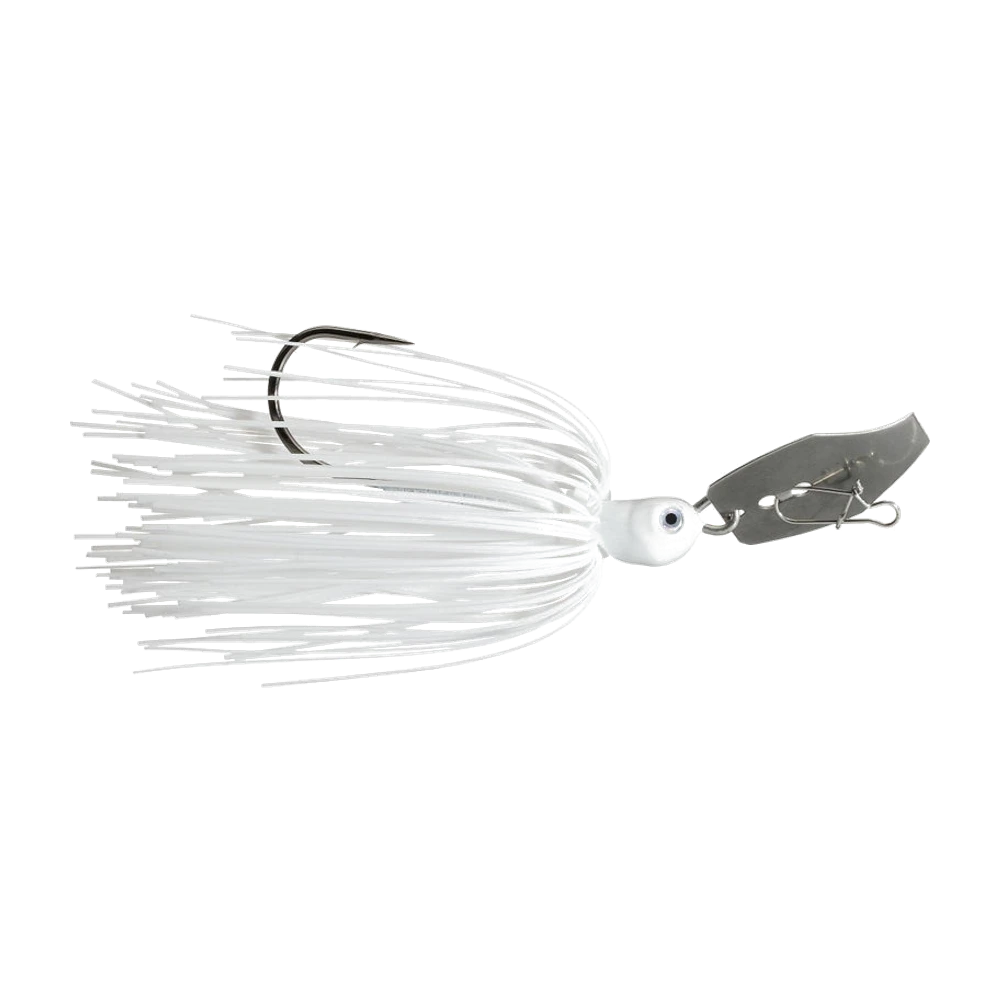
V&M's answer is mechanical. The hexagonal blade attaches directly to a large eyelet that is part of the head, with no intermediate link, through a sturdy snap that doubles as the line tie. The blade's angle of attack is therefore fixed by design, and it turns across the flow as soon as the lure starts moving. In practice you feel the vibration in the rod before you finish the first turn of the handle.
That is also what makes it a good vertical option alongside structure: you can let it fall down a piling, give a short lift, and the blade fires on the way up instead of hanging dead.
What the vibration really does
A chatterbait does not swim straight. The blade swings left and right as it grabs water, and each beat throws the head off line, so the lure moves in irregular lurches, never twice the same. It is that irregularity, not the vibration alone, that triggers the strike: it reads as prey losing its balance, not a fish cruising calmly.
The detailed silicone skirt plays an underrated part here. On every lurch it collapses and reopens, which gives the silhouette a pulsing volume. On a fish committing in the final metre in stained water, that breathing skirt is often what turns a follow into a bite.
If your chatterbait vibrates well but is not getting bitten, slow down to the point where you can feel the blade hesitate between two beats. That threshold speed, where the lure kicks hard sideways on every pick-up, is the most productive one on lethargic fish, and it is also the one almost nobody dares hold for more than ten casts.
The trailer is half the lure
Picking the model
A bare chatterbait, like the one in the photo, is an unfinished lure. The soft plastic trailer supplies the volume, the lift and the drag that set both running depth and the width of the kick.
Three families, three behaviours. A 3.5 to 4.5 in paddle tail such as a Keitech Easy Shiner 4 adds a clean swimming action and an extra signal: that is the default choice, the baitfish imitation. A craw with heavy claws like a Strike King Rage Craw raises drag sharply, slows the lure down and widens the lurches, which suits cold water or hard bottom. A plain twin tail gives the most compact profile for days when the fish refuses anything bulky.
Locking it down
V&M fitted the shank with a multi-ribbed bait keeper, and that detail matters more than it sounds. A trailer that slides back five millimetres after three casts unbalances the whole lure: it starts to spin, the blade loses its rhythm, and you spend the day repositioning plastic. The ribs bite into the body and hold, including after a fish. Thread the trailer dead straight, nose butted against the head, and check the alignment before each series of casts.
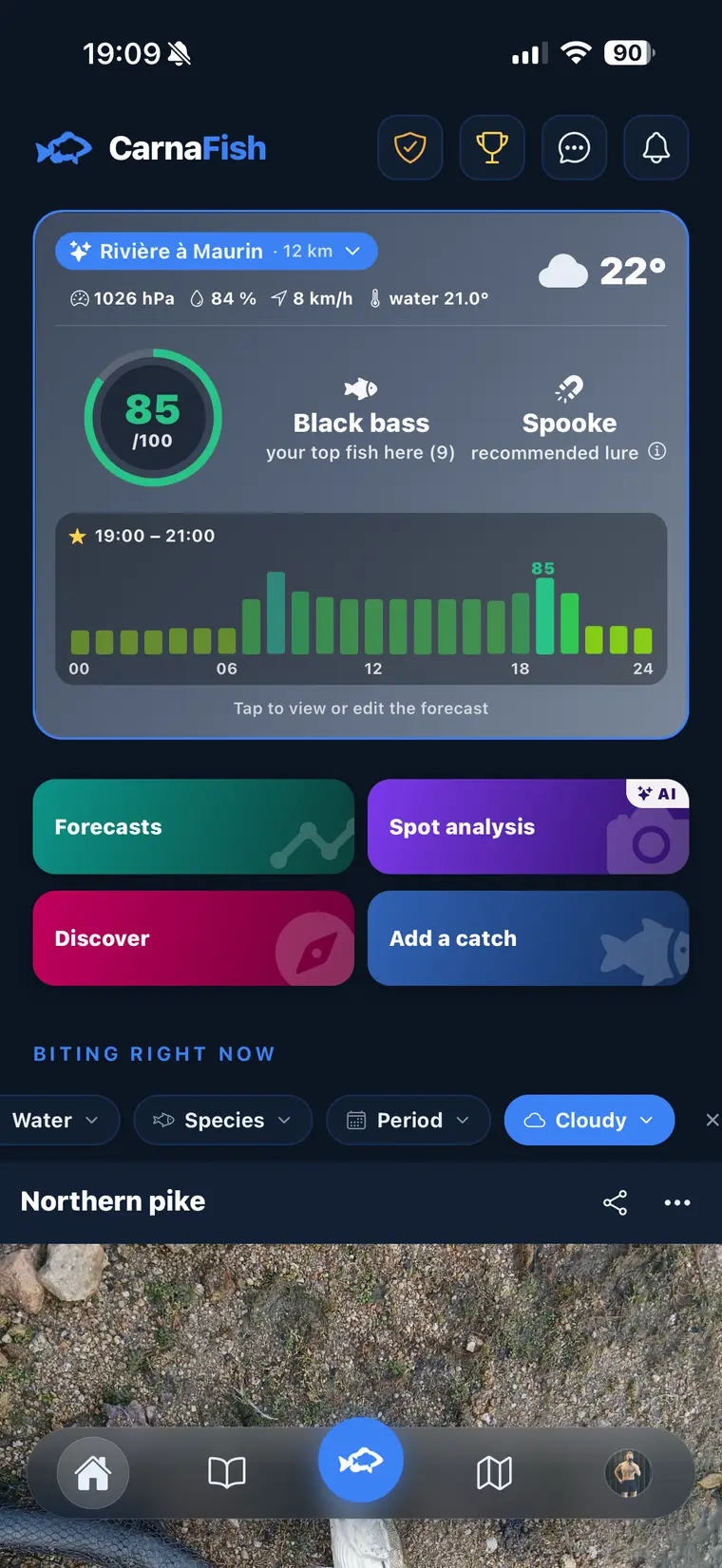
Not sure what to tie on?
Photograph your spot: CarnaFish reads the scene, cross-checks the conditions and gives you the zone, the lure and the retrieve. Free on iOS and Android.
Where and when to use it
The bladed jig is a search tool. Its home water is submerged grass topping out thirty to fifty centimetres under the surface: you run it just above, the blade ticks the stems, and every light contact followed by a sharp pull draws strikes. It also works along reed lines, down dock walls, over shallow flats early in the season and on soft breaks.
In Europe it has a second life Americans never gave it: it has become a seriously good pike lure in stained water, from March to June and again in autumn. Pike react strongly to that low frequency vibration, often better than to a spinnerbait. Fit a twenty centimetre supple wire trace, because a chatterbait hit broadside by a 80 cm pike without one is a lure gone.
The factory 5/0 single hook is a genuine bass hook: heavy wire, wide gape, strong enough to hold a fish dragged out of grass. It also dictates the tackle: a 6 ft 6 in medium heavy casting rod, 30 to 40 lb braid and a metre of fluorocarbon leader to soften the vibration and stay discreet.
The classic mistake
Setting the hook on the first resistance. A chatterbait is constantly brushing vegetation, and the temptation is to swing at every tick. The result is that you rip the lure out of the grass, bring it back loaded, and stop fishing. The right reaction is a sharp burst of the reel handle to clear the blade. If it was a fish, it will still be there and will hook itself on the way.
Colours by water clarity
- Clear water or visible baitfish: solid white, as pictured. With a white or translucent grey trailer, it is the most direct imitation of a shiner or a small roach.
- Clear water over grass: green pumpkin, perhaps lifted with a darker green trailer. More restrained, it is the choice for educated fish and very transparent water.
- Stained water or a chop on the surface: chartreuse and white. The contrast stays readable at half a metre, where every natural tone disappears.
The lure is only half the equation: you still have to know where the fish is holding that day. That is exactly what CarnaFish does, sending back a zone, a depth and a lure family from a single photo of the swim. If you plan to use it on pike, our guide to choosing a pike lure puts the bladed jig back among the other families.
Key takeaways
- The blade mounted straight onto a large head eyelet fires within the first metre, where many chatterbaits waste two metres getting going.
- The trailer is not an accessory: it sets the depth, the width of the kick and the visual volume of the silhouette.
- The ribbed keeper stops the trailer sliding back, and a trailer that slides back is enough to ruin the action.
- In Europe it has become an excellent pike lure in stained water, with a wire trace as a non-negotiable.
FAQ
How much does this chatterbait weigh?
The manufacturer's description does not give weights, and two different price points in the range suggest there are at least two versions. Rather than quote a figure that could be wrong, check the stamp or the packaging: on a bladed jig the weight completely changes the running depth and the minimum retrieve speed.
Do I have to use a trailer?
Yes. Without one the lure lacks drag, rises too fast, vibrates in a narrower arc and loses half its visual volume. The trailer is also the quickest variable to change when the bites stop coming.
What retrieve speed should I use?
Start with a moderate straight retrieve, just fast enough to feel the blade beating steadily. Then look for the threshold speed where the blade hesitates between two beats: that is where the lure throws the widest lurches, and it is often the speed that produces the biggest fish.
Does a chatterbait come through vegetation?
Better than a crankbait, worse than a Texas rig. It crosses sparse grass and clears itself with a sharp pull on the reel, but it is not weedless. In genuinely thick cover, a frog or a weedless rigged soft plastic is still the right tool.
How does it differ from a spinnerbait?
A spinnerbait throws flash and a higher frequency vibration, and threads through timber better. A chatterbait produces a lower, wider vibration that carries a long way in stained water, and its irregular tracking triggers more on active fish. The two complement each other rather than replace each other.
Can it be fished in winter?
Yes, but much slower and with a high drag trailer such as a craw. A chatterbait crawled just above the bottom in February is one of the few vibrating lures cold fish will still take, provided you never accelerate.
The full bass lure guideSeason-by-season strategy: which family of lure, when, and why.Go from theory to fish
CarnaFish reads your spot from a photo and gives you the game plan: zone, lure, retrieve. Free on iOS and Android.