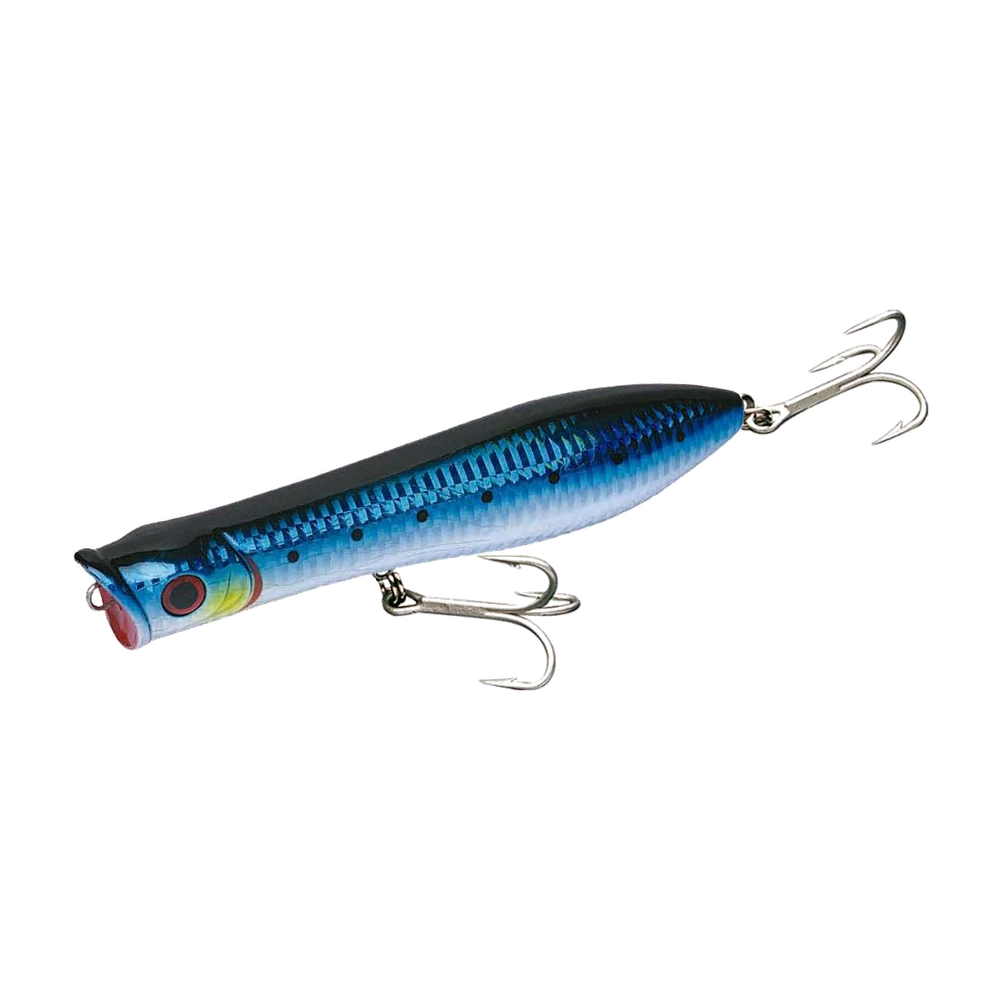
Tsunami Talkin' Popper: sound before sight when calling bass from a distance
Rather not fish it blind? Photograph your spot — CarnaFish cross-checks the conditions and points you the right way.
A sea bass doesn't see a popper fifty metres away. It hears it. That's the whole logic behind the Talkin' Popper: a rear propeller that thumps and clicks on every sweep, built to call a fish in long before sight ever comes into play. On a rocky point or a beach where predators can be scattered across a wide area, that noise is often the difference between a lure that gets ignored and one that pulls a strike from way out.
Sound carries further than sight at sea
In rough or slightly turbid water, a lure's visual range drops to a few metres, while surface noise and vibration travel well beyond that. That's exactly the Talkin' Popper's territory: its rear prop doesn't just create a nice-looking wake — it produces a distinctive click on every sweep that acts as a call, not unlike the splashing of a panicked baitfish school.
Field rule: the rougher the sea or the more stained the water, the more noise matters relative to colour. Never switch colour before you've tried a louder rhythm first.
The retrieve that gets the prop talking
Unlike a standard popper worked with a sharp rod snap, the Talkin' Popper is mostly fished with a firm, continuous reel sweep of a metre or two, followed by a full stop. It's that sweep that spins the prop and triggers the click — a single rod twitch on its own isn't enough to properly activate it. Two rhythms worth trying:
- Long sweeps, 2-3 second pauses: to cover a wide area and call in a fish holding well off the lure's line.
- Short, repeated sweeps with almost no pause: for bass already in an active feeding mode, where the urgency of the noise beats a careful presentation.
Different roles for bass and for mackerel
Mackerel hunt in schools and respond to almost any surface noise paired with fast movement — the Talkin' Popper works from the very first sweep, no fine-tuning needed. Bass, more solitary and more deliberate, tend to use the noise more as a distant alert before closing in to visually assess the lure — which is why real pauses matter once a fish is potentially interested, giving it time to commit to the strike.
Casting distance: the prop popper's other strength
The TSTP5F's weight, combined with its internal weight-transfer system, makes it a lure that casts far even into a headwind — a real asset when a mackerel frenzy is happening out of range of a lighter popper, or when covering a long stretch of beach between two rocky points without constantly relocating.
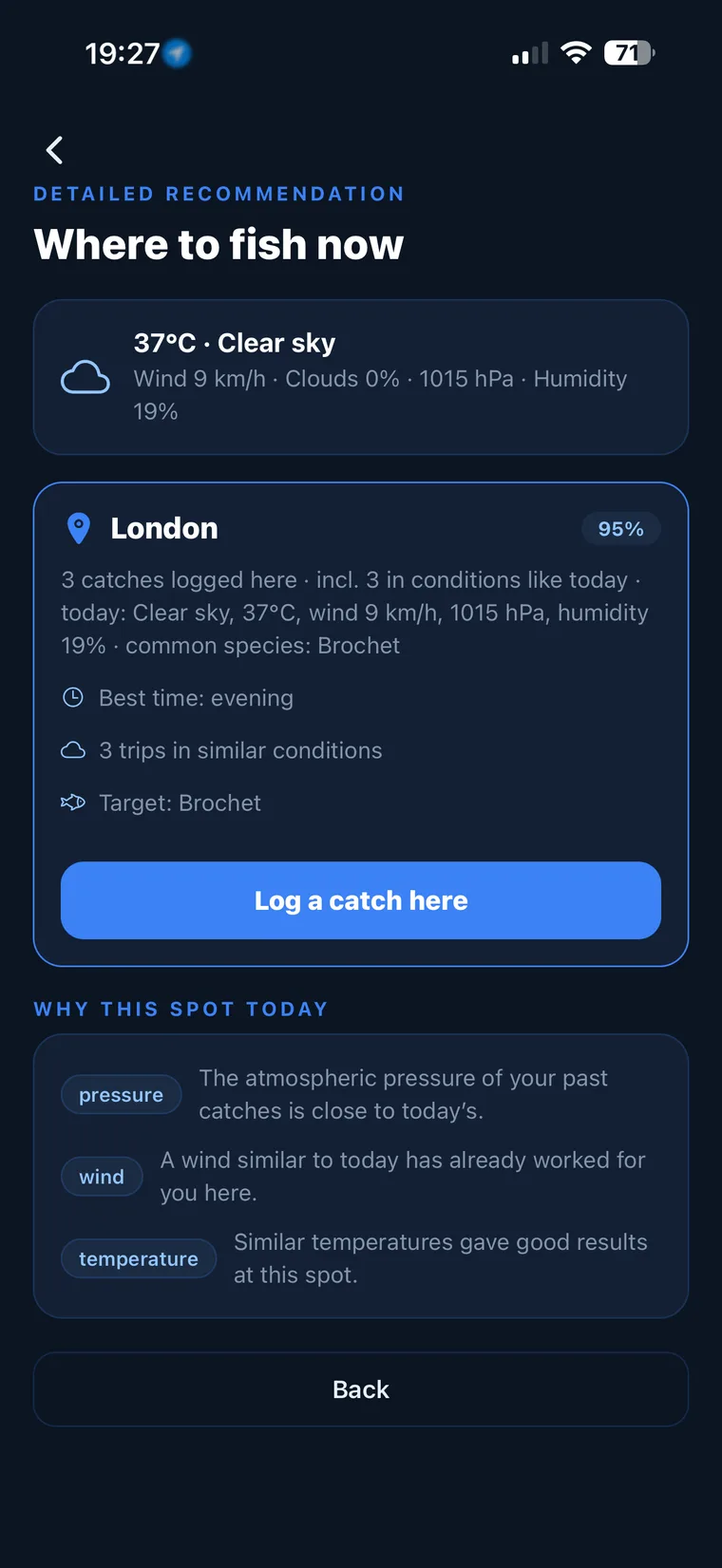
Not sure what to tie on?
Photograph your spot: CarnaFish reads the scene, cross-checks the conditions and gives you the zone, the lure and the retrieve. Free on iOS and Android.
When to reach for a prop popper over a silent one
- Choppy sea or strong wind: background water and wind noise mask a silent swim; the prop's click stands out better.
- A large area to cover: on a long beach with no obvious visual marker, noise calls in fish scattered over a wide area rather than relying on a lucky pass.
- Fish not yet located: early in a session, before spotting a frenzy or a specific mark, the Talkin' Popper doubles as a scouting tool as much as a catching one — a strike gives an immediate read on whether fish are in the area.
Colour: a secondary factor, but not a negligible one
- Clear conditions, clean water: Chrome/Blue, which catches light well without distorting the profile.
- Turbid water after a blow: Bone, more visible as a silhouette against a bright sky.
- A mackerel frenzy identified: the Mackerel colour directly mimics the prey of the moment, an edge when fish are already keyed in on that specific baitfish.
As with any popper, the tide window remains the single biggest factor — our guide to fishing sea bass on lures breaks down the best moments to fish a topwater lure. And to check whether today's wind and sea state actually justify a noisy popper on your spot, CarnaFish reads the current marine conditions from a photo to guide you.
Key takeaways
- Prop noise carries further than sight, especially in a chop or stained water.
- Work it with firm reel sweeps, not just rod snaps, to properly activate the prop.
- Deadly from the first sweep on mackerel, more effective with real pauses on bass.
- Internal weight transfer supports long casts, useful for reaching a distant frenzy.
FAQ
Why does the Talkin' Popper make more noise than a standard popper?
Thanks to its rear propeller, which thumps and clicks on every reel sweep. This noise mimics the splash of a panicked baitfish school and carries well beyond the lure's visual range.
Should I work it with rod snaps like a standard popper?
No — a firm reel sweep is what spins the prop and triggers the click. A single isolated rod twitch isn't enough to properly activate the noisemaker.
Does the Talkin' Popper work as well on mackerel as on sea bass?
Yes, but differently: mackerel respond from the very first sweep with no fine-tuning needed, while bass often need real pauses after the noise to give the strike time to develop.
When should I reach for this kind of noisy popper instead of a silent one?
In a chop, strong wind, or over a large area where fish could be scattered well off the lure's path: noise calls fish in from distance where a silent popper relies purely on sight.
Does this popper cast far?
Yes, its weight and internal weight-transfer system make it a strong caster, even into the wind — a real advantage for reaching a distant mackerel frenzy.
What colour should I choose if I've spotted a mackerel frenzy?
The Mackerel colour, which directly mimics the prey of the moment. In that specific situation, colour realism can make a difference on top of the prop's noise.
The full sea bass lure guideSeason-by-season strategy: which family of lure, when, and why.Go from theory to fish
CarnaFish reads your spot from a photo and gives you the game plan: zone, lure, retrieve. Free on iOS and Android.