Cotton Cordell Pencil Popper: the surf lure built for distance
The right lure in the wrong spot still catches nothing. CarnaFish spots the zone that works, from a single photo.
Fishing sea bass from a beach is first and foremost a distance problem. The bar where fish are feeding sits sixty metres out, the wind is in your face, and half the topwaters on the shelf land twenty metres short or helicopter the moment you force the cast. The Cotton Cordell Pencil Popper was designed by and for shore anglers, and everything about its build follows from that single constraint.
A weight in the tail, and everything that follows
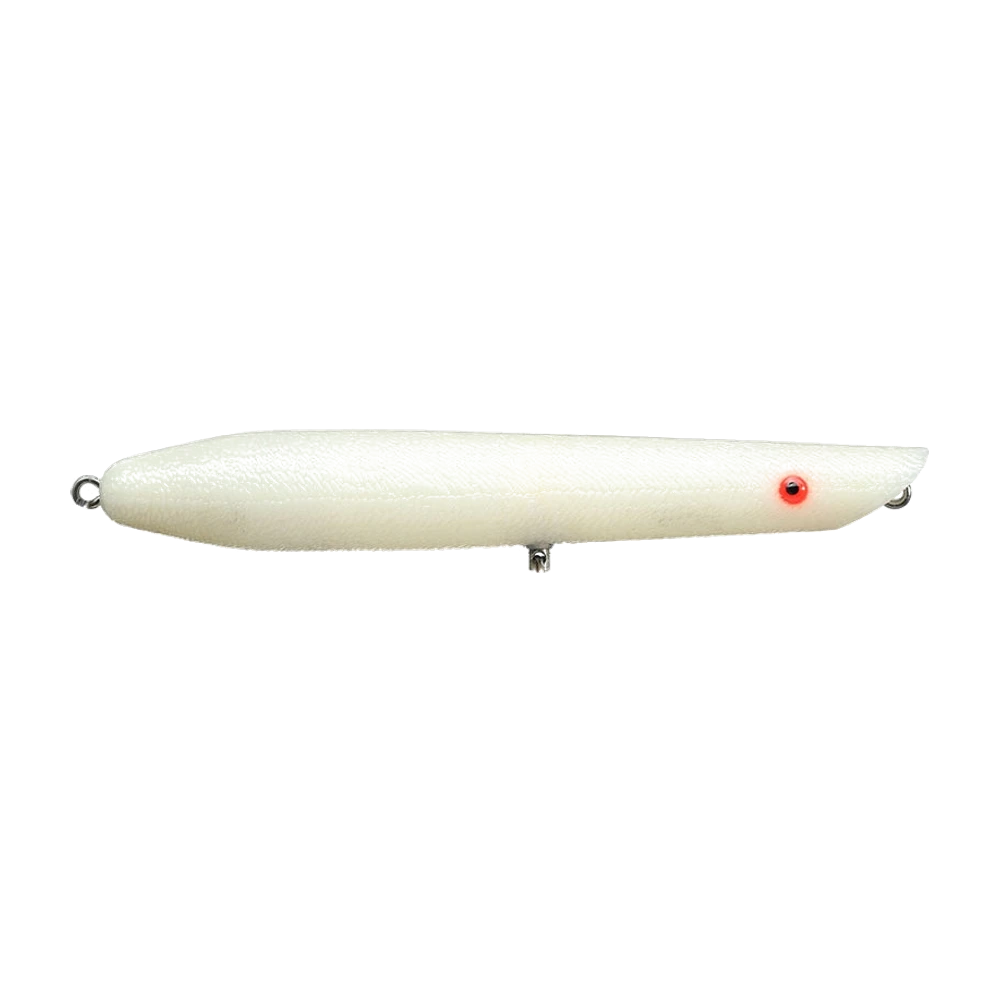
The principle is old and still effective: the maker houses a mass inside the rear section of the body. Two consequences. On the cast, the lure flies tail first, stable, without spinning — which is what allows distances its bulk does not suggest. At rest, it sits tail down, head up, in a nearly vertical attitude. The maker calls it a bobbing target, and that is exactly it: even stationary, the lure moves with the swell and stays visible.
That posture is what separates it from a classic cupped-face popper. You are not after the "plop" of a mouth grabbing air, but a head that slaps and sweeps the surface when you work it.
Three sizes for three contexts
The maker's table lists three versions. Its header omits the length column, but the values are unambiguous:
- 4.5 in / 11.4 cm at 3/4 oz (21.3 g), with size 2 trebles. The all-round shore size, the one that also picks up mackerel when they push up on sandeel shoals.
- 6 in / 15.2 cm at 1 oz (28.3 g), with 1/0 trebles. The right compromise when the wind picks up and distance becomes the limiting factor.
- 7 in / 17.8 cm at 2 oz (56.7 g), with 3/0 trebles. An entirely different tackle bracket, for big fish and rough water.
All three are listed as topwater, meaning the surface. Start with the middle size if this lure type is new to you: the smallest gets pushed around by wind, the largest demands a dedicated rod.
The retrieve, which is not a popper retrieve
This is where most anglers get it wrong. A pencil popper is not worked with spaced-out sharp pulls. You reel continuously, rod high, making the tip vibrate with small, fast wrist movements. The lure then starts swinging its head left and right, throwing water, in a continuous sweeping motion. It takes some arm, and that is normal: this is an active way to fish.
The opposite mistake is reeling fast without whipping: the lure lies down and skates across the surface producing nothing. The signal comes from the whip, not from reel speed.
When a wave comes through, stop everything for two seconds instead of fighting it. The lure rights itself tail down and bobs on its own on the back of the swell. A lot of strikes happen exactly there, while you are doing nothing.
Heavier line than you think
The maker states that all Pencil Poppers are designed for relatively heavy line, and that is not a detail. Two reasons: a mass cast at full power needs a safety margin at the knot, and the whipping retrieve transmits its energy poorly through line that is too fine and too stretchy. In practice, a comfortable braid diameter with a 40-60 lb fluorocarbon leader depending on lure size and ground.
The factory hooks are described as rust resistant, which genuinely matters in salt water. Rinse the lure in fresh water after every session anyway: no treble survives salt indefinitely.
The classic mistake
Setting on the splash. On the surface, sea bass very often miss their first swipe, and a reflex hookset pulls the lure away just before the second. Keep the retrieve going without changing rhythm and wait to feel weight in the rod. It is counter-intuitive, it is hard, and it doubles your landed fish.

Not sure what to tie on?
Photograph your spot: CarnaFish reads the scene, cross-checks the conditions and gives you the zone, the lure and the retrieve. Free on iOS and Android.
Place your casts rather than multiply them
The range this lure gives is worthless if you waste it. On a beach, fish do not hold just anywhere: they follow rip channels, return currents and breaks in the slope, all of which can be read from the colour of the water and the way the waves break. Find the area where the wave breaks irregularly: that is usually where a trough or a current concentrates the bait.
Then cast beyond the target zone, never into it. A 28 g lure landing on the head of a wary fish pushes it off, and in shallow water the impact carries a long way. Retrieve across the current, so the lure crosses the zone instead of leaving it by the shortest route. Three well-placed casts beat twenty random ones — and on fishing this physical, it is also a question of lasting the whole tide.
Colour by light
- Bright light and clear water: bone white, as pictured. A clean silhouette without aggressive flash, matching a sandeel or a small mullet well.
- Deep water or blue sea: a blue or green back, more consistent with the colour of the water seen from below.
- Dawn, dusk, heavy cloud: a dark tone, for a sharp silhouette against low, raking light.
The lure does nothing without reading the spot: current, state of the tide, position of the bar. That is exactly what CarnaFish makes easier: a photo of the shoreline, and the app suggests the zone and the presentation suited to the moment. To build a whole session around the tide, our guide to lure fishing for sea bass sets the frame.
Key takeaways
- Three sizes: 11.4 cm / 21.3 g, 15.2 cm / 28.3 g and 17.8 cm / 56.7 g, all listed as topwater.
- The tail weight does two jobs: casting distance, and a tail-down attitude that bobs at rest.
- The retrieve is a rod-tip whip on a continuous wind, not spaced-out pulls.
- Heavy line is specified by the maker, for the cast and for transmitting the retrieve.
FAQ
Which Pencil Popper size should a beginner pick?
The 6 in (15.2 cm, 28.3 g) is the best entry point: heavy enough to cut wind, contained enough for an all-round sea rod. The 4.5 in stays useful in calm conditions and on smaller fish.
Is it a classic popper?
No, despite the name. It has no cupped face and does not produce a "plop". It is a tail-weighted lure worked with a whipping action, whose head slaps and sweeps the surface instead of grabbing air.
Why does my lure spin on the cast?
Usually because the cast is not committed enough: the tail weight needs a sharp acceleration to orient the lure tail first. Line that is too fine or a snap that is too light make it worse.
Can it be used in fresh water?
Nothing stops you, but that is not its ground. On a lake, a Heddon Super Spook gives a more regular walk-the-dog and demands less power on the cast.
What is a more modern alternative for sea bass?
A DUO Realis Pencil 130SW is built for the same job with a newer finish and balance, at a considerably higher price. The Cotton Cordell remains unbeaten on distance per euro.
And if fish refuse the surface?
Try one size down before changing family. If the refusal persists, move to a cupped-face popper like the Savage Gear Blast Popper, whose noise is very different and sometimes restarts a bite on fish that have already been worked over.
The full sea bass lure guideSeason-by-season strategy: which family of lure, when, and why.Go from theory to fish
CarnaFish reads your spot from a photo and gives you the game plan: zone, lure, retrieve. Free on iOS and Android.