Savage Gear Prey Popper: the tool for surface feeding frenzies
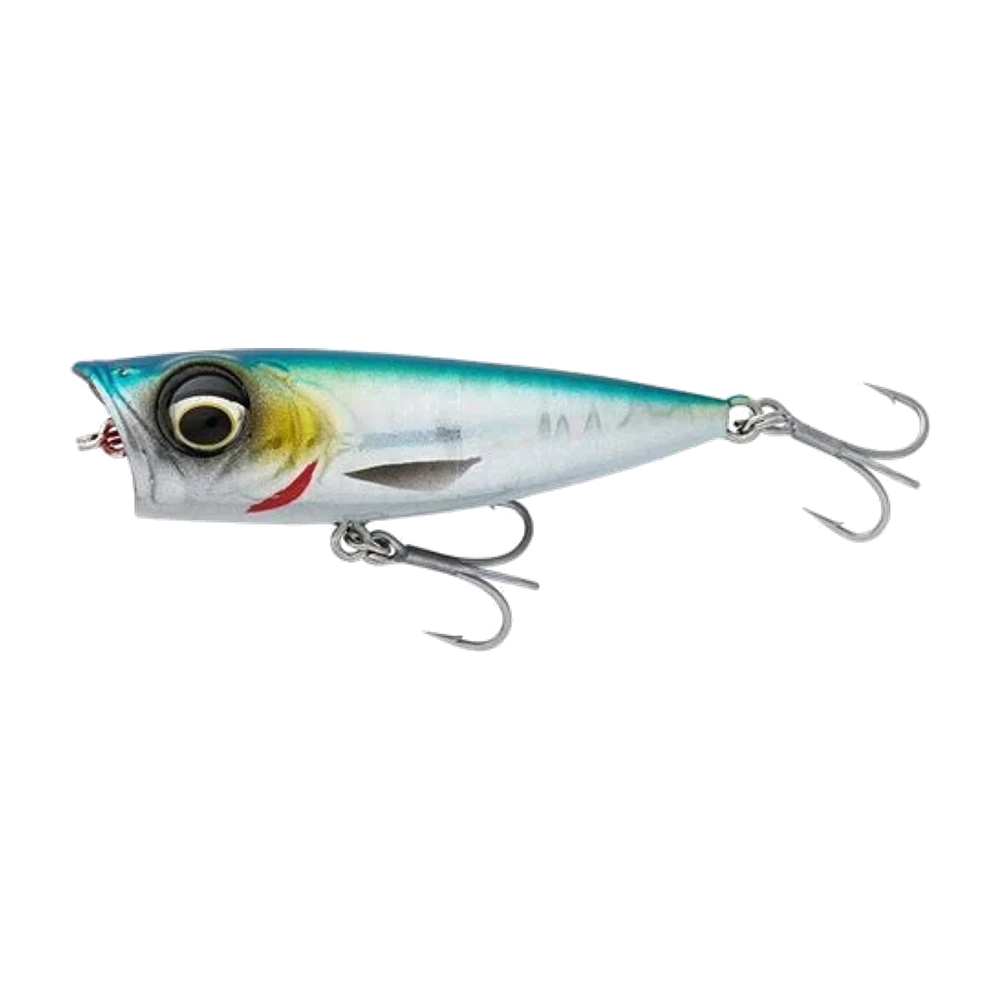
This lure shines under specific conditions. CarnaFish tells you in 10 seconds if today is one of them.
A surface frenzy lasts three minutes. The birds drop, the water starts boiling forty metres out, and you have time for four casts before it all stops. Within those three minutes, two things decide the outcome: how far you can send your lure, and exactly where you put it down.
The second one is counter-intuitive and costs a lot of anglers whole frenzies. We will come back to it.
The Prey Popper is cut for that situation: heavy enough to reach a shoal moving away, loud enough to be noticed in water that is already boiling everywhere, and tough enough to keep going without flinching at a mackerel hitting it side-on.
A spray that has to exist in the middle of the noise
The logic of a saltwater popper is the reverse of a bass popper's. In freshwater, on an educated fish, you are after discretion. Here you are in the middle of a panicking bait ball, with dozens of predators hitting the surface and birds diving. A discreet signal is invisible.
So the Prey Popper leans on three things:
- A wide, deeply cupped mouth that displaces a real volume of water and produces a deep plop that carries.
- Pronounced rear weighting, which serves twice over: it flattens the flight on the cast, and it rights the lure instantly after every pop so you can keep the cadence going with no dead time.
- A straight return path, with no lateral drift. In a frenzy you do not want a lure that zigzags: you want it to cross the zone in a straight line and quickly.
To that add a practical detail that counts when they are on: an audible ball or moving weight, which gives a sound signal underwater on top of the surface spray. In churned water, that second channel helps the fish locate you.
The retrieve: continuous cadence, no pauses
This is where you have to unlearn your freshwater reflexes.
- Work out which way the shoal is heading. It is moving. Cast ahead of it, not on top of it.
- Cast long, aiming three to five metres beyond the active zone.
- Close the bail before splashdown and start working it within the first second. A popper floating motionless in the middle of a frenzy gets ignored.
- Link the pops at a regular cadence: around two a second, wrist and forearm, taking up slack continuously. The lure has to be making real headway.
- Do not pause at all while the shoal is active. The pause, which is everything in freshwater, makes you look like an inert object here.
- Fish it all the way in. Following bass often hit five metres from the rocks, as the lure leaves the zone.
On the water: never cast into the middle of the boil. The baitfish are too dense there, your lure is drowned in the mass and the predator has no reason to pick it. Put it down on the edge of the frenzy or just behind it, where the fish that pick off isolated casualties hold. Those are often the biggest.
When the frenzy dies down and the birds settle, change rhythm instead of changing spot: slow to one pop per second, with a one-second pause every three sprays. The fish often stay under the zone for a few minutes after the visible activity ends.
Choosing the size: the baitfish decide
| Baitfish observed | Size | Cadence |
|---|---|---|
| Small fry, shivering water | 7 to 8 cm | Very fast |
| Sprats, sandeels | 8 to 9 cm | Fast and regular |
| Sardines, big baitfish | 10 to 11 cm | Fast, wide pops |
| Strong wind, frenzy offshore | 10 to 11 cm | Fast, rod held high |
The useful reflex: look at what is jumping, not at what you are hoping to catch. In a frenzy on small fry, an 11 cm popper reads as an intruder and gets ignored, even by good bass.
For mackerel, stay on the small sizes: its mouth is modest and you will convert more contacts with a 7 or 8 cm.
The rig, and the detail that costs fish
Braid. 0.14 to 0.20 mm. You need direct contact to set a hook at forty metres.
The leader. 0.40 to 0.50 mm fluorocarbon over a metre. Deliberately short: too long a leader makes knots in the rings when you cast a long way with a heavy lure.
The trebles. This is the critical point. On this kind of fishing you rattle through fast fights and missed hits, and the trebles bend out quickly. Check them after every fish. A treble opened to forty-five degrees no longer pins.
The hookset. Do not strike at the sound. Plenty of hits miss the lure; strike at every swirl and you rip the popper out of the zone. Wait until you feel the weight in the rod, then set the hook by pulling sideways, not upwards.
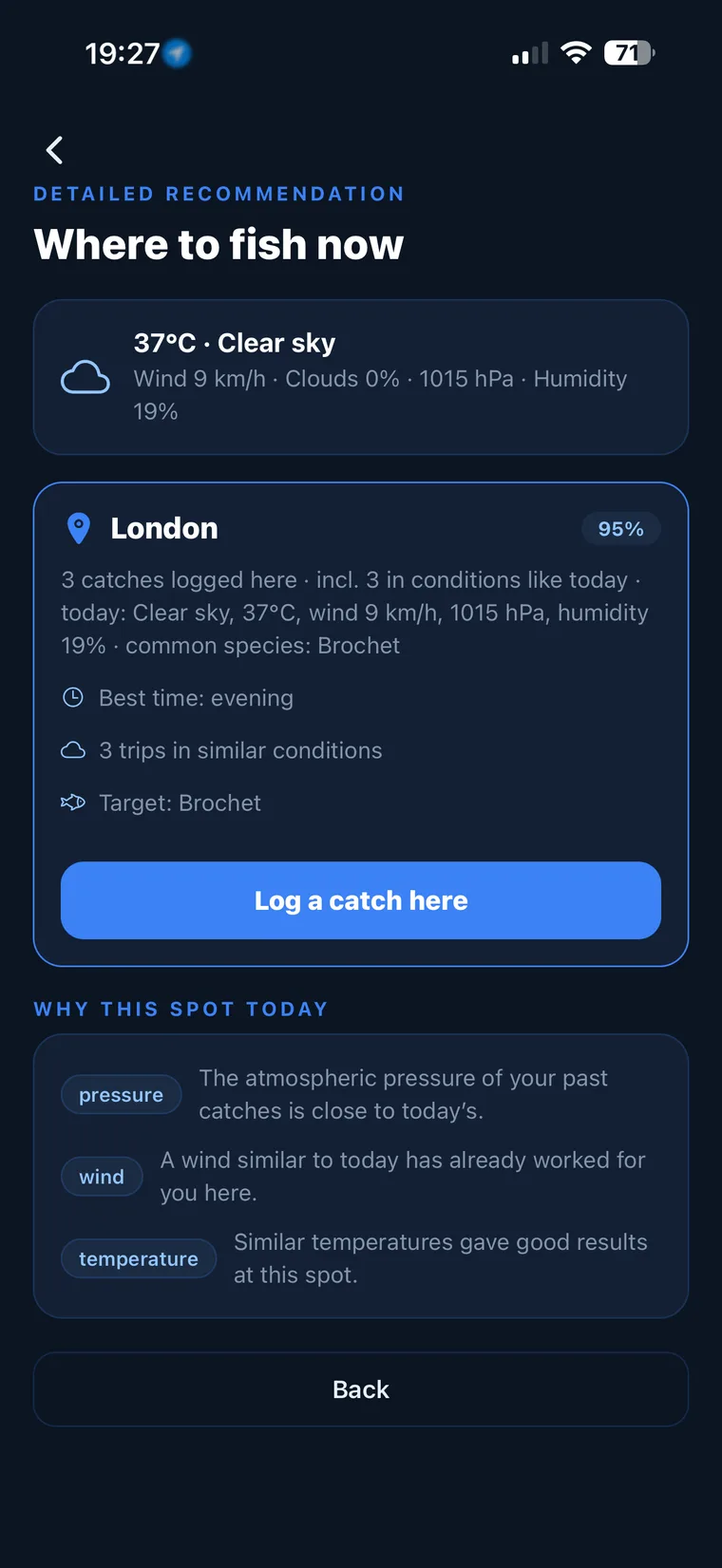
Not sure what to tie on?
Photograph your spot: CarnaFish reads the scene, cross-checks the conditions and gives you the zone, the lure and the retrieve. Free on iOS and Android.
Where it is no use at all
- On flat water with no surface activity. A popper does not "search out" bass sitting on the bottom: it exploits fish that are already high in the column.
- At night. Bass at night feed more slowly and closer in; a loud, fast popper is rarely the right tool.
- In winter. In cold water the surface empties out. Go back down the column.
- On educated fish in very clear, calm water, typically a sheltered bay in high summer: there a discreet topwater lure takes over.
Prey Popper or small sinking pencil
The Bassday Sugapen sits at the other end of saltwater surface fishing: small, sinking, discreet, it works in fine glides on wary fish, in calm and often shallow water. It excels exactly where the Prey Popper is too brutal.
The practical difference is simple. The Sugapen convinces a fish that is hesitating; the Prey Popper calls a fish in an environment saturated with signals. If you are fishing a flat bay at first light, take the Sugapen. If birds are dropping forty metres out, there is no debate.
The Xorus Patchinko 140 is the third term in the equation: it is a stickbait, it glides sideways instead of spraying, and it covers spread-out frenzies well, where fish follow for a long time before committing. In practice plenty of anglers keep all three and choose by the intensity of the visible activity. And if you are torn between calling loudly and staying discreet as you arrive in front of moving water, CarnaFish analyses a photo of the spot and answers.
Our guide to lure fishing for sea bass goes back over reading birds and currents, which is the step before this one.
Key takeaways
- Cast to the edge of the frenzy or just behind it, never into the middle of the boil.
- A continuous cadence of about two pops a second, with no pause, while the shoal is active.
- Size is chosen on the baitfish you can see, not on the fish you are hoping for.
- Do not strike at the sound: wait to feel the weight, then set the hook sideways.
- Ineffective at night, in winter, and on flat water with no surface activity.
FAQ
Should I cast into the middle of the frenzy?
No, that is the commonest mistake. In the centre of the boil your lure is drowned in a mass of real baitfish. Put it on the edge or just behind the active zone, where the fish patrolling for isolated prey are working.
At what cadence should I work the Prey Popper?
Around two pops a second, steadily, taking up slack continuously. Unlike freshwater poppers, you do not pause while the frenzy is on: a motionless lure in the middle of feeding fish gets ignored.
What size should I take for mackerel?
The small sizes, 7 to 8 cm. A mackerel's mouth is modest and you will convert far more of your bites than with a 10 or 11 cm model, even though good bass will also take the small sizes.
Why are my hits not connecting?
Two main causes. First, striking too early, at the sound rather than at the contact: wait to feel the weight. Second, trebles bent out by previous fights, which need checking after every fish on this kind of fishing.
What is the difference with a small pencil like the Sugapen?
The Sugapen is small, sinking and discreet: it convinces a wary fish in calm water. The Prey Popper calls from a distance in an environment saturated with noise. The two cover opposite situations and both stay in the box.
Does it work outside summer?
Hardly. It depends on surface activity, which becomes much rarer in cold water. As soon as the frenzies disappear, you need to go back down the column with a sinking lure rather than persist on top.
The full sea bass lure guideSeason-by-season strategy: which family of lure, when, and why.Go from theory to fish
CarnaFish reads your spot from a photo and gives you the game plan: zone, lure, retrieve. Free on iOS and Android.