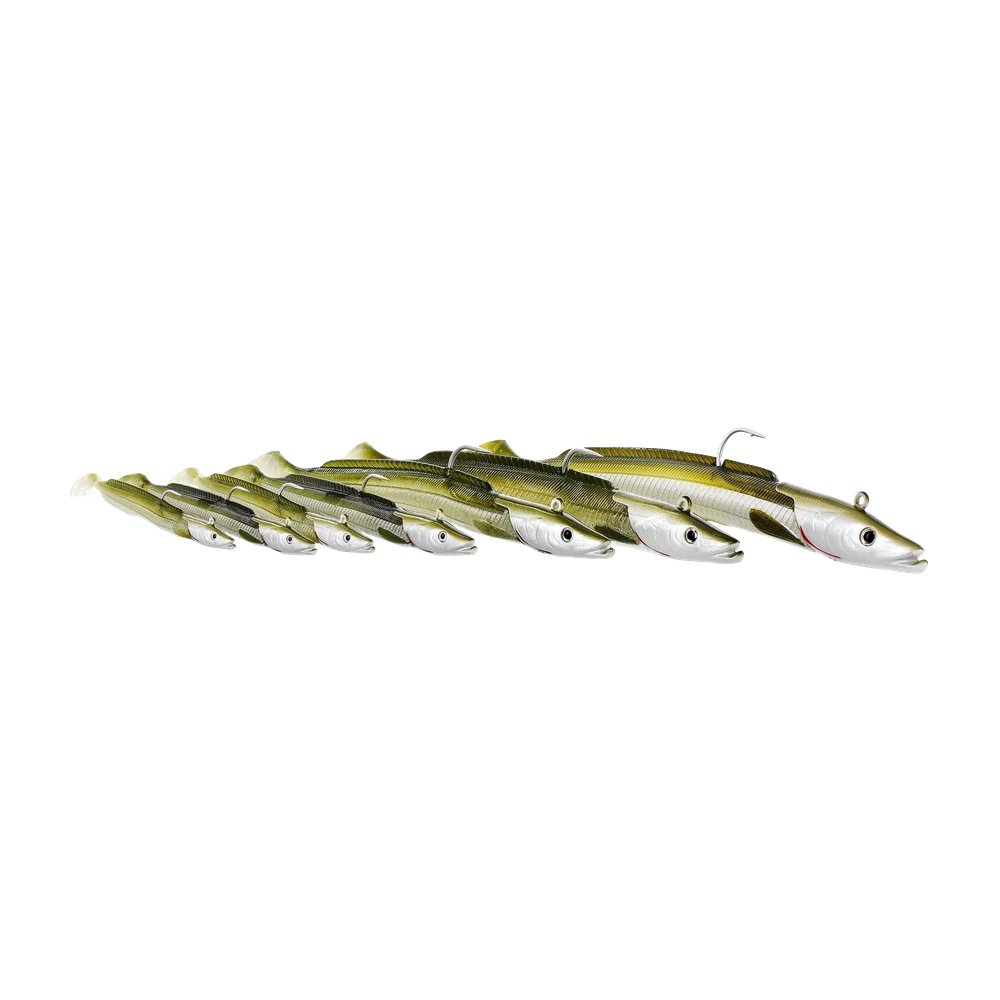
Westin Sandy Andy: the knife-profile jig for working a deep mooring
This lure shines under specific conditions. CarnaFish tells you in 10 seconds if today is one of them.
The Sandy Andy isn't your average sandeel: its knife-thin, sharp-edged profile throws off a much stronger flash on every jerk and a far more pronounced spiral fall than a standard round-bodied sandeel. Ranging from 12 g to over 100 g in the standard line-up, it's one of the few lures that covers a rocky point in 2 metres of water just as well as a deep mooring past 20 metres, without switching lure styles between the two.
What the knife shape actually does
A round-bodied lure swims predictably and evenly. A knife-bladed one catches light differently depending on its angle to the fish: every rod jerk flips it onto its thinnest plane, throwing off a brief, sharp flash that mimics a panicked sandeel suddenly changing direction. That visual signature, more than the swim itself, is what triggers a strike from a cruising bass.
Field rule: on a fish that stays indifferent to a steady swim, a well-jerked knife jig often produces a reaction where a smoother lure only earns a polite follow.
Choosing weight by depth, not by target fish size
This is the most common mistake with this type of lure: assuming weight should scale with the size of fish you're after, when it should actually follow the depth and current of the mark.
- 12-22 g: shallow rocky point or margin, down to 5 metres, weak to moderate current.
- 32-42 g: the most versatile setup, for a drop-off between 5 and 10 metres or stronger current.
- 62-82 g: deep mooring or strong tidal current, past 10 metres, when you need to hold bottom contact without drifting off.
- 122 g and up: vertical fishing from a boat or a high jetty, in significant depths where only a heavy jig reaches bottom quickly.
Two techniques, two types of ground
Vertical jigging, for moorings and steep drop-offs
From a jetty, a high breakwater or a boat, let the lure sink to bottom, then work it with sharp vertical jerks followed by a pause during which the Sandy Andy falls in a spiral — the strike often comes during that fall, with bass tracking the flash before committing as it slows.
Fast straight retrieve, for rocky points
Fishing from shore on a shallow rocky point, a faster, continuous retrieve punctuated with short jerks mimics a sandeel fleeing through open water rather than a sinking one. This approach suits bass already actively feeding near the surface better.
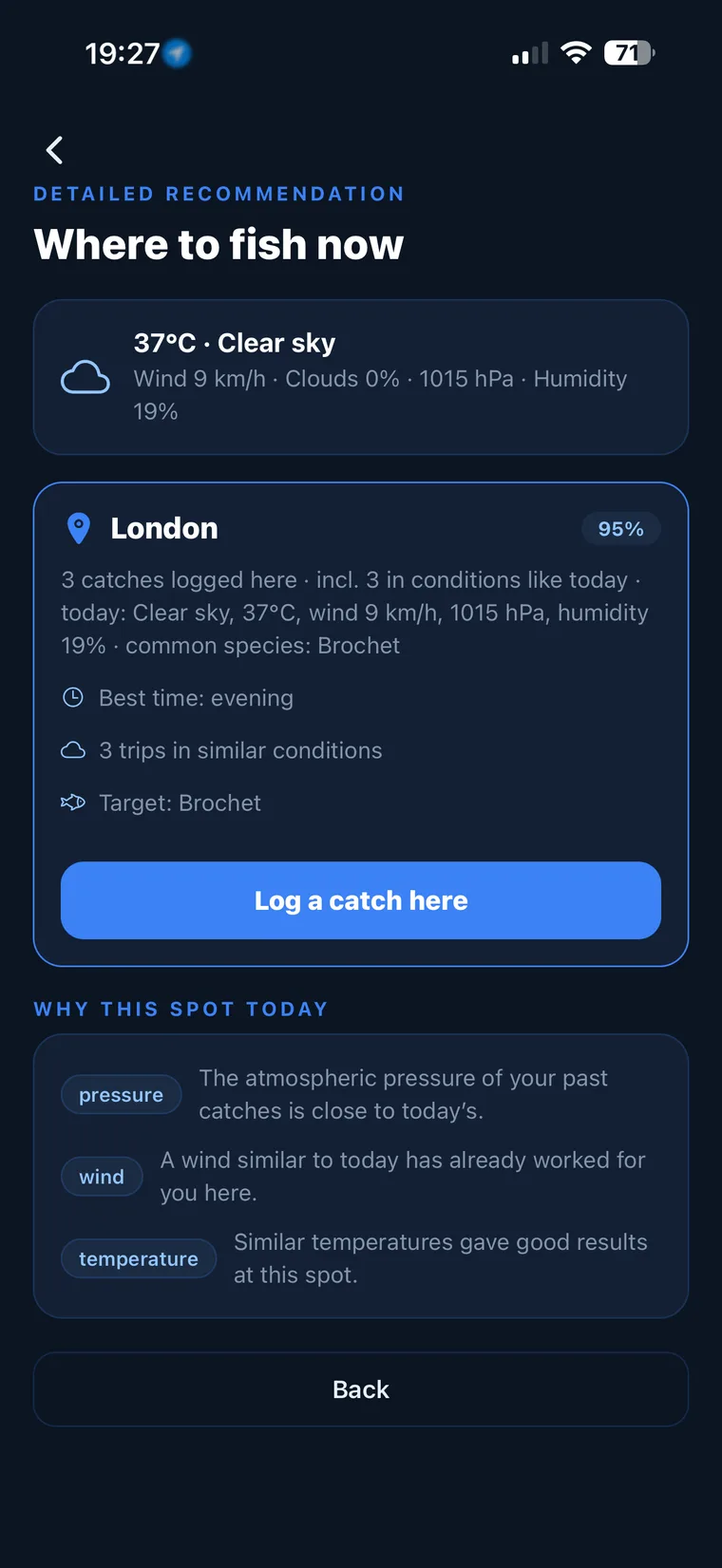
Not sure what to tie on?
Photograph your spot: CarnaFish reads the scene, cross-checks the conditions and gives you the zone, the lure and the retrieve. Free on iOS and Android.
The hook: a detail that matters on big bass
The Sandy Andy comes rigged with sturdy single hooks ranging from #1/0 on the smaller models to #5/0 on the largest. On a mark known for big bass, don't skip checking the hook size that ships with your model — an undersized hook remains the number-one weak point against a fish well above the local average.
Colour by depth and light
- Clear water, shallow: Bleak, a silvery tone that maximises the knife profile's flash.
- Overcast, medium depth: Sardine, a natural compromise that stays effective in changing light.
- Deep water or low light: Black/Red, a high-contrast silhouette that stays identifiable even as natural light fades with depth.
A deep mooring or an exposed rocky point demand real care around safety and reading the tide before committing — our guide to fishing sea bass on lures covers these precautions and which shore marks to prioritise by tidal coefficient. To find out whether today's depth and current call for a heavy jig rather than a light one, CarnaFish reads the tide and current marine conditions from a photo of your spot.
Key takeaways
- The knife profile throws off a stronger flash on every jerk than a round-bodied sandeel.
- Choose weight by the depth of the mark, not by the size of fish you're targeting.
- Vertical jigging with a paused spiral fall for deep moorings, fast retrieve for shallow rocky points.
- Check the hook size shipped with your model on marks known for big bass.
FAQ
What Sandy Andy weight suits a rocky point in 3-4 metres of water?
Between 12 and 22 g is enough in most cases, with weak to moderate current. Size up if the current picks up or you need extra casting distance.
How do I work the Sandy Andy while vertical jigging?
Let it sink to bottom, then work sharp vertical jerks followed by a pause: the strike very often comes during the spiral fall that follows each jerk.
Is the Sandy Andy a shore lure or strictly a boat lure?
Both, depending on the weight chosen. The lighter 12-42 g models fish very well from shore on a rocky point, while the heavier versions are mainly for vertical jigging from a jetty or boat.
Why isn't my knife profile flashing enough?
Check the sharpness of your jerks: a soft, weak movement doesn't flip the lure onto its thinnest plane, which limits the flash effect you're after.
What hook size for big bass?
Favour models rigged with at least a #3/0 or #4/0 hook on a mark known for big fish, rather than a small model with an undersized #1/0 hook for that class of fish.
What colour works in deep water?
Black/Red, a high-contrast tone that stays clearly identifiable even as natural light fades sharply with depth, unlike a pale tone that washes out.
The full sea bass lure guideSeason-by-season strategy: which family of lure, when, and why.Go from theory to fish
CarnaFish reads your spot from a photo and gives you the game plan: zone, lure, retrieve. Free on iOS and Android.