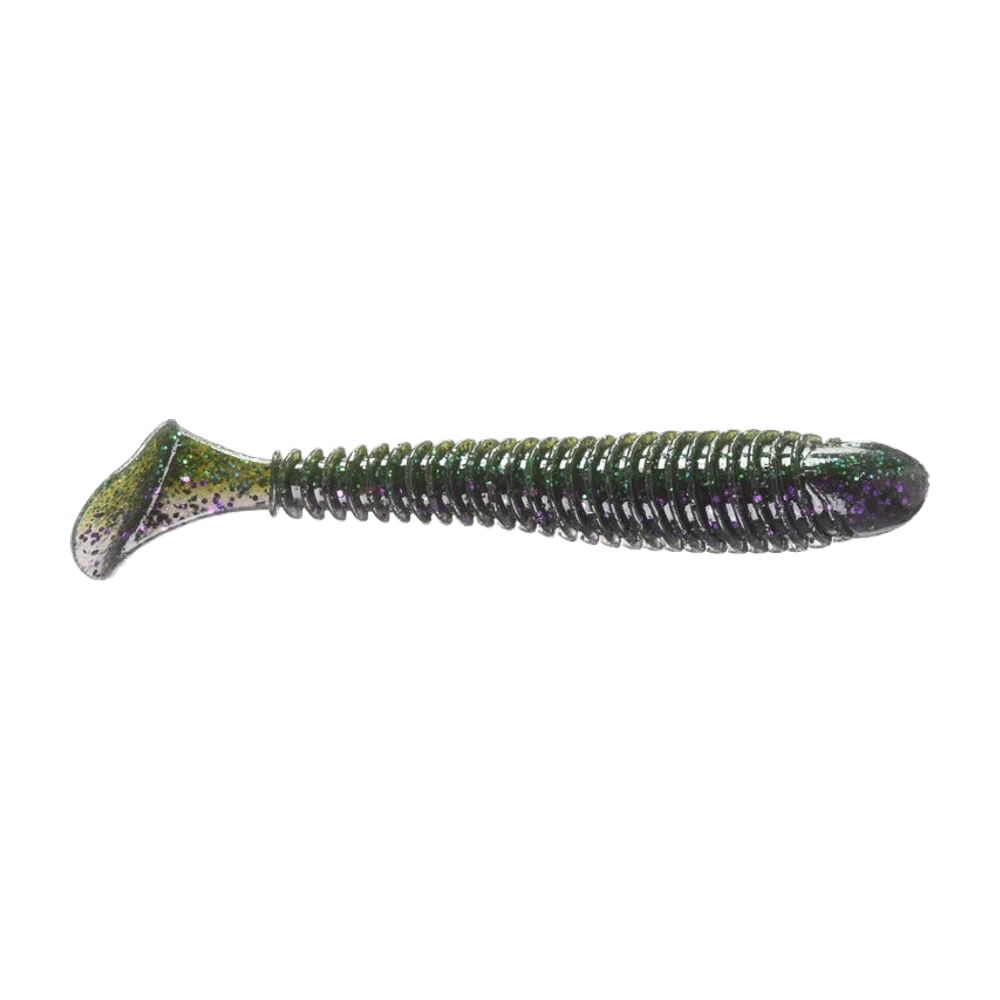
Googan Saucy Swimmer: the ribbed paddle tail that rigs three ways
Rather not fish it blind? Photograph your spot — CarnaFish cross-checks the conditions and points you the right way.
There are two families of paddle tail swimbaits. The ones with a smooth body, which stake everything on the tail, and the ones with a ribbed or ringed body, which add a second signal to the first. Googan's Saucy Swimmer sits squarely in the second camp: its ribs are deep, tight, and run from the collar to the base of the tail. That is not a styling decision, and it changes how you fish the bait.
What the ribs actually do
Googan describes a ribbed body paired with a tail shaped to produce both a shake and a wobble. The mechanics are familiar to soft-plastic makers: a smooth body slips through the water, a ribbed one grips it. Every ridge creates a micro-turbulence, and the sum of those turbulences turns the tail's kick into a vibration spread along the whole bait.
Two concrete consequences. First, the bait "starts" at a lower speed: you do not have to wind faster to feel something in the rod. Second, it displaces more water than a smooth shad of the same size, which makes it more interesting in stained water, where fish locate with the lateral line long before they see anything.
The downside is just as real: a body that grips water spins more easily if you rig it crooked. A Saucy Swimmer hooked slightly off-axis will be rolling on itself within ten metres. Take the time to lay the bait against the shank, mark where the point should exit, and push the hook through straight.
Four sizes, and a table you have to read properly
The manufacturer publishes four lengths: 2.8 in (7.1 cm), 3.3 in (8.4 cm), 3.8 in (9.7 cm) and 4.8 in (12.2 cm).
Watch the second number in that table, because it is a classic trap. The column after the lengths is headed Quantity: the 9, 8, 7 and 6 listed there are bait counts per pack, not weights. The bigger the swimbait, the fewer come in the bag, which is standard practice in American soft plastics. Read the table too fast and you might conclude the 4.8 in weighs 6 g: it does not.
Because that is the genuine gap in this description: no weight is published for any size. No per-bait gramme figure, no density indication. That has a very practical consequence when you pick a jighead: you cannot work out the bait-plus-head total in advance. Weigh one on a kitchen scale the first time, or choose your head by the depth you need to reach rather than by a theoretical calculation.
On use, the 7.1 cm is a perch and wary-bass size, the 8.4 and 9.7 cm cover most situations, and the 12.2 cm becomes a genuine searching swimbait for bigger fish.
Three rigs, three ways of fishing
Weightless swimbait hook
A wide-gap hook with a small keeper coil, no weight at all. The bait then swims just under the surface, very slowly, and travels over weed beds instead of into them. This is the rig to pull out in summer along vegetation edges, when fish are high in the column and refuse anything that drops fast.
Jighead
The baseline rig and the most versatile. A round or bullet head for a steady swim, a flatter head for a bait that slides better over hard bottom. The principle to hold on to: take the lightest weight that still keeps you in contact with the bottom. Too heavy, and the shad sinks faster than it swims, so the tail stops working on the fall.
As a trailer
Googan also presents the Saucy Swimmer as a bait to pair with others. Run as a trailer behind a spinnerbait or a bladed jig, it adds bulk, lift and an extra vibration. That is often what turns a spinnerbait from a bait that attracts into a bait that triggers.
When you use it as a trailer, cut a short length off the nose rather than threading the whole bait on. You keep the profile and the tail, you shorten the total package, and you avoid the short strikes on the tail that spoil half the bites on a spinnerbait that has grown too long.
Finding the right speed
A ribbed swimbait forgives a lot, but it still has a window where it is at its best. Always start at the slowest speed where you can feel the tail thumping in the rod tip. Below that the bait is dead. Just above it you are in the right place: the beat is steady and the body vibrates without starting to spin.
The most productive retrieve is not a pure straight wind but what some call a breathing retrieve: ten turns of the handle, a one-second stop, ten more turns. During the stop the shad falls away and glides, and that is very often when the bite comes — exactly as on a Keitech Easy Shiner 3 or any other paddle tail of this size.
The classic mistake
Oversizing the jighead to get down fast. This is the error that comes up most with wide-tailed swimbaits. Too heavy a head crushes the swim: the bait dives without giving the tail time to beat, and you lose the entire fall phase, which often accounts for half the bites in a day. If you absolutely must get down fast in current, change bait size rather than adding lead.
A second frequent mistake: keeping a swimbait that has torn at the collar. A body that has slid down the shank loses its alignment, and a misaligned shad spins. Push it back into place or replace it; a drop of soft-plastic glue will keep a well-aligned bait going much longer.
Not sure what to tie on?
Photograph your spot: CarnaFish reads the scene, cross-checks the conditions and gives you the zone, the lure and the retrieve. Free on iOS and Android.
Colour by water
- Lightly stained water: the olive green with purple and gold flake in the photo, natural enough while still throwing light back as the bait rolls.
- Clear water over baitfish: a pearl white, the closest thing to a small baitfish and the least likely to raise suspicion.
- Dirty water: a chartreuse with a dark back, where the contrast between back and belly matters more than the colour itself.
Where it sits in a soft-plastic box
The Saucy Swimmer is a general-purpose paddle tail, and that is exactly what is asked of it. Against a Keitech Easy Shiner 3, it plays the body-vibration card rather than the subtle-swim one. Against a Strike King Rage Swimmer it covers the same ground with a more pronounced body. And when you need serious bulk to go after a single big fish, a Megabass Magdraft takes over in a completely different register.
In Europe, the 8.4 and 9.7 cm sizes on a jighead are also a very solid base for perch and zander, well beyond the bass Googan designed it for.
Picking the right size and weight matters, but recognising the right zone matters more. That is what CarnaFish does: a photo of the spot, and the app suggests the zone and the presentation that fit the day's conditions. To go further on the perch side, our guide to perch fishing with lures details the rigs that go with it.
Key takeaways
- The deeply ribbed body adds a lateral shake on top of the tail kick: the bait works from slow speeds up.
- Four published sizes, 7.1 to 12.2 cm. The second figure in the table is a pack count, not a weight.
- No weight is published by the maker: choose your jighead by target depth, not by a theoretical sum.
- Rig it straight and check the alignment: a ribbed body spins far sooner than a smooth one when it is off-axis.
FAQ
How much does a Saucy Swimmer weigh?
The manufacturer does not publish it. Its table gives only lengths and the number of baits per pack. If you need the exact weight to work out a rig, put one on a kitchen scale — more reliable than a figure picked up at random on a forum.
Which size should a beginner choose?
The 3.3 in, 8.4 cm. It is the size that covers the most situations: small enough for perch or a wary bass, bulky enough to interest a good fish. Keep the 2.8 in for tough days and the 4.8 in for searching for bigger fish.
What jighead weight should I use?
The lightest one that still keeps you in contact with the bottom, or that reaches the depth the fish are holding at. Too heavy a head crushes the swim: the shad sinks faster than it swims and the tail stops beating on the fall, which is where a lot of bites happen.
Why does my swimbait spin?
Because it is rigged crooked. A ribbed body grips a lot of water, so it amplifies the slightest misalignment. Lay the bait along the shank, mark the exact exit point with your thumb, and push the hook through dead straight.
Can it be used as a trailer?
Yes, and the maker promotes that use. Behind a spinnerbait or a bladed jig it adds bulk and an extra vibration. Trim one or two centimetres off the nose to avoid making the package excessively long and multiplying short strikes.
Does it float or sink unrigged?
The maker publishes no density or class information for this bait, so it cannot be stated here. In practice it hardly matters: the Saucy Swimmer is made to go on a hook or a jighead, and it is that hardware which decides how it behaves in the column.
The full bass lure guideSeason-by-season strategy: which family of lure, when, and why.Go from theory to fish
CarnaFish reads your spot from a photo and gives you the game plan: zone, lure, retrieve. Free on iOS and Android.