X Zone Whiplash Shad: the soft jerkbait with a whipping tail
One lure, endless conditions. CarnaFish reads your spot from a photo so you are not just guessing.
A reed edge in late summer, small baitfish breaking the surface in packs, and bass that refuse every hard bait you throw. That is soft jerkbait territory: nothing falls as slowly, nothing darts as unpredictably, nothing lands as quietly. The X Zone Lures Whiplash Shad pushes the idea further than most thanks to a tail far longer than the norm.
A tail that whips rather than kicks
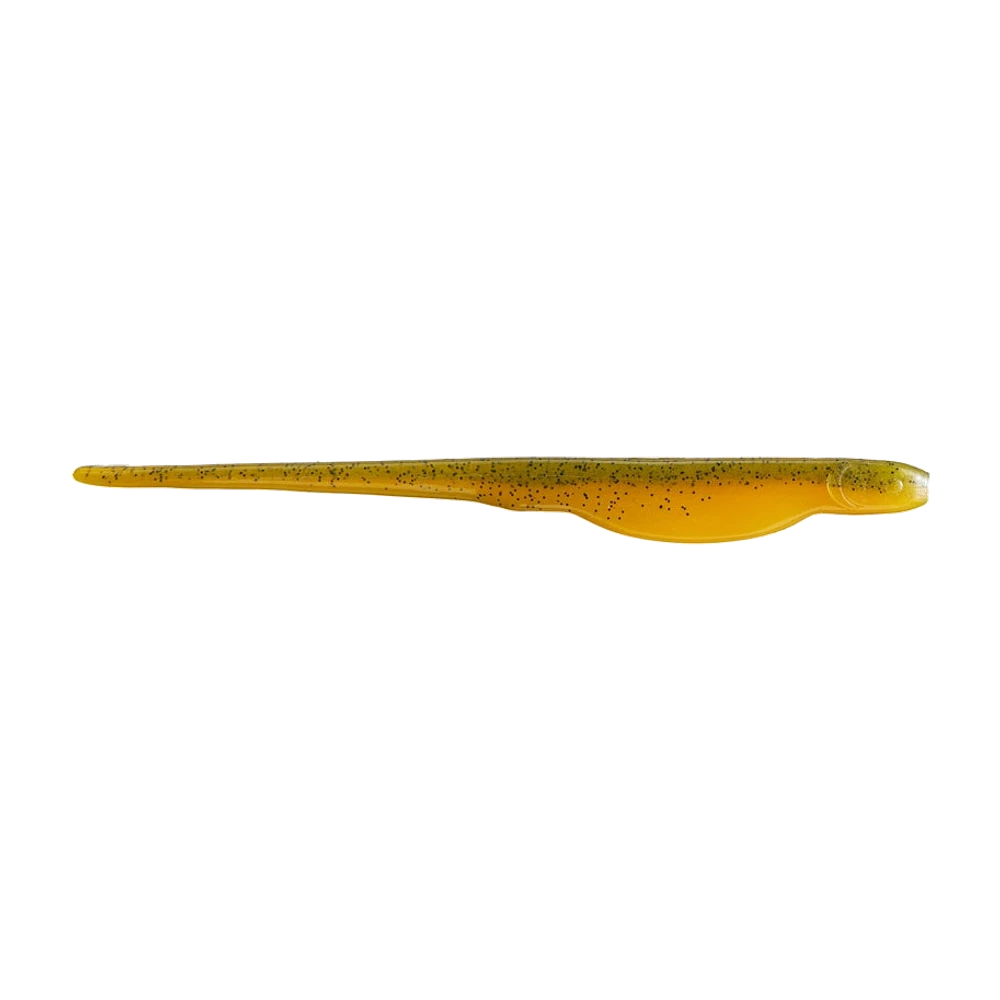
Look at the bare bait: the working body sits in the first two inches, with a small belly keel under the head, then the silhouette stretches into a thread-thin appendage that makes up more than half the total length. That tail has no paddle, no spoon, nothing that creates a programmed swimming action. It is simply long, fine and limp, and that is exactly what makes it valuable.
On the jerk, the inertia of that tail delays the movement: the body shoots sideways, the tail follows a beat later and then whips back the other way. The bait does not glide neatly from side to side like a surface walker, it breaks into disordered darts, exactly like a panicking baitfish. X Zone describes it as built to dart and dive like an injured baitfish, and the phrasing is fair: the escape axis changes on every pull.
The second register is more interesting still. Let the line go completely slack and the bait drops flat while the tail keeps quivering on its own, with no tension on the line at all. That is the mode that makes the difference on a lethargic fish, in cold water or through the heat of the afternoon: you do nothing, the bait keeps working.
The bite almost always comes during the pause and almost never on the jerk. Watch the line rather than the lure: a sideways move, or a line that suddenly tightens when it should stay slack, is a fish. Striking on the sound or the flash means striking too late.
The rig changes everything
Weightless, the reference setting
X Zone is explicit about this: weightless on a wide gap EWG hook is where the Whiplash Shad gives its most erratic and most natural action. No bullet, no head: the bait falls horizontally at the pace of its own density and the tail stays free of any parasitic movement. Use a 3/0 to 5/0 hook depending on body thickness, point tucked under the skin of the back, and check that the bait sits perfectly straight on the shank. A crooked rig will twist your line in two casts.
The downside is well known: a 6 in soft plastic with no weight casts badly into the wind. Thin braid, a slightly longer rod and a loaded cast rather than a lob, otherwise you will work hard for thirty metres.
Light Texas rig when you need depth
A 1 to 3.5 g (1/16 to 1/8 oz) bullet above the knot lets you reach two to four metres without killing the tail quiver. That is the setting for tracing a break line or skipping under a dock. Go heavier and the bait loses its gliding quality and becomes an ordinary swimbait.
Small jig head
Possible, and occasionally useful to cover a deep edge quickly, but it is the rig that exploits the bait least: the head constrains the body axis and the tail whips less freely. Keep it for situations where you have no choice.
The classic mistake
Over-working it. Plenty of anglers chain jerks together without letting the bait breathe, out of fear of doing nothing. With this kind of soft jerkbait the winning sequence has three beats: two or three short sharp pulls, then three to five seconds of fully slack line. It feels long until you get used to it. It is also where the bites come from.
Where it produces, and where it does not
The Whiplash Shad is a high-column, sighted-fish lure. It shines over submerged grass, along cluttered banks, around laydowns, and on visible feeding activity where you need to land quietly a few metres from the fish without making a wave. For pike, the 6 in size fished weightless near the surface works well in clear water, provided you use a bite-resistant leader and accept a higher miss rate than with a treble-armed bait.
It is the wrong choice as soon as you need depth, speed or current holding: it has neither the density nor the stability. To cover a large area at a fixed depth, a paddle tail such as the X Zone Swammer will do the job far more efficiently.
Not sure what to tie on?
Photograph your spot: CarnaFish reads the scene, cross-checks the conditions and gives you the zone, the lure and the retrieve. Free on iOS and Android.
Colours by water and forage
- Clear water, discreet forage: the flaked translucent amber of the bait photographed here, a tone that lets light through and resembles nothing in particular — often an advantage.
- Silver forage, roach or bleak: a pearl white with a pale back, which reproduces the flash of a baitfish flank under the surface.
- Low light, stained water: a dark solid tone, deep green pumpkin or black. Seen against the sky from below, only the silhouette counts.
A complement to the hard jerkbait, not a replacement
Against a suspending hard jerkbait, the Whiplash Shad loses on casting distance, searching speed and current holding. It wins on three points: it enters the water silently, it falls infinitely slower, and it goes into cover where a bait with two trebles would hang up. Those are three precise situations, not a general superiority. Anglers who recognise them keep both in the box.
Recognising those situations on the water is exactly what CarnaFish helps with: a photo of the spot, and the AI suggests a zone, a depth and a presentation that match the moment. To build the basics on bass, our guide to getting started with bass fishing covers spots and tackle from the ground up.
Key takeaways
- The thread-thin tail makes up more than half the bait: it whips on the jerk and quivers on its own during the fall.
- The reference rig is weightless on a wide gap hook — every gram you add cuts into the action.
- Bites come almost entirely during the slack-line pause, not on the pull.
- A poor choice as soon as you need to fish deep, fast or in current.
FAQ
Does the Whiplash Shad really have to be fished weightless?
Weightless gives the most erratic action, and the manufacturer says so. A lightly weighted Texas rig stays useful to reach two or three metres, but every gram you add stabilises the bait and reduces the tail quiver.
Which hook size for a 6 in bait?
A 3/0 to 5/0 wide gap hook, depending on body thickness where the point exits. Too small and you miss hooksets; too big and you stiffen the front section and kill the dart.
How long should the pause be?
Three to five seconds on fully slack line, which feels very long at first. In cold water or on lethargic fish you can stretch to eight seconds and the bait will still be working.
Is it suitable for pike?
Yes in clear water and near the surface, with a bite-resistant leader. Expect more missed fish than with a treble-armed lure: a weightless soft bait only gives you one hook point.
Why does my line twist after a few casts?
The bait is not straight on the shank. A slender soft plastic rigged off-centre spins as it falls and passes that twist up the braid. Unrig, repin it perfectly in line, and the problem disappears.
How many fish does one bait last?
Three to five on average, fewer if the fish are big or you are fishing wood. A seven-pack goes quickly, and that is the real running cost of a slender weightless soft bait.
The full bass lure guideSeason-by-season strategy: which family of lure, when, and why.Go from theory to fish
CarnaFish reads your spot from a photo and gives you the game plan: zone, lure, retrieve. Free on iOS and Android.