Big Bite Baits B2 Worm: the ribbed worm with a long curly tail
Rather not fish it blind? Photograph your spot — CarnaFish cross-checks the conditions and points you the right way.
A break in four metres of water, a gravel bottom, and bass sitting on it that refuse anything moving fast. This is the worm's historic ground: a bait you move twenty centimetres, let settle, and then forget about for thirty seconds. Big Bite Baits' B2 belongs to that family, but with a tail that works where a straight-tail worm does nothing at all.
A slim body and a tail that changes everything
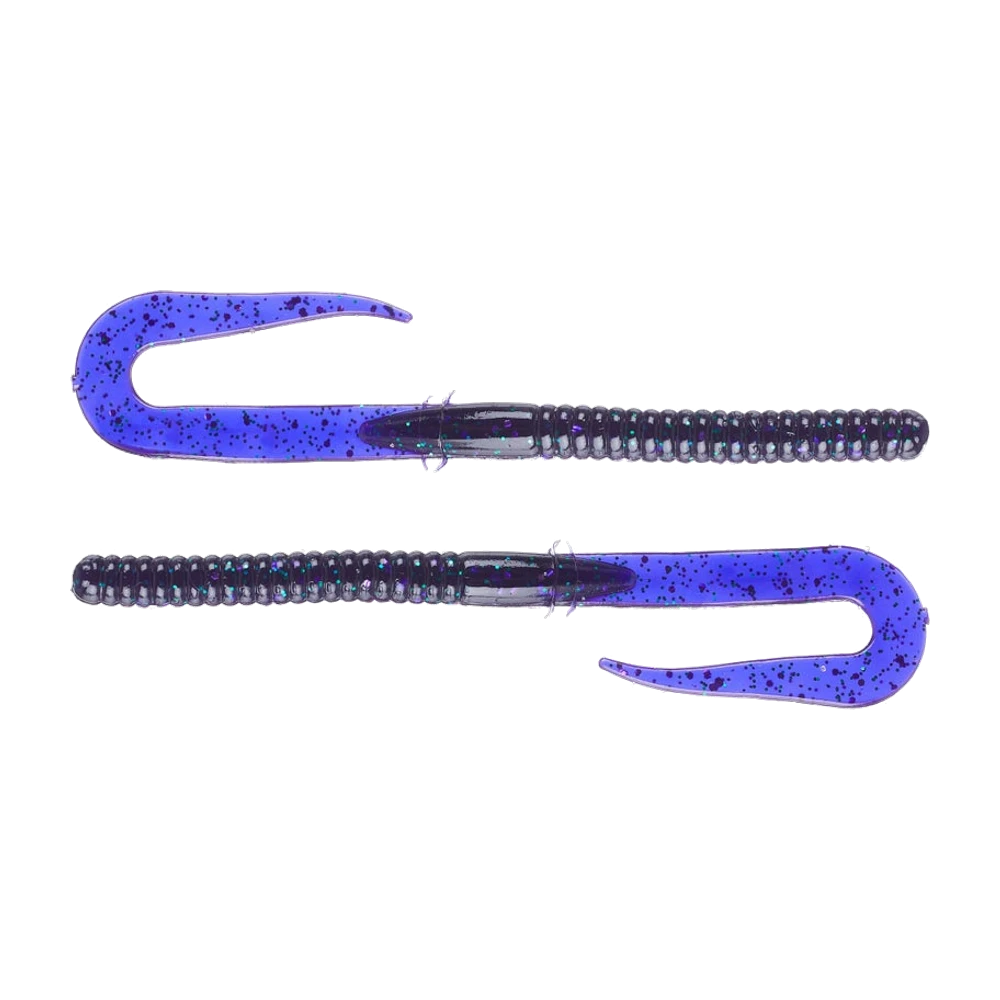
The B2 comes in 17.8 cm / 7 in (twelve to a pack) and 25.4 cm / 10 in (eight to a pack). In both sizes the body is deliberately slim — slimmer than a bulky worm such as a Berkley PowerBait Power Worm — and the front half is ribbed, moulded as a series of rings. In the photo you can clearly see the line between the smooth head, where the hook goes, and the ribbed section starting just behind it.
Those ribs are not decoration. They increase the surface in contact with the water and create a micro-turbulence that slows the fall, exactly as the grooves of a senko do but on a far longer profile. They also give something to hold on to for fish that nip the bait from behind without taking it, which matters when bites are soft.
The real difference is at the back. Instead of a straight tail, the B2 carries a long flat tail curled into a hook shape that takes up almost a third of the total length. A few centimetres of movement are enough to set it rippling and vibrating. That is precisely what a straight worm like the Zoom Trick Worm will not do, since it needs deliberate rod work to come alive.
When dragging along the bottom, do not watch your rod, watch your line. A worm with a long curved tail passes very little vibration into the tip, and many bites show up only as line moving sideways or going slack for no reason.
The two rigs that suit it
Texas rig
This is the default rig, and the one that lets the B2 go into cover. A 4/0 wide gap hook for the 7 in, 5/0 to 6/0 for the 10 in, with a 5 to 14 g bullet weight depending on depth and wind. With the point tucked into the body, the bait travels through branches and sparse weed without hanging up.
Peg the weight against the head with a bead or a stop and you get a compact package that drops straight and slips through cover better. Leave the weight free to slide and the worm lifts off the bottom on every pause, giving the tail an extra beat. Both work; the sliding version is slower, and therefore often better on passive fish.
Carolina rig
Over a deep flat or a long break, the Carolina rig separates the weight from the bait with a 50 to 90 cm fluorocarbon leader. The weight drags on the bottom, raises a cloud of sediment, and the worm follows behind, free in the water just above the substrate. That is the rig that makes best use of the B2's long tail: it kicks continuously throughout the drag, with nothing required from you.
On a Carolina rig the 10 in version earns its place. Over a large uniform area a big profile is spotted from further away, and the average size of the fish goes up.
The classic mistake
Setting the hook too far back, into the ribbed section. The body is slim, and the point then exits among the rings, which stiffens the whole front end and kills the tail's beat. The hook has to stay in the smooth head, within the first two or three centimetres.
Drag, hop, or swim
Three retrieves cover everything this bait can do.
The drag is the slowest: rod low, you move the bait twenty to thirty centimetres along the bottom, then wait. That is the summer register on hard bottom, when the fish are settled and barely moving.
The hop means lifting the bait forty to sixty centimetres with the rod and letting it fall back on a tight line. The tail kicks on the way up and still vibrates on the way down. It is the retrieve to favour on a pronounced break or at the foot of a vertical obstacle.
The steady retrieve is less obvious, but the maker claims it and it works: in open water a worm swum slowly through the middle layers behaves like a small snake, and takes fish that will not come down to the bottom. Keep the speed constant and let the tail do the rest.
Not sure what to tie on?
Photograph your spot: CarnaFish reads the scene, cross-checks the conditions and gives you the zone, the lure and the retrieve. Free on iOS and Android.
Colours by water
- Stained water: the flaked junebug purple of the photo, with its mauve and green flake. It is the historic bass worm colour, and it stays readable when visibility drops.
- Clear water: green pumpkin, closer to a crayfish or a leech on a gravel bottom.
- Low light, dark water: black and blue, a clean silhouette that does not rely on colour.
With a bottom bait, choosing the spot matters far more than the colour. That is exactly what CarnaFish is for: a photo of the spot, and the AI suggests the zone, the depth and the lure family suited to the day's conditions. For the rest of the reasoning, our guide to getting started with bass fishing covers reading the water and the basic tackle.
What to remember
- Two sizes, 17.8 and 25.4 cm: the big one is not a gimmick, it earns its place mainly on a Carolina rig over large flats.
- The ribbed section slows the fall and gives something to grip; the long curved tail works on the smallest movement.
- Texas rig for cover, Carolina rig for deep uniform ground.
- Big Bite Baits publishes no weight for this bait: the rig's lead is what determines the whole behaviour.
FAQ
Which B2 Worm size should I choose?
The 7 in covers most situations and stays easy to hook up. The 10 in comes in when you want a bigger average fish, typically on a Carolina rig over a large deep flat or in summer on bass feeding on sizeable prey.
What hook for a Texas rig?
A 4/0 wide gap hook for the 7 in, 5/0 to 6/0 for the 10 in. Put it through the smooth part of the head, never into the ribbed section: otherwise you stiffen the front of the bait and choke the tail.
How much does the B2 Worm weigh?
Big Bite Baits publishes no weight for this model, only lengths and pack counts — twelve pieces in 7 in, eight in 10 in. In any case it is the rig's lead that sets the fall rate and the depth.
Do I need a fluorocarbon leader?
On a Texas rig, 25 to 35 lb fluorocarbon tied straight through is enough and transmits well. On a Carolina rig, the 50 to 90 cm fluorocarbon leader is part of the rig and exists to keep the bait away from the weight.
Can this worm be fished on a steady retrieve?
Yes, in open water at a constant speed. The long curved tail ripples on its own and the bait behaves like a small swimming snake. It is a good option when the fish are up off the bottom and refusing a bait sitting still.
How does it differ from a straight-tail worm?
A straight worm like the Zoom Trick Worm does almost nothing without input: bringing it alive is your job. The B2, thanks to its curled tail, vibrates as soon as the bait moves a few centimetres, which makes it more effective on a very slow drag and more visible in stained water. For a profile in between, the Culprit Original Worm remains the historic reference of the category.
The full bass lure guideSeason-by-season strategy: which family of lure, when, and why.Go from theory to fish
CarnaFish reads your spot from a photo and gives you the game plan: zone, lure, retrieve. Free on iOS and Android.