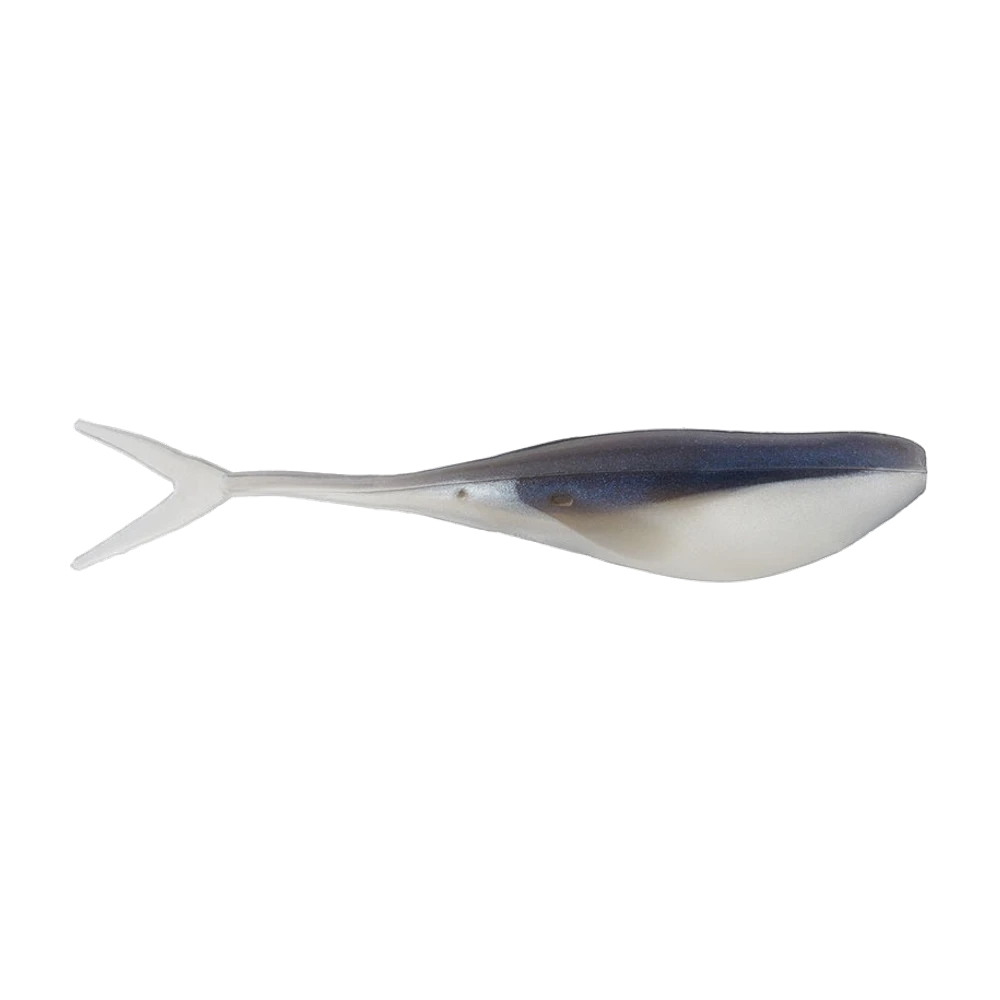
Lunker City Fin-S Shad: a shad body grafted onto a fluke tail
Not sure this lure fits YOUR spot today? CarnaFish tells you in 10 seconds, from a photo.
A school of fry blowing up on the surface, fish cutting into it from below, and you getting nowhere with a paddle-tail shad: that steady paddle swim is exactly what those fish are not looking for. What they hit is the one individual breaking sideways, the one that has lost its line. The Fin-S Shad is built to reproduce that, and its odd shape — a stocky body sitting on a thread-thin tail — exists for no other reason.
Two baits in a single piece of plastic
Lunker City calls the Fin-S Shad a soft plastic jerkbait, not a swimbait, and the silhouette shows why. The front end is a genuine shad body: wide, flattened on the flanks, with a sharp dorsal ridge and real volume below the lateral line. The back end drops abruptly to a slim stem finished with a forked V.
That change of section does all the work. On every stroke the mass is up front and the tail offers no resistance to stabilise the path, so the bait pivots around that weak point and shoots sideways, never twice to the same side. A conventional paddle-tail does the opposite, resettling itself on every turn of the handle. It is the difference between a fish that swims and a fish that flees.
The trade-off is worth stating plainly: on a straight retrieve the Fin-S Shad produces almost nothing. No vibration, no thump you can feel in the blank. If you want a bait that works on its own while you wind, look at a Keitech Shad Impact 3 instead. Here the action comes from your rod and from nowhere else.
Three sizes, and what the table actually says
The maker publishes three lengths, each paired with the number of baits per bag — not a weight, not a hook size. Read it that way or you will get it badly wrong:
- 1.75 in / 4.4 cm, 20 per bag. The perch size, and the only one that makes sense on fish keyed into this year's fry. Twenty in a bag, for a bait that tears after a few fish, is the right arithmetic.
- 3.25 in / 8.3 cm, 10 per bag. The middle size, for average bass and for sea bass along the edges. If you only buy one, buy this one.
- 5 in / 12.7 cm, 5 per bag. The big-fish size, and the one for water where the forage is already full-grown.
Lunker City publishes no weight and no buoyancy rating for this bait: neither floating nor sinking appears anywhere in the spec sheet. So do not buy the Fin-S Shad counting on a particular fall behaviour — rig one, drop it into thirty centimetres of water at your feet, and in ten seconds you will know what your bag actually does. That behaviour varies with colour and batch, and no published figure will tell you.
The split belly, the detail that changes hook-ups
Two moulding features explain why this bait rigs better than most. First a split belly: a lengthwise slot that collapses under pressure instead of resisting, so the hook point drives through the body almost effortlessly on the strike. Second a recessed back cavity, a groove where the point sits flush with the back instead of standing proud.
The result is a Texas rig that is genuinely weedless, clearing grass and dead timber without catching, yet without the usual cost of a tucked point. That is the compromise most soft plastics miss: either they go through everything and hook badly, or they hook well and snag on everything.
Weedless Texas
A wide-gap hook, 1/0 to 3/0 depending on the size. In through the nose, out under the body after a centimetre, rotate the hook, back in through the back and bury the point in the groove. With or without a tungsten bullet depending on depth: weightless it stays high and gliding, with 3 to 7 g it tracks down vertical structure.
Weightless, with nothing at all
This is the rig that exploits the change of section best. Cast at a school that is feeding, the Fin-S Shad throws wide, unpredictable darts on every rod stroke, with long glide phases in between. On calm water and active fish, nothing beats it.
Jighead, drop shot, Carolina
The maker lists these three as well, and each has its use. On a light jighead the bait keeps its darts but drops faster; on a drop shot the thin tail quivers at the slightest movement of the line; on a Carolina rig the body glides several metres behind the sinker after every pull.
The mistake to avoid
Working it continuously. The Fin-S Shad needs dead time for its body to settle back to horizontal before the next stroke — without it the darts get shorter and the bait ends up coming straight back at you. Two rod strokes, two seconds of nothing, then start again.
The thing you learn through use: once the Texas rig is in place, check from above that the body sits straight on the shank. A Fin-S Shad rigged two millimetres off-centre will spin on itself from the first stroke and twist your whole leader inside ten minutes. It is the only real flaw of this bait, and it always comes from the rigging.
Not sure what to tie on?
Photograph your spot: CarnaFish reads the scene, cross-checks the conditions and gives you the zone, the lure and the retrieve. Free on iOS and Android.
Colours by water clarity
- Clear water: pearl with a midnight blue back, like the one in the photo. The white belly catches the light coming off the bottom, the dark back supplies the silhouette seen from below.
- Lightly stained water: solid pearl white, which stays readable without ever looking artificial. It is the catch-all colour in this family.
- Dirty water or post-flood: flaked chartreuse, reserved for situations where fish feed on contrast rather than detail.
Where it sits among the other forked soft plastics
The Fin-S Shad fills a precise slot between two known references. It has more volume than a Zoom Super Fluke, so a more convincing silhouette when the forage is deep-bodied, but it stays less slender than a Lunker City Slug-Go, which glides more and drifts further between strokes. Put simply: take the Fin-S Shad when your fish are eating roach or a good-sized bleak, and the Slug-Go when they are eating needlefish or slim baitfish.
Lure choice always comes after reading the spot, which is exactly what CarnaFish is for: one photo of the swim and the AI suggests the zone, the depth and the kind of presentation that match the conditions of the moment. To build a method around this kind of small soft plastic, our guide to perch fishing with lures covers the rigs and the water worth covering first.
Key takeaways
- Shad body up front, thread tail behind: the change of section creates disorderly darts, not a steady swim.
- Three published lengths — 4.4, 8.3 and 12.7 cm — and the second figure in the table is the count per bag, not a weight.
- Split belly plus recessed back groove: a Texas rig that is genuinely weedless without sacrificing hook-up ratio.
- No weight and no buoyancy published: test your own bag at the bank before building a strategy around its fall rate.
FAQ
Which Fin-S Shad size should I start with?
The 3.25 in / 8.3 cm. It is the middle size: big enough for a decent bass or sea bass, discreet enough not to spook fish that have seen plenty of lures. The 4.4 cm is for perch and for fry blow-ups.
Does the Fin-S Shad swim on its own with a straight retrieve?
Barely. The thin forked tail creates neither vibration nor thump: the action comes from rod strokes. That is deliberate, since Lunker City presents it as a soft plastic jerkbait and not as a swimbait.
Is it really weedless on a Texas rig?
Yes, thanks to two moulding features: a split belly that collapses on the strike, and a groove cut into the back where the point sits flush. The combination clears grass without snagging while still hooking properly.
How many baits come in a bag?
Twenty in 1.75 in, ten in 3.25 in, five in 5 in. That is what the right-hand column of the maker's table gives, and it is a quantity, not a weight.
What does a Fin-S Shad weigh?
Lunker City does not publish it: the spec sheet lists lengths and quantities only. If you need an exact weight to calibrate a cast, weigh one from your own bag — that is the only reliable number.
Fin-S Shad or Slug-Go?
Both come from the same maker but imitate different things. The Lunker City Slug-Go is long and slim and glides a long way between strokes; the Fin-S Shad is deep-bodied, imitates a stocky baitfish and works on shorter darts.
The full bass lure guideSeason-by-season strategy: which family of lure, when, and why.Go from theory to fish
CarnaFish reads your spot from a photo and gives you the game plan: zone, lure, retrieve. Free on iOS and Android.