Yum Scutter Bug: the creature bait built to crawl the bottom
The right lure in the wrong spot still catches nothing. CarnaFish spots the zone that works, from a single photo.
Some soft baits are worked, others are simply walked. The Scutter Bug belongs to the second group: drop it on a rock shelf and move it four inches, and its two wide flat legs start beating on their own. The whole design rests on an idea that runs against the current finesse trend — push water and make noise close to the bottom while the angler does almost nothing.
One bait, two names
The Scutter Bug is not new: it is the former Gene Larew Biffle Bug, now carried in the Yum catalogue. That matters, because the bait comes with a specific tournament record attached — Tommy Biffle won the BASS Fort Gibson Elite Series event in 2010 with this design. When an older American fishing story mentions a Biffle Bug, it is talking about exactly what you are holding.
The name change did not alter the recipe. Yum packs features borrowed from several soft bait families into one compact shape: the ribbed body of a tube, the appendages of a creature bait, the beating legs of a craw. It is a deliberate hybrid, and it shows — it looks neither like a realistic crawfish nor like a plain worm with legs tacked on.
Half solid, half hollow
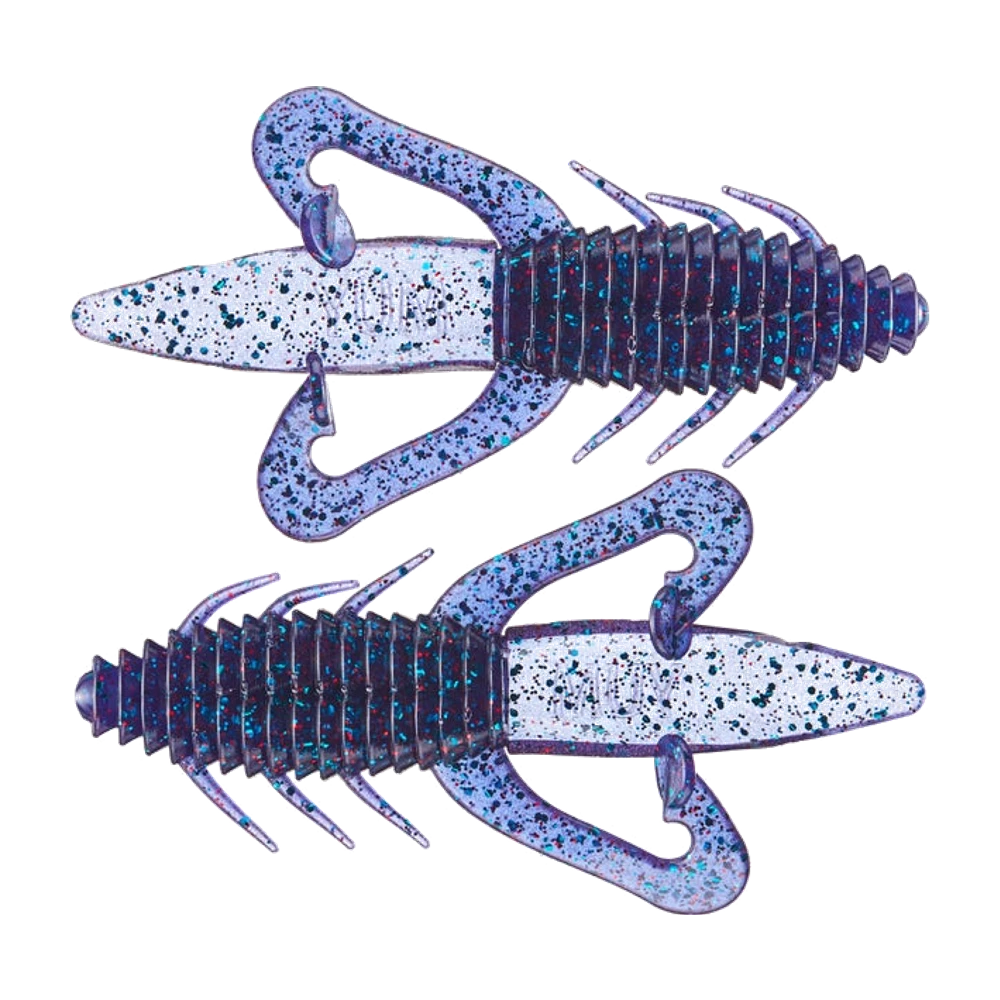
The most important feature of the Scutter Bug is invisible from the outside. The first 3/4 in of the bait — roughly 1.9 cm, the flat lance-shaped front you can see in the photo — is moulded solid. Everything behind it, the ribbed section that tapers towards the rear, is hollow like a tube.
That two-part build has two practical consequences. First, the solid nose takes a hook point without tearing on the first fish: this is where you rig, and it is the area that absorbs every bit of strain. Second, the hollow rear leaves room for the plastic to collapse when a bass closes on it — something anglers underestimate on bulky creature baits, which act like a spring against the jaw and cause missed hooksets.
The rings around the body are not decoration either. A smooth body slides through water without displacing much; a ribbed one grabs water at every edge and sends out a far broader pressure signal. The same logic drives a Berkley Chigger Craw, with a narrower profile here that slips through laydowns more easily.
Paddle legs, and why you sometimes tear them off
The two wide flat legs, each ending in a hooked foot pad, are the centrepiece. They come alive on the smallest movement: no sharp rod stroke needed, a simple slide of the jig head across a slab is enough to set them beating. That is what lets you fish painfully slowly without the bait ever going dead.
Yum openly supports a second use: you can pinch those legs off. The bait becomes more compact, and above all its descent changes. With nothing to brake the rear, the flat body glides sideways instead of dropping straight down. Two baits in one, depending on whether you want bottom signal or a gliding fall under a low branch.
Do not cut the legs first thing in the morning. Always start the day with the bait intact: if the fish are active, the paddles do the searching for you. Switch to the trimmed version only once you have seen that bites come on the fall, or that fish follow without committing.
The rig that made its name
The swinging football head
Yum pairs the bait with its Hardhead Swinging Football Jig Head, a football head whose hook swings freely instead of being moulded into the lead. The result is an action the maker compares to a crankbait: the head tips and bounces off every irregularity, the swinging hook lets the body trail a beat behind, and the legs fire at each knock. You reel steadily and very slowly, without ever pulling with the rod.
The method is disconcerting at first, because it feels more like a crankbait retrieve than soft bait work. Its strength is coverage: you can comb an entire rocky flat without lifting the bait off the bottom, where a standard Texas rig keeps you working one spot.
Fallback rigs
Nothing forces you onto the swinging head. Texas-rigged with a wide gap hook set into the solid nose, the Scutter Bug becomes a sound flipping bait for laydowns and sparse grass: the narrow profile threads between branches and the legs fire the moment it touches cover. It also works as a jig trailer, as long as you accept that the paddles nearly double the finished bulk.
The classic mistake
Working it too hard. The Scutter Bug does not need rod strokes: it reacts to tiny moves, and an aggressive animation only lifts it away from the fish. If you feel like you are doing a lot, slow down further. The second common mistake is hook placement: setting the hook too far back, in the hollow section, wears the plastic out in two or three fish.
Not sure what to tie on?
Photograph your spot: CarnaFish reads the scene, cross-checks the conditions and gives you the zone, the lure and the retrieve. Free on iOS and Android.
Where and when to use it
This is a hard bottom bait: rock shelves, gravel, riprap on dams. Over sand or soft silt the appeal drops sharply because the head digs in and the deflections disappear. It also shines along laydown edges, where its narrow shape hangs up less than a bulkier creature bait such as a Z-Man Hella CrawZ.
Season-wise, the obvious window runs from late spring through autumn, when bass hold tight to the bottom between feeding windows. In cold water it still catches, but you have to drop another gear in speed.
Colours and water clarity
The manufacturer does not publish a named colour list, so it makes more sense to think in families — which is how you pick at the water's edge anyway.
- Stained water: the purple shades with blue and red flake, the family the photographed bait belongs to. It is the long-standing compromise on this kind of bait, dark enough to show a silhouette, bright enough to catch light.
- Clear water over hard bottom: the green pumpkin family, discreet, passing for a crawfish without drawing a wary fish's eye.
- Dark water or low light: the black and blue family, which no longer relies on colour but on a clean outline seen from below.
Lure choice means little without reading the spot: knowing whether you are facing a workable rock shelf or a dead soft bottom changes more than the colour of the plastic. That is what CarnaFish does from a single photo of the swim, suggesting a zone and a presentation for the day's conditions. If you are new to the species, our guide to getting started with bass fishing lays the groundwork before you dig into this level of detail.
Key takeaways
- It is the former Gene Larew Biffle Bug: American fishing stories using that name describe the same bait.
- Solid nose over about 1.9 cm / 3/4 in, hollow tube-like rear: rig in the nose, never in the hollow part.
- The paddle legs fire on the slightest move; pinched off, they turn a vertical drop into a gliding fall.
- A hard bottom and laydown bait, to be walked slowly rather than worked with the rod.
FAQ
How long is the Yum Scutter Bug?
The manufacturer publishes neither an overall length nor a size table: the only dimension given is the 3/4 in (about 1.9 cm) solid front section. It is described as compact, but check the packet rather than trusting an approximation.
Does the Scutter Bug sink or float?
The description gives no density rating, and a soft bait of this kind mostly behaves according to what sits ahead of it. In practice the jig head or Texas weight decides the fall rate, not the plastic.
Do I really have to pinch the legs off?
No, it is an option rather than a step. Intact legs give maximum bottom signal; removing them makes the bait more compact and lets the body glide on the drop. Keep both versions in the box and switch according to what the fish show you.
Which rig should I start with?
The swinging football head is what the bait was designed around, and it makes the most of deflections on hard bottom. If you do not have one, a Texas rig with a wide gap hook in the solid nose is an excellent way in, especially around wood.
Is it worth using for pike or perch?
It is a bass bait, built for slow bottom contact fishing. A good perch may take it as a small jig trailer, but that is not its ground. For pike, a soft bait this size offers nothing a shad or swimbait does not do better.
How does it differ from a standard soft craw?
A classic craw relies on two bulky claws standing up, like the Gary Yamamoto Yama Craw. The Scutter Bug plays a different card: a ribbed body that pushes water and two paddle legs that fire on the smallest move, in a narrower shape that threads through wood more easily.
The full bass lure guideSeason-by-season strategy: which family of lure, when, and why.Go from theory to fish
CarnaFish reads your spot from a photo and gives you the game plan: zone, lure, retrieve. Free on iOS and Android.