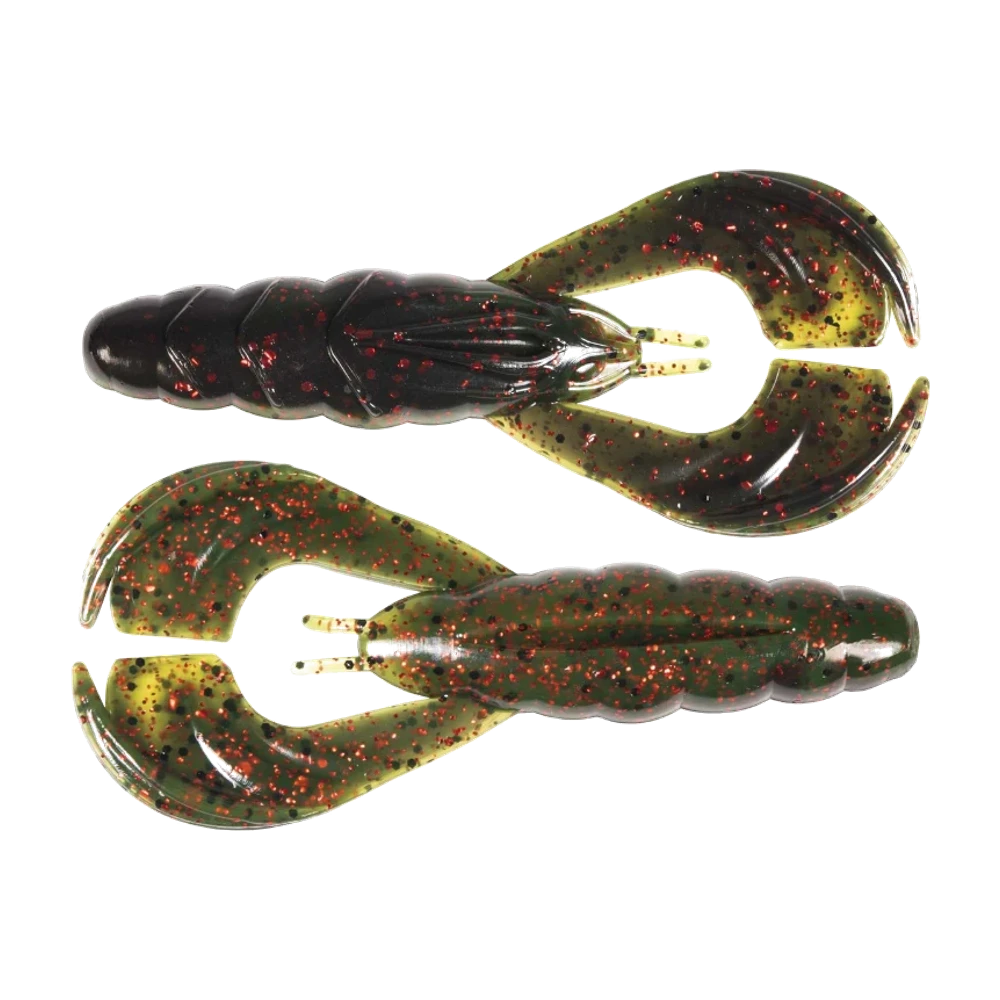
Z-Man Hella CrawZ: the craw that keeps its claws in the air
Before tying this one on, it helps to know if the spot actually calls for it. CarnaFish reads the scene from a photo.
You drop a soft craw on the bottom, let it sit for thirty seconds, and nothing happens. Of course: during those thirty seconds your lure is lying on its side, flattened in the silt, completely inert. A real cornered crawfish never does that. It braces on its back legs, raises its claws and holds them open as long as the threat is there.
That is exactly the posture the Hella CrawZ reproduces on its own, with no input from you. The material it is made of — Z-Man's own ElaZtech — is less dense than water. The result: when the weight hits bottom and you stop everything, the body lies down, but the two big claws rise and stay up in the air.
That is not a cosmetic detail. On a bass sat there watching without committing, it is the difference between a dead piece of plastic and a prey item defending itself.
What ElaZtech changes in practice
Standard plastisol, the stuff nearly every soft plastic is made of, sinks. ElaZtech floats, and it is far more elastic. Three very practical consequences:
- Positive buoyancy in the appendages. Claws, legs and antennae lift as soon as the lure is still. On a weighted Texas rig or as a jig trailer, you get a standing profile instead of a collapsed one.
- Deformation at very low energy. The material moves under nothing more than a bottom current or a micro-movement of the line. You do not need to work it for something on the lure to be alive.
- Unusual tear resistance. A plastisol craw often goes after three or four fish, or as soon as a small perch nips a claw. ElaZtech takes far more, which offsets its higher unit price.
Honest trade-off: this material dislikes prolonged contact with standard plastisol. Stored loose with regular craws, it melts into them. Keep it in its original bag.
The two rigs that exploit the buoyancy
The Hella CrawZ is only worth using if it is rigged so the claws are free to rise. Two configurations cover 90% of situations.
As a jig trailer. That is the most obvious use. You thread the body onto the jig hook, claws facing back, taking care not to squash them against the skirt. Once the head settles on the bottom, the jig tips onto its flat, the skirt flares and the claws go up. A football-head jig is the logical partner: its geometry tips the whole thing the right way up on almost every drop.
On a weighted Texas rig. On a 4/0 wide-gap hook with a 5 to 14 g bullet, you get a slimmer, more compact lure that goes through timber and weed. The rig itself is covered in our Texas rig page — no need to repeat it here. The one point specific to the Hella CrawZ: ElaZtech being very elastic, it tends to slide down the shank over a series of casts. A silicone stopper or a small drop of glue at the eye fixes it for the day.
The retrieve: move little, stop for a long time
- Cast and let it drop on a semi-tight line. Follow the line with your eyes. A good share of the bites come on that first fall, before you have even started fishing.
- Let it sit for eight to fifteen seconds without touching anything. That is the phase where the claws lift and the lure takes up its defensive posture.
- Two small pulls of the rod tip, ten to twenty centimetres each, without taking up line on the reel. The lure hops on the spot, the claws flap then fold back down.
- Another long pause. Take up the slack gently, keeping contact.
- Move it one metre and start again. A single cast should take you several minutes to fish back.
On the water: on a spot you know holds fish, do not move the lure at all during the second pause — just make it shiver in place by tapping the rod tip on a slack line. The claws move, the body stays put. A wary bass will often accept a prey item that thrashes without fleeing, while refusing the same prey item that moves two metres away every time.
Weights and depths
Weight choice dictates everything: too heavy and you kill the feathered fall and pin the claws to the bottom; too light and you lose contact and stop feeling the deck.
| Depth | Texas weight | Jig head | Context |
|---|---|---|---|
| Under 1.5 m | 3.5 to 5 g | 7 g | Margins, sparse weed, calm water |
| 1.5 to 3 m | 5 to 10 g | 10 g | Gentle drop-offs, drowned timber |
| 3 to 5 m | 10 to 14 g | 14 g | Steep banks, rockslides, deep docks |
| Over 5 m or windy | 14 to 21 g | 18 to 21 g | Dams, dykes, fast drift |
For line: 0.12 to 0.16 mm braid with a 0.30 to 0.35 mm fluorocarbon leader in timber, or straight fluorocarbon in 0.28 to 0.30 mm in clear, open water. A medium-heavy rod with a tip that transmits the grain of the bottom does the rest.
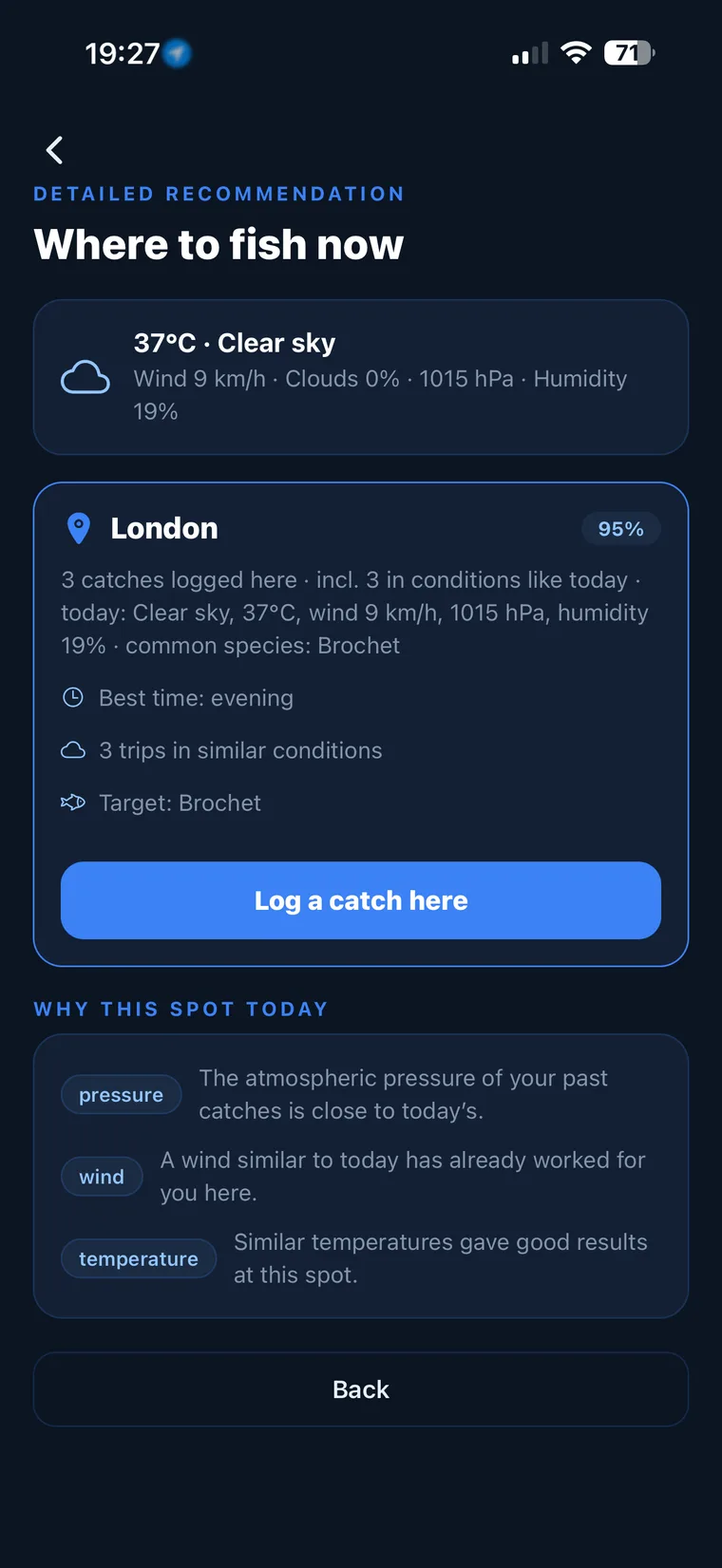
Not sure what to tie on?
Photograph your spot: CarnaFish reads the scene, cross-checks the conditions and gives you the zone, the lure and the retrieve. Free on iOS and Android.
Where it excels, where it is pointless
It comes out ahead on hard, structured bottoms: rock, rockslides, boulders, dock footings, isolated stumps. Anywhere crawfish actually live, and where fish are used to seeing them. It also excels on holding, apathetic fish, in late autumn and winter, when the only way to trigger a bite is to stay a long time in the same place.
It is poorly suited to covering water, though: you search very little ground per hour, and it is not a lure for finding scattered fish. Over soft silt or dense filamentous weed, the floating claws get lost in the vegetation layer and the visual effect disappears. And in open water, or for intercepting hunting fish, it has no role at all.
Hella CrawZ or a standard plastisol craw
Against a Keitech Crazy Flapper, the difference is not in the shape but in the material. The Keitech, in soft salted plastisol, sinks and lies down: its strength is the very wide flapping of its appendages as soon as it moves, plus a salty taste that makes a fish hold it a second longer. The Hella CrawZ never lies down completely and works above all while it is still.
In practice: if you fish by working the lure regularly, the Keitech is at least as good and costs less. If you fish slowly, spot by spot, with pauses of ten seconds and more, the Hella CrawZ keeps a live signal going while the other is dead. The two complement each other in the same box more than they replace each other.
Our beginner's guide to bass fishing places crawfish imitations in the context of a full season. And if you are unsure what weight to rig when you arrive in front of a rockslide, CarnaFish analyses a photo of the spot and answers.
Key takeaways
- ElaZtech floats: the claws lift at rest, the lure stays alive without you working it.
- Only two useful rigs: football jig trailer, or weighted Texas rig on a 4/0 wide-gap hook.
- Eight to fifteen second pause, then two short pulls. Barely move the lure at all.
- Hard structured bottoms, holding fish, cold water. No use for covering water fast.
- Never store it touching standard plastisol lures, it attacks them chemically.
FAQ
Does the Z-Man Hella CrawZ really float?
Yes. ElaZtech is less dense than water, so the bare lure rises. Rigged with a weight or on a jig head, the whole thing sinks but the claws and appendages stay pointing upward at rest.
Can I store it with my other soft plastics?
No. ElaZtech reacts to prolonged contact with standard plastisol and both end up degrading each other. Leave it in its original bag or in a separate compartment of the box.
What hook size for a Texas rig?
A 4/0 wide-gap Texas hook for the standard size. The material being very elastic, plan on a silicone stopper or a drop of glue to stop it sliding down the shank over a series of casts.
How long should I let the lure sit?
Eight to fifteen seconds on active fish, longer in cold water. The claws-up posture takes one to two seconds to establish, so too short a pause cancels the whole benefit of the material.
Is it more durable than a standard craw?
Markedly. It takes far more fish and incidental nips before tearing, which offsets its higher unit price. It does deform more under a pull, so check regularly that it is still sitting straight on the hook.
Which colours should I choose?
Browns and dark greens cover most of it over rocky bottoms. In stained water or under a low sky, switch to black/blue. Contrasting claw tips, orange or red, help a fish aim at the part of the lure closest to the hook.
The full bass lure guideSeason-by-season strategy: which family of lure, when, and why.Go from theory to fish
CarnaFish reads your spot from a photo and gives you the game plan: zone, lure, retrieve. Free on iOS and Android.