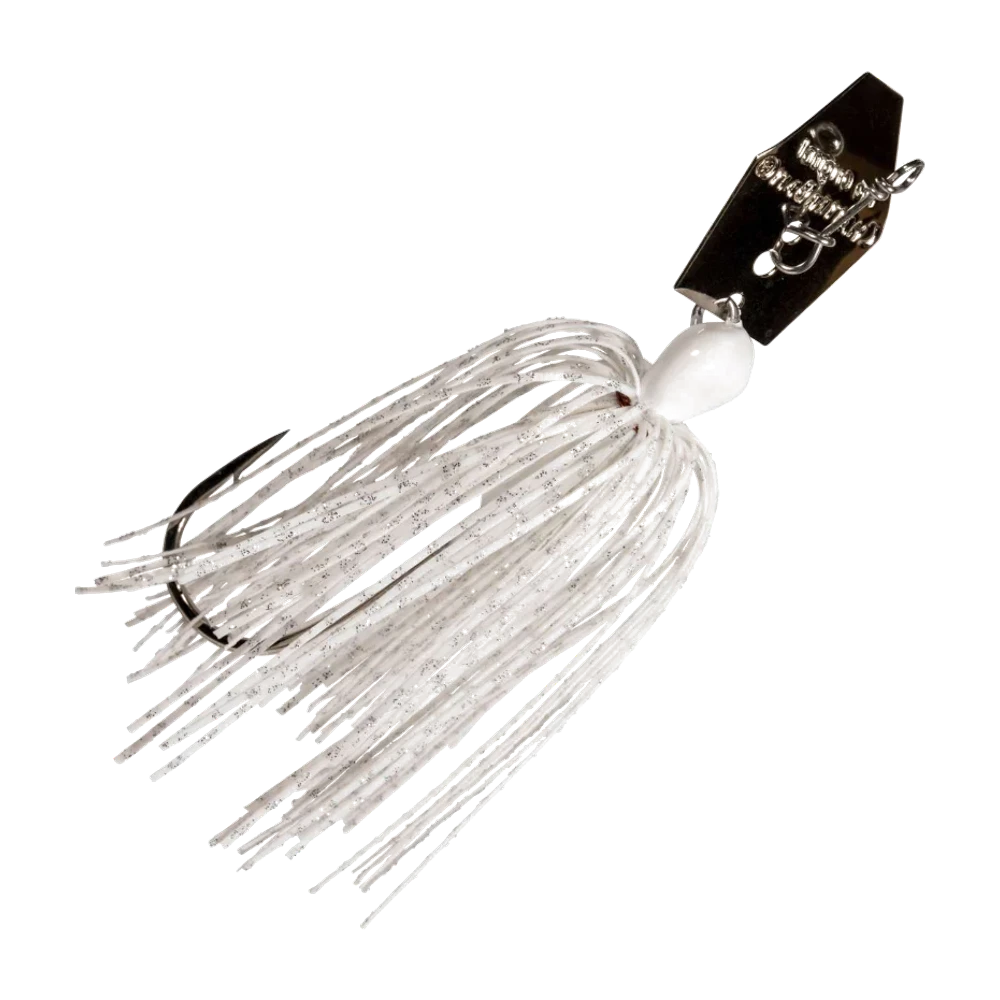
Z-Man ChatterBait Elite: the blade does all the searching for you
Rather not fish it blind? Photograph your spot — CarnaFish cross-checks the conditions and points you the right way.
When you arrive on water you do not know, you have two hours to work out where the fish are. A crankbait covers ground but snags as soon as there is vegetation. A spinnerbait goes everywhere but puts out a fairly vague signal. A soft plastic is precise but too slow for searching.
The chatterbait settles that triangle. It is a simple build: a jig head with a single hook, a skirt, a soft-plastic trailer, and in front of all that a metal blade hinged straight onto the line tie. As you retrieve, the blade catches the water, kicks out, comes back, and passes a wide, noisy sideways oscillation into the lure.
The result is a lure that vibrates almost as hard as a lipless, that goes through sparse vegetation thanks to its single upward-facing hook, and that you retrieve straight without thinking. Z-Man's Elite range refines the formula with a reworked blade, a heavy-wire hook and a denser skirt.
The vibration is set with speed, not weight
This is the point most anglers miss. A chatterbait does not have a fixed action: its behaviour changes radically with retrieve speed.
Too slow: the blade does not open properly, the lure waddles limply, you feel almost nothing in the rod. The signal is weak.
Right: the blade beats steadily, you feel a continuous, clean vibration in your wrist, and the lure tracks straight. That is the working zone.
Too fast: the blade pins back, the lure starts rolling onto its flank or coming out of the water. You lose both the vibration and the path.
The method is simple: speed up gradually until you feel the vibration settle in firmly, then hold that speed. It varies with model weight, trailer size and depth, so redo the test at every change of configuration.
| Model | Target depth | Context |
|---|---|---|
| 7 to 10 g | 0.3 to 1 m | margins, sparse weed, warm water |
| 14 g | 1 to 2 m | standard use, general searching |
| 18 to 21 g | 2 to 3 m | cold water, drop-offs, wind, big waters |
The trailer is not an accessory
A chatterbait without a trailer does not work properly. The soft plastic rigged on the hook has three jobs: it completes the bulk, it stabilises the path, and it determines the swimming speed.
Paddle tail trailer (shad style). It adds its own vibration and slows the lure down, which lets you fish more slowly without losing the action. A good default choice, and the best one for pike.
Craw trailer (with claws). It adds resistance and lift, slows things further still, and gives a wider profile. Favour it in cold water or along shallow margins.
Slim fluke-style trailer. It reduces drag and lets you fish fast without the lure leaving its line. Use it on active fish or when you need to cover a lot of ground.
A Keitech Easy Shiner 4 or a Zoom Super Fluke make two excellent trailers in those two opposite registers.
On the water: the chatterbait is a lure that has to make contact. Deliberately steer it into a post, a rock, the edge of a weed bed. The blade jams for a fraction of a second, the lure kicks violently off to one side, and it is that loss of balance that draws the strike — far more than a clean swim through open water.
The retrieve: straight, but not monotonous
- Cast past the spot and start the retrieve before the lure even reaches the bottom.
- Find the speed that makes it vibrate firmly, and hold it.
- Look for contact with obstacles and vegetation rather than avoiding them.
- When it pulls free of a weed bed, make a half-second stop: the lure noses down, and that is a classic trigger.
- Vary with a yo-yo in cold water: three turns, a one-second stop with the lure dropping, then pick up again.
For pike, slow down and go heavier. For bass in warm water, speed up and fish higher.
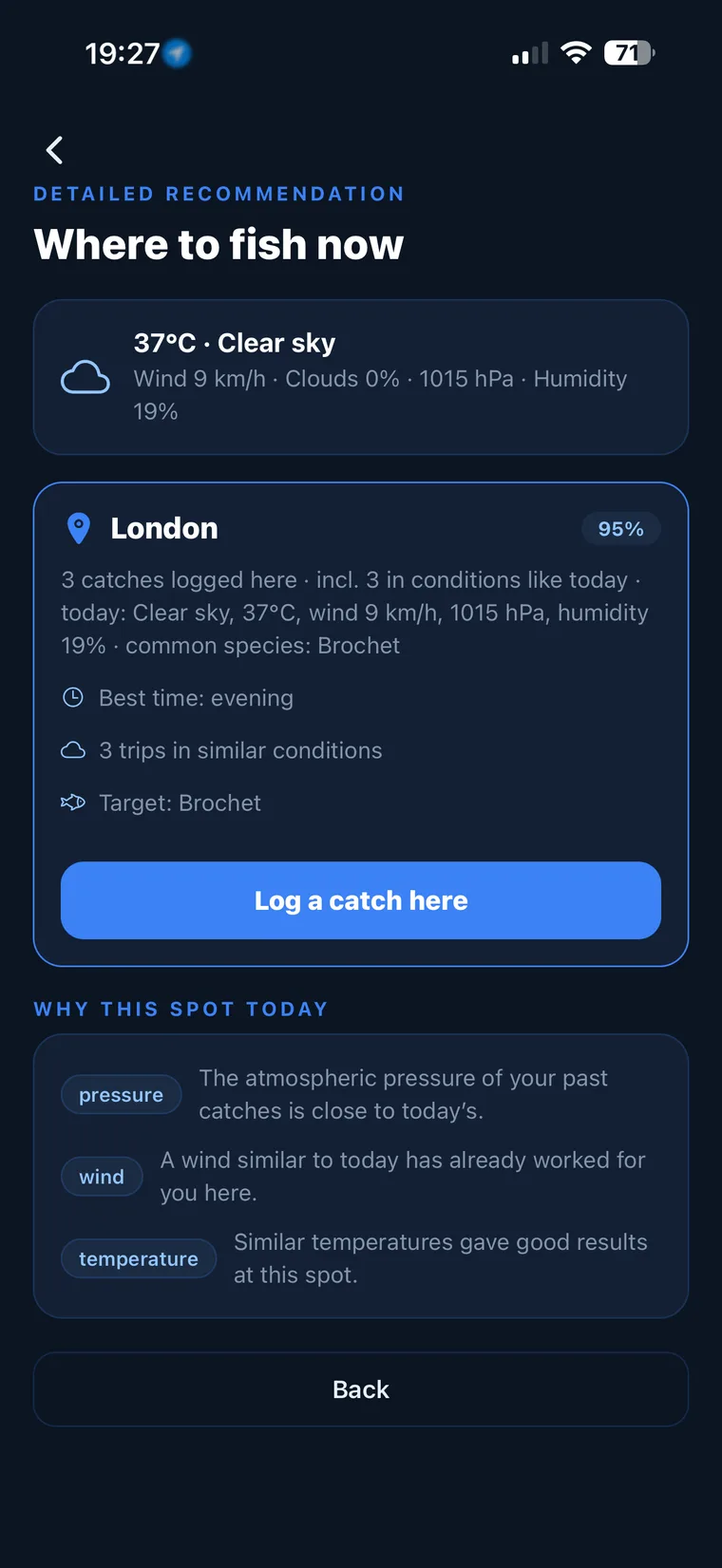
Not sure what to tie on?
Photograph your spot: CarnaFish reads the scene, cross-checks the conditions and gives you the zone, the lure and the retrieve. Free on iOS and Android.
What it cannot do
- Dense vegetation mats: the single hook helps, but the blade collects filaments. On genuinely thick lily pads, switch to a frog or a Texas rig.
- Very clear cold water on passive fish: the signal is too heavy-handed.
- Real depth: beyond three metres, holding a water layer becomes a gamble.
- Ultra-finesse fishing: this is not a finishing lure, it is a searching lure.
For pike, a short wire or titanium leader is essential. The chatterbait is often attacked head-on, and the skirt leads the fish to engulf the whole lure.
ChatterBait Elite or spinnerbait
The spinnerbait and the chatterbait occupy the same searching slot, but with two different signatures.
The spinnerbait puts out flash: the blades spin, reflect light, and produce a softer, more diffuse vibration. It goes through branches better thanks to its weed guard arm, and it excels in clear water.
The chatterbait puts out raw vibration: a strong sideways oscillation, a low-frequency signal that carries a long way in coloured water. It is more compact, casts better in wind, and its stubby profile looks more like a fish than a mechanical object.
Against the Z-Man ChatterBait Jack Hammer, the positioning is close within the same brand, the differences being in the blade finish and the hook build. A Strike King Thunder Cricket is the direct alternative from a competitor.
Our beginner's guide to bass fishing explains how to move from searching to finishing on the same spot. And if you are unsure what speed to give it when you reach the bank, CarnaFish analyses a photo of the spot and answers.
Key takeaways
- The vibration is set with speed: accelerate until it settles in, then hold it.
- The trailer determines swimming speed and bulk. Paddle tail to slow down, fluke to speed up.
- Look for contact with obstacles: the violent kick-off is the main trigger.
- A wire leader is compulsory wherever there are pike.
- A searching lure for stained or weedy water, not a finishing lure for clear water.
FAQ
How fast should you retrieve a chatterbait?
At the slowest speed that makes the blade vibrate firmly, felt continuously in your wrist. Too slow and the blade does not open; too fast and it pins back and the lure lies over. Redo that adjustment at every change of trailer.
What trailer should you rig on a ChatterBait Elite?
A paddle tail shad to slow it down and add vibration, a clawed craw in cold water or shallow, a slim fluke when you want to fish fast. The trailer directly determines the swimming speed.
Does the chatterbait go through weed?
Through sparse vegetation yes, thanks to the single upward-facing hook. On a dense mat the blade ends up collecting filaments: a frog or a Texas rig is then the better call.
Do you need a wire leader for pike?
Yes, a short one, in soft wire or titanium. The chatterbait is attacked head-on and often engulfed whole, skirt included, which puts fluorocarbon straight against the teeth.
What weight should you choose?
7 to 10 g to fish high along the margin, 14 g as the versatile standard between 1 and 2 m, 18 to 21 g in cold water, in wind or to hold 2 to 3 m of depth.
What is the difference with a spinnerbait?
The spinnerbait produces flash and a diffuse vibration, it excels in clear water and goes through branches better. The chatterbait produces a far more pronounced low-frequency vibration, more effective in coloured water and in wind.
The full bass lure guideSeason-by-season strategy: which family of lure, when, and why.Go from theory to fish
CarnaFish reads your spot from a photo and gives you the game plan: zone, lure, retrieve. Free on iOS and Android.