Z-Man Shadtron LT: the line-through swimbait with two sink rates
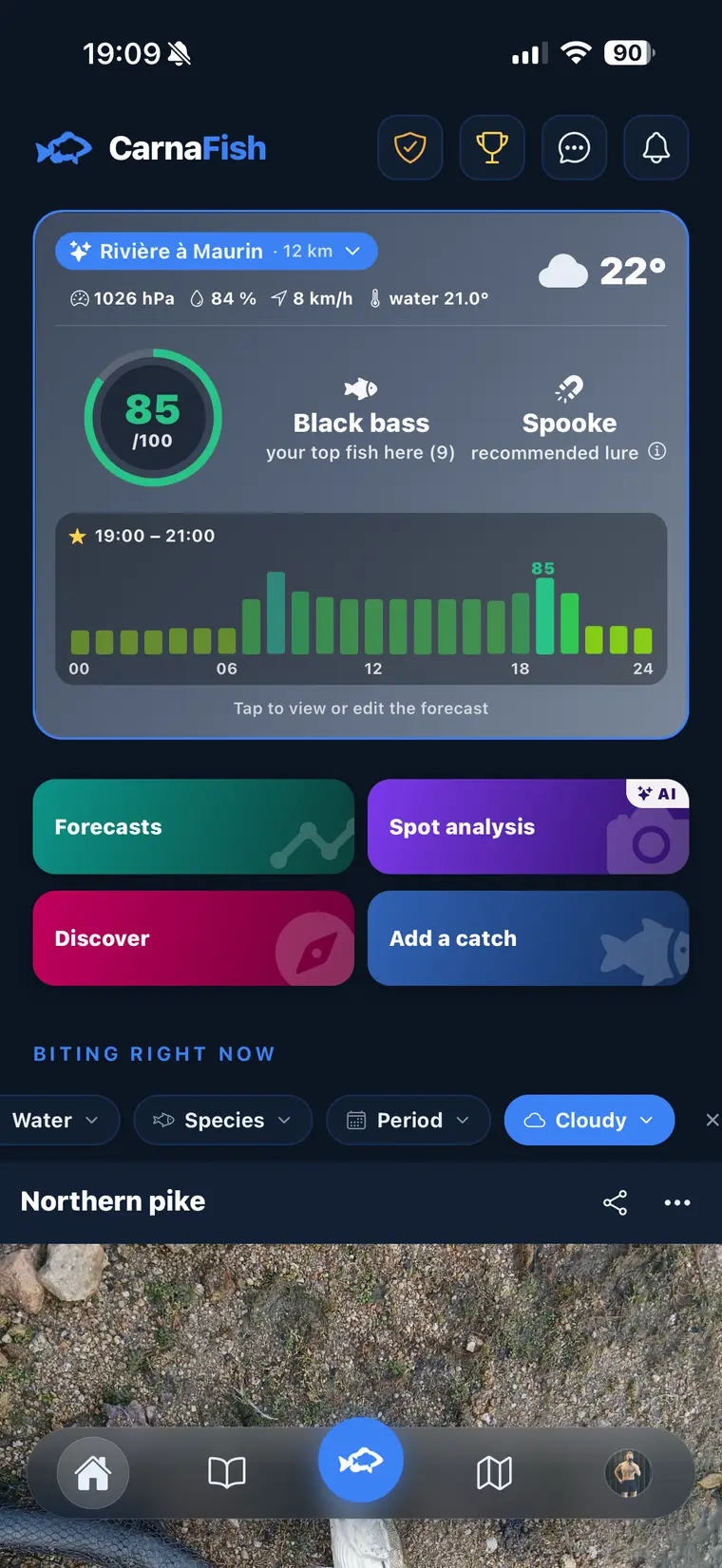
One lure, endless conditions. CarnaFish reads your spot from a photo so you are not just guessing.
A classic soft swimbait has one flaw you always end up paying for: after a few fish, the hook has ploughed through the body and the lure goes in the bin. A line-through rig solves that by shifting the load onto a wire that runs the whole length of the body. Z-Man's Shadtron LT applies that principle while letting you choose which side the hook comes out of — and that choice changes the fishing completely.
The line-through system, top or belly
Z-Man presents its system as an industry first, which should be taken for what it is: a marketing phrase. The idea is still worth stopping on. The body is pierced right through, and you decide between two ways of rigging it.
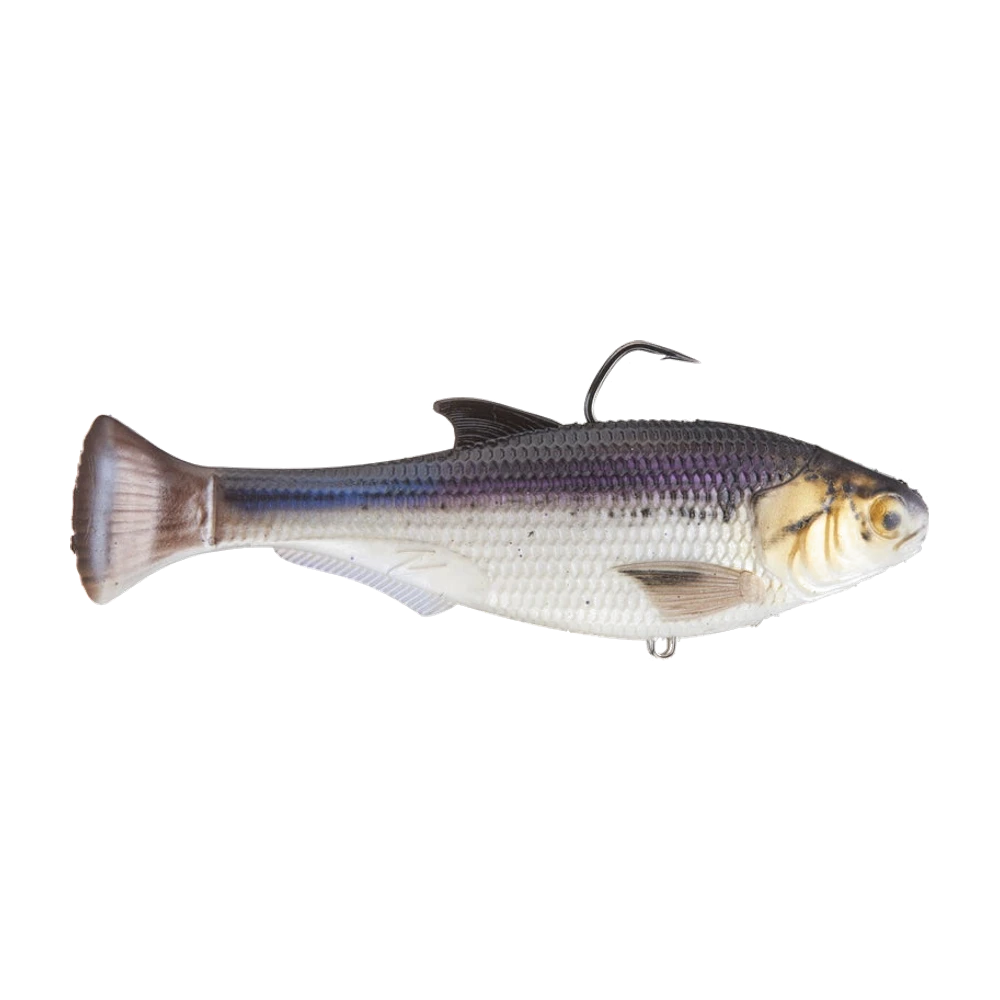
Rigged top-hook, the supplied single hook — a so-called sickle bend, in black-nickel steel — comes out of the top of the lure, point up. That's the most all-round option: the lure becomes semi-weedless, and it goes through sparse vegetation and drowned branches without snagging on every cast. In the photo, this is the rig in place, with the hook exiting just in front of the dorsal fin.
Rigged belly, you set the single hook aside and clip a treble of your choice onto the belly ring, visible under the lure. You gain hook-up ratio on soft strikes and lose the ability to work cover. This is the open-water rig, for when you're fishing a school in the middle of the water column and every bite counts.
Four versions, and a column worth reading carefully
The Shadtron LT size chart needs a little attention, because the Class column doesn't refer to buoyancy in the usual sense but to a sink rate. The four references:
- 11.4 cm — 21 g / 0.75 oz — slow sink — 3/0 hook
- 11.4 cm — 28 g / 1 oz — fast sink — 3/0 hook
- 15.2 cm — 51 g / 1.8 oz — slow sink — 5/0 hook
- 15.2 cm — 62 g / 2.2 oz — fast sink — 5/0 hook
The gram figures are conversions of round ounce values: read them as orders of magnitude, not as weighed measurements. And 3/0 and 5/0 are hook sizes, not fractions of an ounce: don't mistake them for a weight when you're comparing two pages.
The point that really matters: all four versions sink. There is no floating Shadtron. The difference between "slow" and "fast" isn't a difference in nature but in rate of descent, and it decides which layer of water you can hold. The slow version gives a fish time to come up on a lure sinking through 2 or 3 m; the fast one reaches the bottom of a deep spot without losing ten seconds per cast.
One claim to check for yourself
Z-Man advertises both a balanced weighted harness and a "highly buoyant" superplastic material, meant to keep the lure upright on the fall and even sitting on the bottom. The two statements don't strictly contradict each other — a buoyant body weighted by a harness does sink while staying stable on its axis — but they pull in opposite directions, and the result depends entirely on how each reference is actually balanced.
Run the bucket test before your first outing. You want to know two things: how fast your particular lure really goes down, and what position it settles into once it lands. If the lure lies over on its side instead of staying upright, you'll find out at home rather than after three hours without a bite.
The rounded wedge tail, and why it changes slow fishing
Like the Z-Man Mulletron, the Shadtron LT carries a rounded wedge tail on a thin wrist, rather than a classic rectangular paddle. That geometry lowers the speed at which the tail starts up: where a traditional paddle needs a positive retrieve to begin kicking, this one is already swinging when you reel at a crawl.
That's exactly what you need in late autumn, when the water drops below 10 °C and the fish refuse anything moving fast. You reel at the edge of perceptible, you feel the tail working in the rod tip, and the lure stays credible at a speed where an ordinary swimbait would be inert.
The mistake that ruins a line-through rig
Cinching the knot straight onto the harness's nose ring without a snap or a loop knot. On a line-through lure, all the pull goes through that point; a locked knot restricts the lure's nose and limits the amplitude of the tail. A small strong snap, sized for the weight of the lure, fixes the problem and also lets you swap versions quickly.
Not sure what to tie on?
Photograph your spot: CarnaFish reads the scene, cross-checks the conditions and gives you the zone, the lure and the retrieve. Free on iOS and Android.
Colours by water clarity
The lure in the photo is a highly detailed baitfish imitation: grey-purple back with blue highlights, silver flanks, white belly, painted scales and fins, gold eye ringed in black. That's a finish that doesn't forgive approximation — it only makes sense in clear water, where the fish actually sees those details.
- Clear water: exactly that sort of pattern, dark back over white belly. The dividing line between back and belly gives the fish the visual cue it expects from a prey item.
- Stained water: paler opaque shades, white or light grey, which keep a visible volume at a metre where the detail of the scales disappears.
- Dark water or low light: a dark solid colour, for an outline that reads against the light.
Who it's for, and what it's up against
In 11.4 cm, the Shadtron LT is a bass lure for open spots and thinly covered margins. At 15.2 cm and 51 to 62 g, you're in a different register: this is a pike lure, which calls for a swimbait rod, a high-retrieve reel and a non-negotiable steel or titanium leader. At those weights, the cast has to be prepared: you don't throw 62 g on a 20 g rod without breaking something.
Against the brand's plain soft shads, like the Z-Man DieZel MinnowZ or the Z-Man MinnowZ, the Shadtron LT plays in another category: dearer, heavier, more detailed, and ready to fish with no jighead. In return it is far less adjustable — you don't set its depth by changing the weight, you change reference.
The best swimbait doesn't make up for a badly chosen zone, and that's exactly what CarnaFish makes easier: one photo of the spot, and the AI suggests the zone, the depth and the type of presentation that fit the moment. If you're after pike with the 15.2 cm version, our guide to choosing a pike lure puts the line-through swimbait back among the other families.
What to remember
- Four references: 11.4 cm in 21 or 28 g, 15.2 cm in 51 or 62 g. They all sink, none floats.
- The chart's
Classcolumn gives a sink rate, not a buoyancy, and 3/0 and 5/0 are hook sizes. - Top-hook line-through for cover with the supplied single hook, belly-rigged with a treble for open water.
- The rounded wedge tail starts well below the swimming speed of a classic paddle: this is a slow-fishing lure.
FAQ
Which version of the Shadtron LT should I start with?
The 11.4 cm slow sink if you're fishing bass on spots under 3 m, the fast version if you need to reach the bottom quickly. The 15.2 cm models are pike lures that call for dedicated tackle.
Does the Shadtron LT float?
No. All four references sink, in slow or fast versions. The body material is advertised as buoyant, but the built-in weighted harness sinks the whole thing in every case.
What do 3/0 and 5/0 mean in the chart?
They're hook sizes, not weights. The 3/0 goes with both 11.4 cm versions, the 5/0 with both 15.2 cm versions. The single hook is supplied with the lure.
Can a treble replace the single hook?
Yes, that's the whole point of the system: a belly ring takes the treble of your choice. You gain hook-ups on soft strikes, but you lose the ability to work cover.
Do I need a steel leader with this lure?
On the 15.2 cm version yes, always: at that size you're fishing for pike, and no fluorocarbon reliably survives a pike's teeth. In 11.4 cm on a pure bass spot, fluorocarbon is enough.
What rod do I need to cast the 62 g version?
A so-called swimbait rod, with a stated power that comfortably covers that weight, and a sturdy casting reel. Casting 62 g on an outfit that's too light breaks the tip or the lure, sometimes both.
The full bass lure guideSeason-by-season strategy: which family of lure, when, and why.Go from theory to fish
CarnaFish reads your spot from a photo and gives you the game plan: zone, lure, retrieve. Free on iOS and Android.