Strike King Final Copy Swimbait: the pre-rigged bait that drops fast
Not sure this lure fits YOUR spot today? CarnaFish tells you in 10 seconds, from a photo.
There is a moment in late autumn when the baitfish stack up on a break at five or six metres and nothing comes up any more. A paddle tail on a jighead does the job, but you have to work it so it falls straight and retrieve it slowly to keep it down there. A pre-rigged soft swimbait, weighted forward and listed as fast-sinking, attacks the problem differently: it drops on its own, quickly, and swims the moment you start reeling.
Three sizes, one class
For once the size chart is complete, and it says the same thing about all three versions. 10.2 cm (4 in) for 14 g (1/2 oz), 12.1 cm (4.75 in) for 25 g (7/8 oz), 15.2 cm (6 in) for 43 g (1.5 oz) — with the fast-sink label on every one of those three lines. That is structural information: whichever size you pick, you are working with a bait that will not hang in the water and that will ask you to count it down.
The progression is consistent from one size to the next, the weight roughly tracking the volume. The middle size, given as four and three-quarter inches, is a slightly unusual figure that lands exactly on 12 cm; take the order of magnitude rather than the millimetre.
The manufacturer states a salt-loaded, scented plastic and draws a commercial conclusion from it: sinking faster and fishing deeper than comparable soft plastic swimbaits on the market. That is Strike King's claim, to be taken as such — no measured comparison is published. What is factual is the stated class and the weight-to-length ratio, and those two are enough to confirm you are holding a dense bait.
The harness, and why it is built that way
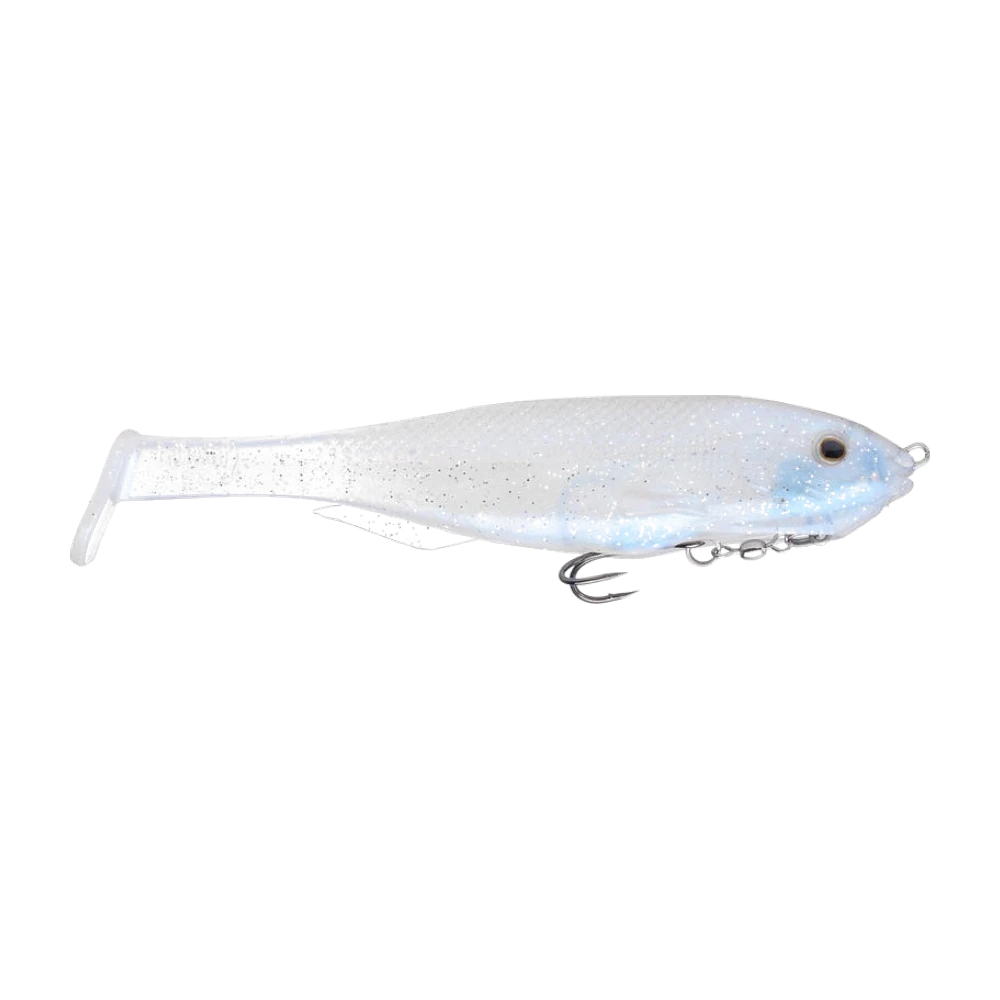
This is the most interesting part of the product. The treble is not buried in the plastic: it is held and positioned against the belly by a magnet set into the body. On the product photo you can indeed see the treble lying flat under the bait, linked by a short chain of split rings to a ball bearing swivel, itself running forward to the head.
The stated mechanism makes sense. As long as the bait is swimming, the magnet keeps the treble flush against the belly: the profile stays clean, the bait travels better and snags drop off. On the bite, the harness pulls free of the magnet. The fish then finds itself on a hook connected through a link that rotates freely — which is the whole point of the ball bearing swivel: the bait can no longer lever against the hook during head shakes, the single most common cause of lost fish on a big swimbait.
The manufacturer also notes an eyelet on top of the head, intended for adding a stinger hook. On the photo, that metal eyelet is clearly visible above the head. It is the adjustment to consider if you are getting short strikes late in the season.
The mistake to avoid with a pre-rigged bait
Trying to re-hook it. The instinct to swap the factory treble for a bigger one breaks the system: an oversized treble no longer sits properly on the magnet, it hangs, and the bait loses its clean swim while collecting everything in its path. If you want more hooking power, the head eyelet and a stinger are what you use, not a bigger belly hook.
How to work it
The straight retrieve is the starting point, and the manufacturer claims a true swim at any speed thanks to the forward weighting. In practice, forward weighting does two things above all: it stabilises the bait when you speed up, and it makes it nose down the instant you stop reeling.
It is that second property you want to exploit. Reel for ten metres, stop everything, let the bait dive nose-first for three or four seconds, then start again: the abrupt restart after a head-down fall is a very reliable trigger, far more so than a straight retrieve. With a bait listed as fast-sinking, that sequence covers a lot of water depth quickly.
On a spot with a break, cast beyond the drop and count the fall as you come over it. If the bait touches down at twelve instead of eight, you have just found the edge of the break without a sounder — and that is exactly where you need to come back through.
Not sure what to tie on?
Photograph your spot: CarnaFish reads the scene, cross-checks the conditions and gives you the zone, the lure and the retrieve. Free on iOS and Android.
Which size, and where
The 10.2 cm is the all-rounder, the one that interests an average bass without demanding special tackle. The 12.1 cm is the compromise: big enough to sort fish, reasonable enough to cast on a standard medium-heavy rod.
The 15.2 cm at 43 g is a different category. In Europe it is first and foremost a pike bait: a heavy rod, 0.35 to 0.40 mm braid, and a steel or titanium leader that is not up for discussion — a pre-rigged bait at this price is not something you sacrifice to a badly armed pike bite.
If you would rather rig a soft paddle tail yourself than buy a pre-rigged one, the Strike King Rage Swimmer covers the same ground with far more freedom over head weight. And if the weighted pre-rigged concept appeals but you want something that crawls along the bottom instead, the Megabass Dark Sleeper works on a different principle, with a weighted head and a dorsal hook.
Colours by water clarity
- Clear water: the pearl white with silver flake from the photo, with its bluish cheeks, imitating a silver baitfish without excess shine.
- Lightly stained water: a dark roach or perch back, giving a clean dorsal line when seen from below.
- Dirty water: chartreuse or an orange belly, best paired with the 15.2 cm size so volume compensates for the lack of visibility.
Picking the right swimbait size comes down to the size of the forage present and the depth of the spot, not to the catalogue. That is exactly what CarnaFish makes easier: one photo of the spot, and the AI suggests the zone, the depth and the lure type that match the day's conditions. For the rest of the approach on this fish, our guide to choosing a pike lure covers the families worth knowing.
What to remember
- Three sizes, 10.2 / 12.1 / 15.2 cm, all listed as fast-sinking: that is the most useful line in the chart.
- The belly treble is held by a magnet and pulls free on the bite, with the ball bearing swivel stopping the bait levering against the hook.
- The sequence that works: retrieve, stop, three to four seconds of nose-down fall, sharp restart.
- Do not change the size of the factory treble; if you want more hooking power, use the head eyelet and a stinger.
FAQ
Does the Final Copy float or sink?
It sinks, and fast: the size chart lists fast-sink for all three sizes. Count the fall every time, it is the only way to know what depth you are actually fishing.
Which size should you pick for pike?
The 15.2 cm at 43 g, with a heavy rod and a steel or titanium leader. The two smaller sizes suit bass and medium-sized fish better.
What is the magnet under the belly for?
It holds the treble flush against the body while the bait swims, which keeps the profile clean and cuts down on snags. On the bite, the harness pulls free of the magnet.
Why is there a ball bearing swivel in the rig?
Because it rotates freely: the fish can no longer use the bait's body as a lever during head shakes, which is the classic cause of lost fish on a big swimbait.
Should you add a stinger hook?
Only if you are getting short strikes. The manufacturer provides an eyelet on top of the head for exactly that, visible on the product photo, and it is the right way to go rather than upsizing the belly treble.
How do you work it for the most bites?
Straight retrieve for a few metres, full stop, three to four seconds of nose-first fall, then a sharp restart. It is the restart after the fall that triggers, far more than the continuous retrieve.
The full bass lure guideSeason-by-season strategy: which family of lure, when, and why.Go from theory to fish
CarnaFish reads your spot from a photo and gives you the game plan: zone, lure, retrieve. Free on iOS and Android.