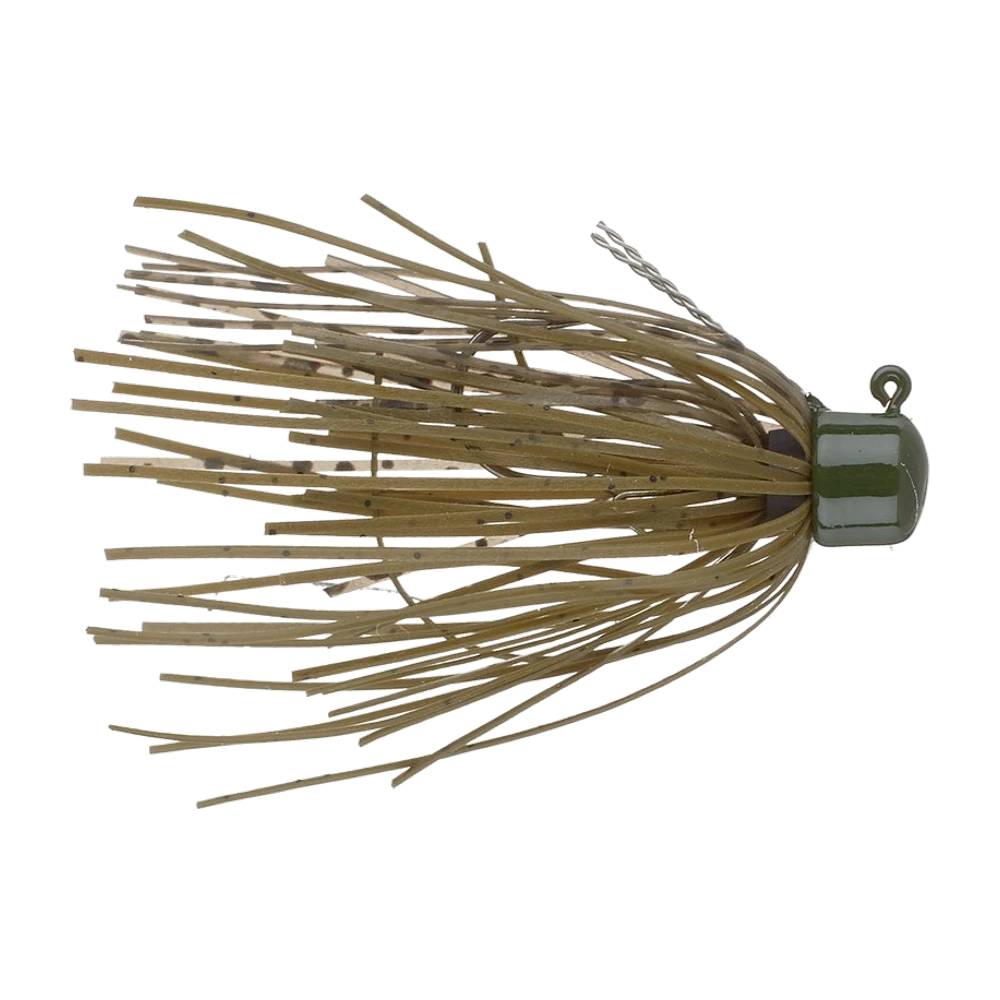
Z-Man Shroomz Micro Finesse Jig: a skirted jig on a Ned head
The right lure in the wrong spot still catches nothing. CarnaFish spots the zone that works, from a single photo.
There are days when everyone on the water is throwing a jig and nobody gets bit. The fish are there, the electronics say so, but a 10 g skirted jig crashing down in front of a bass that hasn't moved in three hours reads less like a crawfish than like an assault. The Z-Man Shroomz Micro Finesse Jig was built for that exact moment: it keeps the bulk and the breathing of a skirted jig, but grafts them onto a Ned-style mushroom head and a light-wire hook. It is a hybrid, and that is precisely what makes it useful.
A skirted jig built on Ned rig logic
Z-Man describes this one as an evolution of its original Shroomz Jigheadz, the mushroom heads that made the Ned rig famous. The head shape is not cosmetic. A mushroom head has a flat front face and a high line tie, so it digs slightly into the substrate on the drop and stands the bait up instead of laying it down. A conical jig head does the opposite — it noses over and buries.
You feel the difference on the first cast. The Shroomz Micro sits upright, skirt flared, and every small tightening of the line makes the strands pulse without moving the head an inch. You can work one square metre for thirty seconds. On a fish that is holding tight and refuses to chase, that is often the only presentation that triggers.
The manufacturer stresses two things: a 100% silicone skirt, and a deliberately slow fall. They work together. Silicone, stiffer than natural hair, splays on the way down and brakes the lure by surface area — the skirt acts as a parachute. That is what gives the drop the hanging quality that lethargic fish will accept.
The light-wire size 1 hook is the key spec here
The product copy lists a light-wire jig hook in a black nickel finish, size 1. That is a gauge, not a weight: a size 1 is a small finesse hook, well below the 3/0 and 4/0 found on a standard bass jig. The thin wire penetrates on its own, which is exactly Z-Man's argument — easy hooksets on light gear.
Follow that through to the end. A light-wire size 1 does not forgive a lumberjack hookset on a stiff rod and unforgiving braid: it opens. Fish this on a medium-light to medium rod with a soft tip, a light main line, and a drag set low. The Shroomz Micro is not a heavy-cover jig in miniature — it is a technical lure for pressured fish.
Set the drag before the first cast
Pull line by hand until it slips under a firm but smooth tug, roughly half of what you would run on a Texas rig. On a big fish the drag absorbs the surge, not the rod. Sweep the hookset backwards rather than snapping the tip.
Working a micro skirted jig
The base retrieve has three beats: cast, follow the fall on a tight line watching the rod tip, and then do absolutely nothing for two to four seconds after it touches down. The vast majority of bites land in that window, while the skirt is still closing. Pick the line up straight away and you have cancelled the lure's main argument.
Then work short. A twenty-centimetre pull, a long pause, half a crank to recover slack, another long pause. The goal is not to cover ground but to keep the skirt alive in one spot. Over rock, add a short drag: the flat face of the head catches the substrate, lifts a small cloud, and the skirt folds back over it. Over soft mud, skip the drag.
Fish it on a count. Three seconds of pause, then five, then seven, and note which count the bite falls on. On a finesse jig the pause length is as decisive a setting as head weight — and it shifts from one hour to the next on the same day.
The classic mistake
Over-trailering. Since the skirt already supplies the bulk, plenty of anglers bolt on a fat craw with oversized claws to make it look livelier. The result is the opposite: the appendages stiffen the package, stop the skirt from flaring on the fall and turn a slow lure into an inert lump. If you add a trailer, keep it compact.
The trailers the maker had in mind
Z-Man explicitly names three of its own baits as partners: the TRD, the Crusteaz and the Finesse Shadz. That is not catalogue filler. All three are moulded in ElaZtech, a buoyant elastomer: on a mushroom head, a floating body stands up at rest instead of flopping over. Combine that with a flaring skirt and you get a lure that literally stands on the bottom, claws or tail pointing up, in a defensive crawfish posture.
In practice a trimmed Z-Man TRD gives the most compact, most universal profile. A Z-Man Finesse ShadZ stretches the silhouette and suits fish keyed on silver forage. A Z-Man TRD CrawZ pushes the crawfish imitation furthest, at the cost of a little extra drag. One warning: ElaZtech melts standard plastisol on prolonged contact. Keep those trailers in their own bag, never loose in a box with other soft plastics.

Not sure what to tie on?
Photograph your spot: CarnaFish reads the scene, cross-checks the conditions and gives you the zone, the lure and the retrieve. Free on iOS and Android.
Colors by water clarity
The product copy names no color at all — a point where caution beats inventing references. The sample photographed here carries an olive green painted head and a brown-olive skirt flecked with dark specks, with a few paler strands buried in the mass. That is the green pumpkin family, and it sets the logic:
- Clear water, rock or gravel bottom: green pumpkin and flecked brown as shown, tones that vanish into the background and let the movement do the work.
- Lightly stained water: brown-orange shades, which read as a moulting crawfish without ever turning garish.
- Dark water, mud bottom or low light: black and blue, a clean silhouette seen from below.
What the product copy leaves out
No head weight, no length, no named color: the listing says nothing about dimensions. On a jig that is the single most useful missing number, since weight sets the fall rate and therefore everything else. Choose it by depth and wind, starting with the lightest head that reaches bottom in a tolerable time, and read the packaging at the point of sale.
The right jig never replaces reading the spot — you still need to know where the hard bottom ends and the mud begins. That is exactly what CarnaFish does: one photo of the spot, and the AI suggests the zone, the depth and the kind of presentation that fit the day's conditions. To build the groundwork behind that choice, our beginner's guide to bass fishing sets the scene.
Key takeaways
- A Ned mushroom head plus a silicone skirt: the lure stands up on the bottom and works in place, without travelling.
- Light-wire size 1 hook: light gear, soft drag, sweeping hookset — this is not a heavy-cover jig.
- Bites come during the pause that follows bottom contact, not during the pull.
- A compact trailer is mandatory: a bulky craw blocks the skirt and kills the slow fall.
FAQ
Which head weight should I pick?
The manufacturer does not publish the weights offered, so you have to read the packaging. The rule is the same as on any finesse jig: the lightest head that reaches bottom in a bearable time, and you only go heavier when wind or current stop you following the fall.
Will a size 1 hook hold a big bass?
Yes, provided the tackle matches. Thin wire penetrates very easily but opens under brutal pressure: medium-light rod with a soft tip, low drag setting and a sweeping hookset rather than a snap. Around heavy cover, pick a jig with a stouter hook.
Do I have to add a soft trailer?
No, the skirt alone already fishes, especially on very pressured fish. A compact trailer adds bulk and slows the fall; a bulky one with big claws does the reverse by stopping the strands from flaring.
Will this jig come through vegetation?
The sample photographed shows no weedguard: the hook is buried in the skirt but still exposed. This is a hard-bottom, rock and clean-edge lure, not a tool for thick grass.
Does it work for perch?
Yes, and that is one of its best uses in Europe. The downsized profile and fine hook suit a big perch holding on a rocky bottom very well, as long as you fish it even slower than you would for bass.
How is it different from a plain Ned rig?
A Z-Man TRD on a bare head trades on a minimalist profile and a buoyant body that quivers at rest. The Shroomz Micro adds a skirt: more bulk, a distinctly slower fall and a permanent visual signal, at the cost of some subtlety.
The full bass lure guideSeason-by-season strategy: which family of lure, when, and why.Go from theory to fish
CarnaFish reads your spot from a photo and gives you the game plan: zone, lure, retrieve. Free on iOS and Android.