Z-Man TRD Gobyz: the ElaZtech goby that stands its tail up off the bottom
The right lure in the wrong spot still catches nothing. CarnaFish spots the zone that works, from a single photo.
If you fish the Rhine, the Moselle, the Danube or the Baltic, you already know the round goby — the invasive little bottom fish that colonised the rip-rap in a handful of years and became, for the perch and zander of those waters, the most abundant prey of their lives. Baits that imitate it properly are rare, because a goby has neither the profile nor the behaviour of an open-water baitfish. Z-Man's TRD Gobyz is one of the few designed for exactly that job, and its defining trait fits in one word: it floats.
A body that stands up instead of lying flat
Z-Man moulds this bait in ElaZtech, a PVC-free plastic known for extreme tear resistance and, more to the point here, for being noticeably lighter than water. The description builds its main argument on that: at rest, the material lifts the tail off the bottom while the jighead stays planted. The bait therefore sits nose down, tail up, exactly like a small fish rooting through the substrate.
That is more than a cosmetic detail. A goby has no swim bladder: it does not hold mid-water, it settles, moves off in short hops and settles again. A bait that collapses flat on the bottom loses the silhouette a predator is hunting for; a bait that stays upright keeps a readable shape and a target point even when motionless. It is the same principle as a standard Zman TRD Ned Rig, applied to a fish profile instead of a stick.
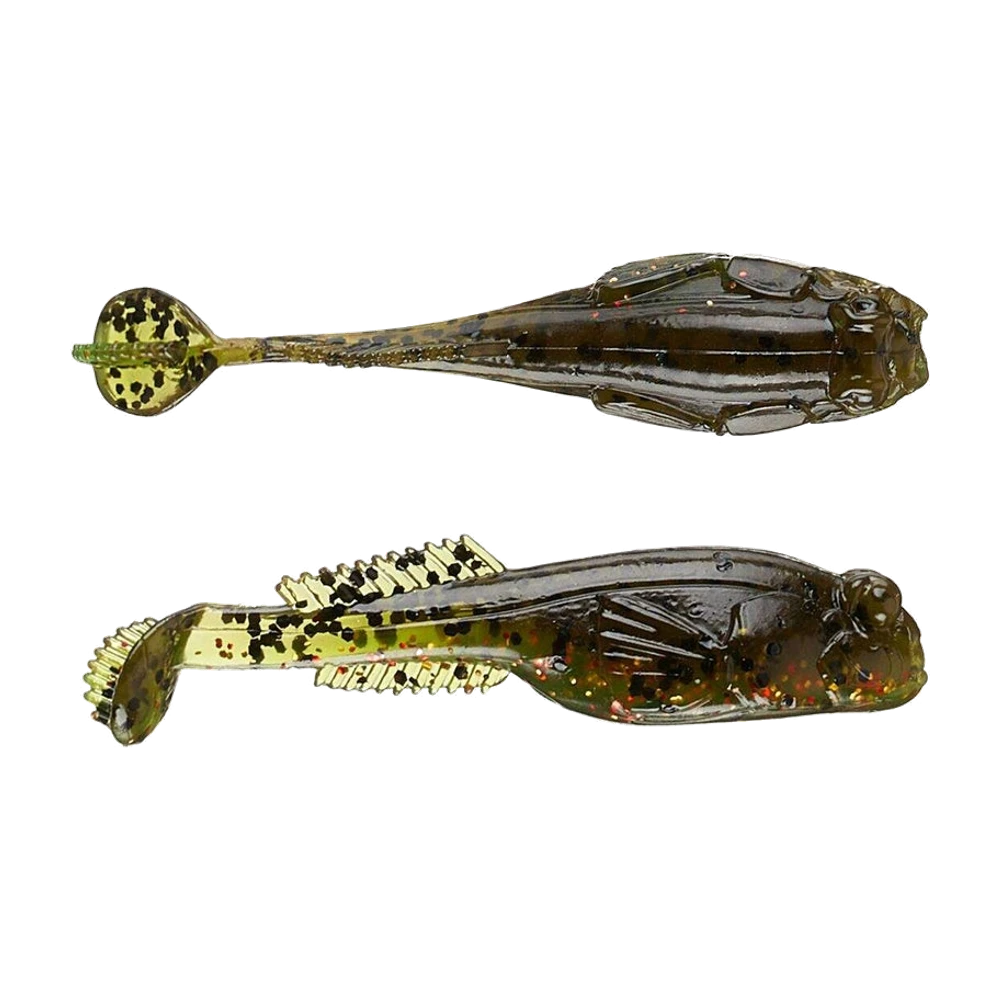
The sculpting goes a long way. On the product photo you can make out a wide, flattened head with raised eyes, spread pectorals, a long saw-edged dorsal fin running the whole length of the back and a matching anal fin underneath. The body narrows sharply towards the rear and finishes on a small rounded paddle. Both views show the bait bare, with no hook: it is a soft body you rig yourself.
One size, and a table to read the right way round
The retailer's table boils down to one line: "Z-Man Size Quantity / TRD Gobyz 2.4" 6". First column: the model name, not a measurement — the usual trap. So there is a single size, 2.4 in or roughly 6.1 cm, sold in packs of six. The 6 is a pack count, not a weight.
Z-Man publishes no mass for this bait, which is consistent with how it is used: on a ned rig the jighead carries the weight of the whole thing, the body weighing next to nothing. If you need a precise casting weight — working a far bank, a crosswind — think in terms of the head and treat the body as negligible. The 6.1 cm figure is a conversion of a round 2.4 in value: take it as an order of magnitude.
Jigheads and rigging
The mushroom head by default
A 2 to 5 g (0.07-0.18 oz) mushroom finesse head is the original ned system rig. It pushes into the nose of the bait, whose section is wide enough to hold without glue through several fish thanks to the ElaZtech. The whole thing settles naturally on its base and lets the body stand up. A Z-Man Shroomz Micro Finesse Jig does precisely that job in the small sizes, for perch.
The football head for hard bottom
Over rip-rap, cobble or gravel — goby habitat — a 5 to 7 g (0.18-0.25 oz) football head holds its attitude better and rolls onto its side less when dragged. It snags more in timber, but gobies do not live in timber.
Hook and leader
A short bent-shank hook, size 1 or 1/0 in this format: those are hook gauges, not ounce fractions. Fluorocarbon of 0.18 to 0.24 mm on a thin braid. If the spot also holds pike, step up to heavy fluorocarbon or a supple titanium leader — and accept that you lose stealth on wary perch.
The classic mistake
Working it like a shad. The TRD Gobyz has no paddle for that: the tail is small, round and deliberately understated, and a steady straight retrieve produces almost nothing. The bait works on a slow drag in bottom contact, in short twenty to thirty centimetre pulls followed by a full three to five second stop. The stop is when the body stands up, and when the bite comes.
Keep a slight tension in the slack during the stop without pulling. On this kind of bait the bite is very often just weight arriving, with no tap at all — if your line is lying loose you miss it and conclude the spot is empty.
Not sure what to tie on?
Photograph your spot: CarnaFish reads the scene, cross-checks the conditions and gives you the zone, the lure and the retrieve. Free on iOS and Android.
Where and when it produces
The TRD Gobyz is first and foremost a hard-bottom bait: bank rip-rap, bridge pilings, groynes, boulder fields, channel edges, the gravel stretches of big rivers. Wherever the goby has established itself, perch and zander have folded it into their diet and recognise the silhouette. The bullhead-type sculpin, a native bottom fish of stony rivers, offers a very similar profile, which extends the bait's use to waters where the goby has not arrived.
Spring and autumn are the best windows, when perch hold tight to the bottom along clean breaks. In summer the bait still earns its keep during the dead hours, when fast fishing stops producing and you have to grind out a precise spot very slowly. Z-Man writes this bait for smallmouth bass, which has no real equivalent in most European waters: the transposition that holds here is perch over hard bottom, and zander on the same spots at dusk. Gravel-pit bass take it well too, especially when they are pinned to the bottom.
Colour by water clarity
Z-Man names no colour in this description, but the bait photographed is representative of the useful family: a translucent green pumpkin flecked with black and orange, with a lighter belly.
- Clear water over light bottom: green pumpkin with flake, exactly as shown. The orange specks echo the highlights of a goby in spawning dress.
- Stained water: a solid brown or dark chocolate tone, more readable from below against the light.
- Very clear water and sight fishing: a translucent grey-green, the closest match to a real goby sitting on clean gravel.
The right bait is worthless in the wrong place, and a productive boulder field looks a lot like a dead one from the bank. That is exactly what CarnaFish makes easier — a photo of the spot, and the app suggests a zone and a presentation suited to the day's conditions. For the fundamentals of finesse percid fishing, our guide to perch fishing with lures is a good companion to this page.
Key takeaways
- Buoyant ElaZtech stands the tail up at rest: that nose-down posture is the whole point of the bait.
- One size only, 2.4 in or 6.1 cm, in packs of six; Z-Man publishes no body weight.
- Slow drags with long stops, never a steady retrieve: the small paddle cannot carry a fast presentation.
- Home ground: hard bottom, rip-rap and boulder fields, where gobies and sculpins live.
FAQ
Does the TRD Gobyz really float?
Z-Man states a highly buoyant ElaZtech, and that is the model's central argument: at rest the body lifts the tail while the jighead stays on the bottom. It is a manufacturer claim, and an easy one to check at home by dropping a bare bait into a glass of water before you go.
What jighead weight should I use?
2 to 5 g on a mushroom head for perch in 1 to 5 m, up to 7 g on a football head over deep hard bottom or in current. Always take the lightest weight that keeps contact: too heavy a head flattens the raised posture.
How many baits per pack?
Six. The figure comes from the "Quantity" column of the retailer's table, whose first column carries the model name rather than a measurement — a common source of confusion.
Is it a bass-only bait?
No. Z-Man writes it for smallmouth bass, but in Europe its most natural target is perch over hard bottom, then zander on the same spots. Gravel-pit bass take it too, especially when pinned to the bottom in summer.
How is it different from a standard ned rig?
A Zman TRD Ned Rig is a plain stick with no identifiable silhouette. The TRD Gobyz keeps the same buoyancy and rigging principle but adds a sculpted bottom-fish profile, with a wide head, fins and a paddle. On educated fish that see a lot of ned rigs, that difference in silhouette matters.
Does ElaZtech really survive multiple fish?
Yes, that is the material's genuine strength: it stretches enormously before tearing and holds up far better than standard plastisol under repeated hits. Watch the storage, though — ElaZtech reacts to prolonged contact with other soft plastics and is best kept in its own bag.
The full perch lure guideSeason-by-season strategy: which family of lure, when, and why.Go from theory to fish
CarnaFish reads your spot from a photo and gives you the game plan: zone, lure, retrieve. Free on iOS and Android.