Z-Man Gobius Swimbait: the pre-rigged goby that sits tail-up
The right lure in the wrong spot still catches nothing. CarnaFish spots the zone that works, from a single photo.
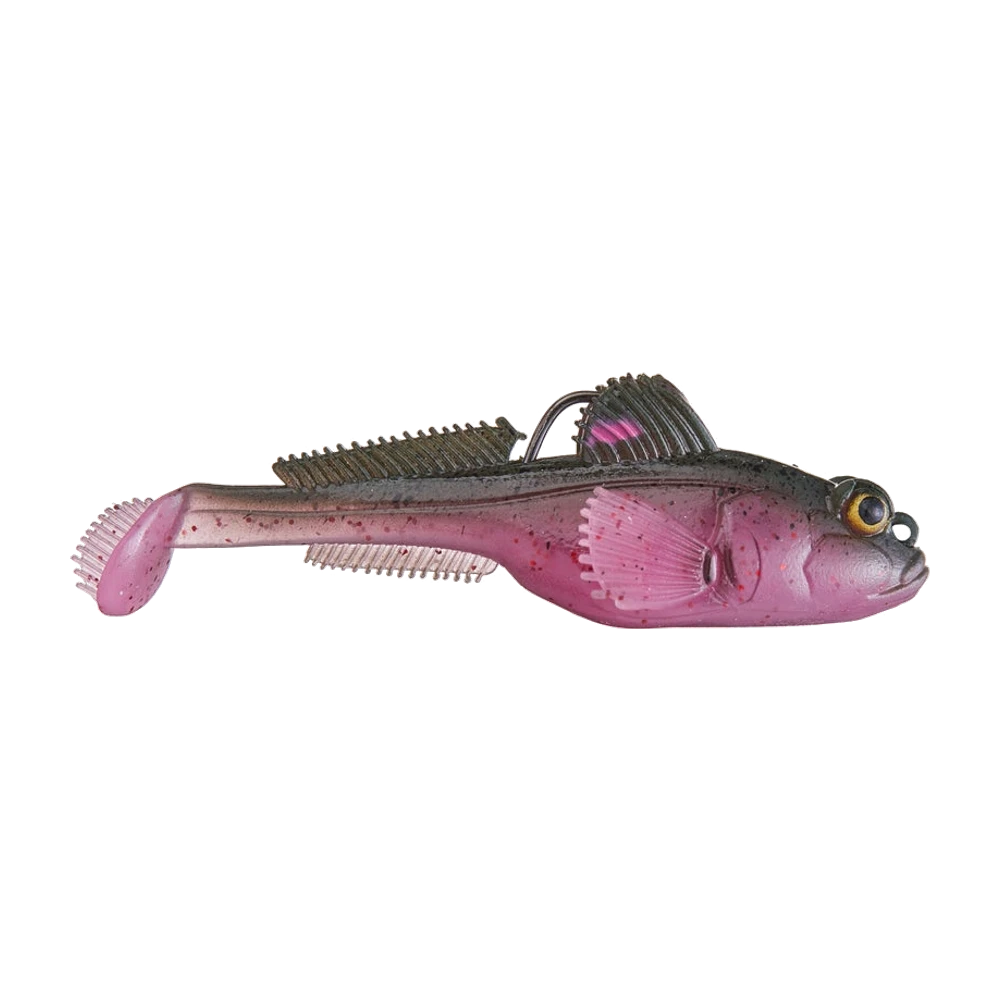
Over the past fifteen years or so the round goby has colonised the Rhine, the Moselle, the Danube and a good part of Europe's major navigable waterways. Zander and perch in those stretches have changed their diet: they spend much of their time nose-down on the bottom, hunting a stocky little fish with no swim bladder that moves in short hops between rip-rap blocks. Z-Man's Gobius Swimbait is a direct answer to that kind of forage, delivered pre-rigged and ready to fish.
Pre-rigged, and what that word actually covers
The Gobius comes with its lead head already in place, a structure-jig style lead harness moulded into the body, and a 1/0 medium wire sickle hook in a black nickel finish. Nothing to assemble, nothing to choose, nothing to get wrong. Three head weights are offered, all on the same 3 in body, roughly 7.6 cm: 3/8 oz (10.6 g), 1/2 oz (14.2 g) and 3/4 oz (21.3 g).
That point is worth reading carefully, because it often gets read backwards: the column that changes from one item to the next is the weight, not the length. All three versions share exactly the same silhouette. So you pick a head weight the way you would pick a separate jighead: the lightest one that still lets you feel the bottom at the day's depth and current.
The body is moulded from Z-Man's 10X Tough Elaztech, the house elastomer known for lasting far longer than PVC plastisol. On a pre-rigged lure that durability carries extra weight: when the body of a conventional soft bait is finished you replace it for pennies, whereas here the body is married to a head and a hook you would throw away with it. That is the core argument of the product, and it is also what justifies its price against a bare soft plastic.
The resting posture is the real selling point
Z-Man describes a combination of balanced weighting and highly buoyant plastic that gives the lure a tail-up posture when it sits on the bottom, meant to mimic a small baitfish feeding on the substrate. That is exactly the stance of a feeding goby, and it is what you should build your presentation around.
Be careful not to conflate two things, though. The complete lure, carrying 10 to 21 g of lead, sinks firmly: this is not a floating lure. It is the body that is buoyant, and that relative buoyancy only serves to lift the rear end once the head has settled. The result on hard bottom is a Gobius parked nose-down, tail up, with the paddle quivering at the slightest movement of the line.
Check the posture in a bucket or in the first metre of water before you fish, with the weight you actually plan to use. Depending on body density and wear the angle is not always as pronounced as advertised, and knowing what your lure looks like at rest changes how you pause it.
How to work it
Slow retrieve in contact
The small rounded paddle produces a discreet swimming action, not a wide thump. That is intentional: a goby does not swim like a bleak. Retrieve slowly, touching bottom every two or three seconds, and let the paddle do its own work. Over sand or gravel that regular contact raises a fine cloud that matters as much as the vibration.
Pull and fall
A short lift of the rod, then follow the descent on a semi-tight line. The lure lifts off, parachutes forward thanks to the horizontal balance of the harness, and settles back tail-up. The bite almost always comes during the fall or within two seconds of the landing.
Sight fishing on sonar
The Gobius was designed in an era when live imaging is changing the way we fish the bottom, and its stable horizontal posture during the descent makes it easy to read on screen. Do not overplay it, though: a goby does not hover in open water. Suspend it three metres off the bottom for a minute and you strip it of everything that makes it credible.
What the split dorsal really changes
The dorsal fin is split into two sections and the hook point tucks between them. It works as a soft brush guard: the lure deflects off rip-rap, stumps and boulders without the point burying itself, yet the point frees up the moment a fish closes its mouth on it. It is a subtler compromise than a stiff weed guard, which hampers the hookset.
The system has one honest limit: it protects against snagging on an edge, not against wedging between two blocks. In sharply angled rip-rap you will still lose lures, and since the head and the hook go with the body, that costs more than a soft plastic on a cheap jighead.
The classic mistake
Grabbing the 3/4 oz by default because the water is deep. Twenty-one grams on a 7.6 cm lure flattens the paddle's quiver completely and turns the Gobius into a disguised sinker. Start with the 3/8 oz and only go heavier when you stop feeling the bottom or when wind lifts your line.
Not sure what to tie on?
Photograph your spot: CarnaFish reads the scene, cross-checks the conditions and gives you the zone, the lure and the retrieve. Free on iOS and Android.
Colors by water clarity
Z-Man does not publish a named color list for this bait, only a range. So reason in families of shades.
- Clear water, light bottom: the natural speckled olive-brown finishes, which reproduce the real livery of a goby sitting on gravel. The hand-painted details and the yellow-ringed eye earn their keep at close viewing range.
- Stained water or dark bottom: the bright-flanked versions, like the red-flaked magenta pink in the photo with its olive-brown back. That is not imitation, it is a contrast marker, and it works well on zander in coloured water.
- Low light, deep water: a solid dark back and a neutral belly, for a clean silhouette rather than a perceived color.
Next to other goby imitations
The soft tube remains the oldest and cheapest goby imitation: a Z-Man TRD TubeZ on an internal jighead gives a spiralling fall the Gobius does not reproduce. Conversely, the Gobius brings a level of visual detail and a resting posture a tube does not have. For faster searching over the same ground, a Z-Man Slim SwimZ on a plain jighead covers more water to find fish before you slow down.
The right lure does not replace reading the spot, and that is exactly what CarnaFish does: take a photo of the swim and the AI suggests the zone, the depth and the lure family that fit the conditions. To structure your approach to lure fishing for zander, our beginner guide to zander fishing lays out the basics.
What to remember
- The three items differ by head weight (10.6, 14.2 and 21.3 g), not by length: the body is always 7.6 cm.
- Only the body is buoyant; the complete lure sinks and settles tail-up on the bottom.
- The split dorsal protects the point against edges but will not save you from wedging between two blocks.
- Always start with the lightest head that still lets you feel the bottom.
FAQ
Does the Gobius Swimbait come in several sizes?
The description mentions multiple sizes, but the spec table supplied lists only one body length, 3 in, offered in three head weights. Treat this page as covering the 3 in format, and check the exact figure on the packaging if you are after another size.
Which head weight should I start with?
The 3/8 oz, 10.6 g. That is the weight that leaves the small paddle the most freedom and is enough in most situations down to five or six metres in still water. Move up to 1/2 or 3/4 oz only when current or wind stop you feeling the bottom.
Does the lure really float?
Not as a whole, no. Z-Man advertises a highly buoyant plastic, but the integrated lead head weighs between 10 and 21 g, so the assembly sinks. The buoyancy of the body only serves to lift the tail once the lure is down.
Should I add a treble or a stinger?
No. The lure ships pre-rigged with a 1/0 medium wire sickle, and the split dorsal is designed to shield it. Adding a treble would destroy its ability to deflect off rock, which is the whole point of the bait.
Is it a good zander lure in Europe?
Yes, and for a concrete reason: the round goby has become a major zander forage on several large European river systems. An imitation worked slowly on the bottom matches exactly what the fish is hunting there.
Can the body be replaced on its own?
Z-Man publishes nothing on that for this item: the Gobius is presented as a body, head and hook assembly. Budget accordingly, because a lure lost in rip-rap costs far more than a soft plastic on a bare jighead.
The full zander lure guideSeason-by-season strategy: which family of lure, when, and why.Go from theory to fish
CarnaFish reads your spot from a photo and gives you the game plan: zone, lure, retrieve. Free on iOS and Android.