Hog Farmer Spunk Shad: the thread tail that rewrites the swim
One lure, endless conditions. CarnaFish reads your spot from a photo so you are not just guessing.
There are days when a wide paddle shad gets refused three casts in a row and nobody can say why. The fish follows, studies, leaves. The signal is too loud, too regular, too mechanical. The Spunk Shad solves that with a part almost no product page explains properly: a tail reduced to a thread, which does not slap the water but snakes through it.
A tail that is nothing like a paddle
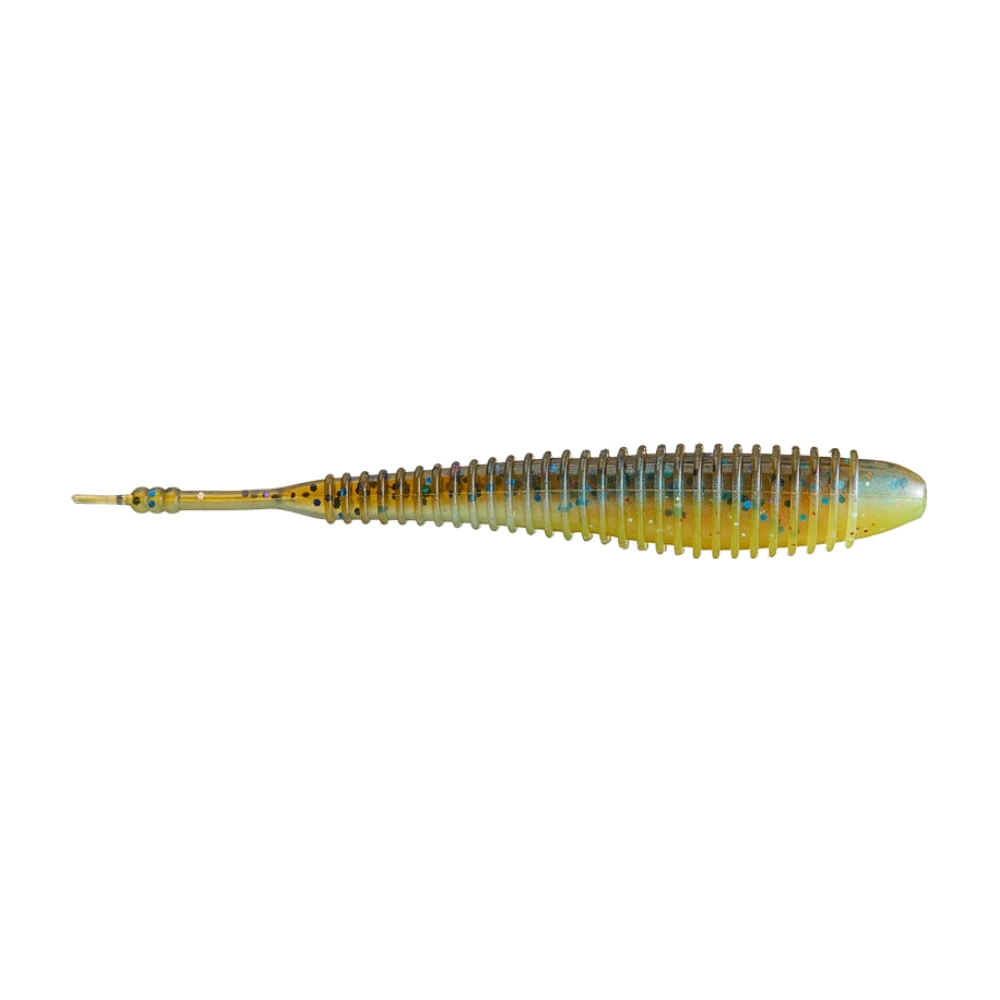
In the photo on this page the bait is shown bare, and the detail jumps out: the body is covered in tight horizontal ribs and ends in an unusually fine appendage, a plain thread finished with a tiny blade. That is what the maker calls a pintail profile, and it is the exact opposite of a big-paddle shad.
The practical consequence matters. A wide paddle produces a broad, rhythmic thump that a fish detects from a long way off but eventually reads as artificial after the third pass. A thread tail generates almost no low-frequency vibration: it undulates, it twists, it follows the body's own wake. The result is a furtive swim, closer to a small fish fleeing than to a lure announcing itself. Next to a Keitech Easy Shiner 3 you are changing signal category entirely, not just size.
Reading the table correctly
The maker's table has two columns, and the second one is not what it looks like at first glance. It reads Length Quantity, then 3 in for 12, 3.5 in for 9, 4.5 in for 7, 5.5 in for 6 and 6.5 in for 5. That second figure is the number of pieces per pack, not a weight. In centimetres that gives five lengths: 7.6, 8.9, 11.4, 14 and 16.5 cm.
And it needs saying plainly: the per-bait weight is not published. The maker gives no grammage, no density and no buoyancy statement. That has real consequences for jighead choice, because you cannot work out the bait-plus-head total in advance. You either weigh one at home or accept some trial and error on the first two casts. One catalogue detail worth knowing too: the maker notes that Natural Gill and Bluegill are the same colour across some packaging runs.
Three rigs, three different lures
The description points first to two rigs, and they do not produce remotely the same bait.
Scrounger head
This is the rig that makes the most of the ribbed body. A scrounger head carries a soft bill-shaped collar that makes the whole thing zigzag on a straight retrieve. Paired with a pintail, it produces a hesitant path that drifts from one side to the other instead of running straight. The retrieve is deliberately slow and continuous: you let the head do the deflecting and the tail handles the rest.
Bladed jig
Rigged as a trailer behind a vibrating blade, the Spunk Shad does the opposite job of a big paddle shad. Where a heavy-tailed trailer adds vibration to a blade that already makes plenty, the thread tail lets the blade speak alone and contributes only volume and a residual movement. On a Zman Chatterbait Jackhammer that is exactly what you want when the water is clear and the fish have already seen ten blades this season.
Weightless, as a soft jerkbait
The third use, the one the maker highlights, is the weightless Texas rig. A wide-gap hook through the back, no weight at all, and an action made of sharp rod snaps with slack between them. The bait then shoots off in irregular sideways darts, with no predictable path, and sinks slowly between snaps. Same principle as a Zman Scented Jerk Shadz, with a ribbed body that slows the fall a little more.
With a tail this fine, the mistake is cutting or shortening it by threading the hook crooked. Take the time to line the bait up along the shank before you pierce it: a pintail offset by two millimetres makes the whole body roll on the retrieve, and the bait starts putting twist into your line.
Picking a size by water and by species
Five lengths is a lot, and they do not serve the same situations. The 7.6 and 8.9 cm are pure finesse sizes: clear water, pressured fish, slow fishing. The 11.4 cm is the all-rounder, equally at home behind a bladed jig or rigged weightless. The 14 and 16.5 cm shift into another category entirely, the one where you present a big volume over few casts.
Worth noting: the pieces-per-pack count drops as the size goes up, from twelve for the smallest down to five for the biggest. On an unarmoured soft plastic that wears fast once a fish chews it, that point counts as much as the price on the tag.
The maker only mentions bass. In Europe the 7.6 to 11.4 cm sizes also work very well on perch and zander, precisely because a thread tail puts out a discreet signal those two species accept better than a noisy paddle — that is an extrapolation from European fishing rather than a maker's claim, but it follows directly from the action described.
Not sure what to tie on?
Photograph your spot: CarnaFish reads the scene, cross-checks the conditions and gives you the zone, the lure and the retrieve. Free on iOS and Android.
Colour by water
- Clear water: translucent olive gold with blue and black flake, exactly the finish visible in the photo on this page. The transparency avoids the opaque block that gives an artificial away in clear water.
- Stained water: pearl white or a light opaque tone, still readable at a metre of visibility without ever turning garish.
- Dark water or low light: a solid dark tone. On this kind of bait the silhouette carries, not the colour.
A second-choice shad, for when the first one gets refused
The Spunk Shad is not the bait you start a day with. Its place is just after: when a standard shad has raised fish without closing them, dialling the signal down usually pays better than changing colour or size. The missing weight data remains the real weakness of its spec sheet, and that is the sort of thing you would rather know before you are standing at the water.
Finding the right signal level starts with reading the spot and the water clarity, and that is exactly what CarnaFish makes easier: a photo of the spot, and the app suggests a zone and a presentation suited to the day's conditions. For the tackle and spot-reading fundamentals for bass, our beginner's guide to bass fishing is a good place to start.
Key takeaways
- The pintail puts out a discreet signal: this is a second-pass bait, not a noisy searching bait.
- The maker's table gives length and pieces per pack, never a per-bait weight — weigh one yourself before picking a head.
- Three very different rigs: scrounger for the zigzag, bladed jig as a quiet trailer, weightless Texas for soft jerkbait work.
- Line the bait up carefully on the shank: an offset thread tail will put twist in your line within a few metres.
FAQ
What sizes actually exist?
Five lengths in the maker's table: 3, 3.5, 4.5, 5.5 and 6.5 in, so 7.6, 8.9, 11.4, 14 and 16.5 cm. The 12, 9, 7, 6 and 5 alongside them are the number of pieces per pack, not a weight.
How much does a Spunk Shad weigh?
The maker does not publish it, and that is a genuine gap in the spec sheet. If you need the total weight to match a rod or calibrate a cast, weigh a piece at home rather than trusting an estimate based on length.
Does it float or sink?
The table carries no buoyancy column and the text does not state one either, so nothing can be asserted here. Test it in 30 cm of water at your feet before building an action around an assumed fall rate.
How does it differ from a standard paddle shad?
The thread tail does not slap the water, it undulates through it. You lose vibration range, so some ability to pull a fish in from a distance, and you gain discretion on fish that have already refused a loud swim.
Does it work as a bladed jig trailer?
Yes, it is one of the two rigs the maker highlights. Its specific value is not adding vibration to a blade that already makes plenty: you keep the volume and the silhouette without saturating the signal.
Does it catch anything besides bass?
The maker only mentions bass. In Europe the 7.6 to 11.4 cm sizes produce well on perch and zander, for the same reason they work on a wary bass: a weak signal gets past a fish that has already seen plenty of lures.
The full bass lure guideSeason-by-season strategy: which family of lure, when, and why.Go from theory to fish
CarnaFish reads your spot from a photo and gives you the game plan: zone, lure, retrieve. Free on iOS and Android.