6th Sense Masterclass Strobe Shaker: the shad that rolls on its own
One lure, endless conditions. CarnaFish reads your spot from a photo so you are not just guessing.
A fish sitting still on the forward-facing sonar screen, twelve metres ahead of the boat, suspended three metres down. You cast, you start working the rod, and while your attention is on the tip you lose track of the bait's depth: the fish drops back towards the bottom. The fish is almost never the problem. The problem is having to animate a soft bait before it comes alive. The Masterclass Strobe Shaker is built to remove that step.
A vertical lip moulded into the head
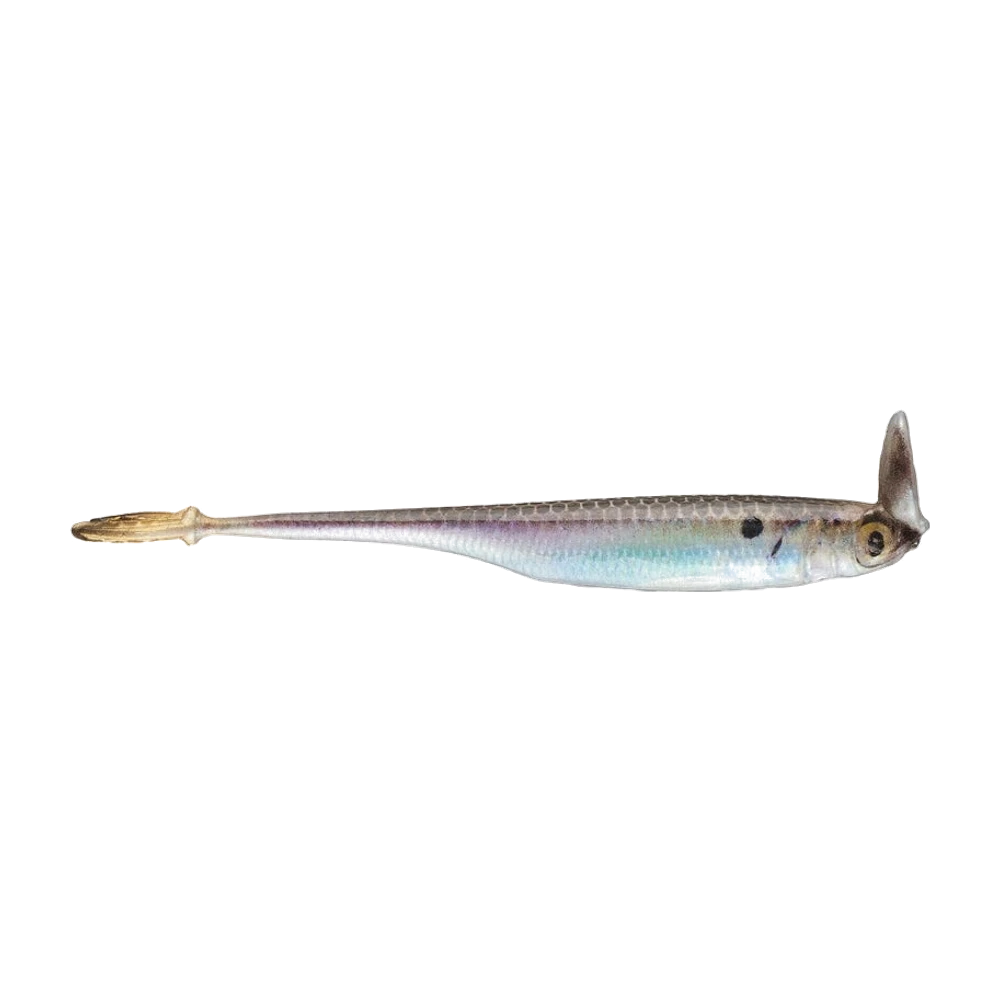
What makes the Strobe Shaker different is visible in ten seconds on the shelf: a small rounded, vertical lip moulded straight into the head of the soft bait. It is not cosmetic. That surface grabs water ahead of the body and creates a permanent imbalance with every turn of the handle. The bait does not swim straight, it rolls on its axis, flank over flank, without stopping.
That turns the usual logic upside down. On a paddle-tail shad the action starts at the back — the tail kicks and the body more or less follows. Here the engine is at the front and the tail is just an accompaniment. The practical consequence is that the bait works from the first few centimetres of the retrieve, even at a very low speed, without having to wind faster to switch the tail on.
The roll serves one main purpose: showing each flank in turn. The scale finishes and 3D paint schemes of the Masterclass line then throw back a short, repeated flash at a regular frequency. That is where the name comes from, and it is exactly the signal that gets a reaction from a fish watching a lure come in from a distance in clear water.
The flat tail and its small nub
The Strobe Shaker's tail is flat and thin, with a small nub at its base, a deliberate thickening. That detail creates a precise hinge point: instead of bending anywhere along its length, the tail always articulates at the same place, just behind the body. The secondary action that comes out of it is a quiver and a slight wave, not a wide kick.
You need to understand the hierarchy between the two actions, because it dictates how you fish the bait. The body roll is the primary, visible action, the one that carries the signal. The tail quiver is a finishing touch, a background noise that makes the whole thing credible once the fish is fifty centimetres away. Speed up to drive the tail harder and you kill the roll, which means you lose the point of the bait.
The habit to build with this bait is to reel more slowly than your instinct tells you. Count two seconds between turns of the handle and watch the rod tip: as soon as the tip stops pulsing regularly, you are too slow. As soon as the vibration becomes smooth and continuous, you are too fast. The right speed is the one where you feel a clear, spaced-out pulse.
Working it: as little as possible
The Strobe Shaker is a straight-retrieve bait. Nothing else. You cast, count it down to the layer you are interested in, and reel at a constant speed. No twitches, no slack, no sawing motion. That feels odd to an angler used to bringing soft baits to life with the rod, and it is exactly what makes it easy to fish when your attention is elsewhere — on the screen, on the line of the cast, on the fish's depth.
The only genuinely useful variation is a sharp half-second stop when a fish follows without committing. The bait tips nose down, the roll breaks off, the tail keeps quivering for a moment on inertia: that break in rhythm often triggers the bite. But use it once, and do not repeat it.
The rig that protects the roll
6th Sense designs the Strobe Shaker around a round tungsten jig head such as the Masterclass Tungsten Ball Jig Head, and that choice matters. A round head is hydrodynamically neutral: it creates no lift and therefore does not fight the lip. A shaped head with a beak or a flat competes with it and flattens the roll.
On weight, stay at the minimum that reaches the depth you want within a sink time you can accept. Too heavy a head pulls the nose down, changes the bait's attitude and cuts the amplitude of the roll. It is the same trap as on a finesse shad fished Ned-style: wanting to get down fast costs you the whole quality of the swimming action.
A finesse spinning rod, thin braid for detection and one to one and a half metres of fluorocarbon leader complete the set-up. The fluorocarbon is not there for abrasion resistance but for discretion: this bait fishes clear water, on fish that see everything.
The classic mistake
Fishing it like a standard shad. An angler who takes the Strobe Shaker out of the bag and starts making it dance on rod twitches gets a bait that spins out, leaves its path and becomes unreadable. The second mistake is picking an oversized jig head to feel the bait better. If you need weight to feel your bait, your braid is too thick or your rod too soft — the head is not too light.
Where and when it catches
This bait is made for clear water and visible fish. Its sweet spot is bass suspended over a hole, scattered schools in open water, and more generally every situation where you know where the fish is and at what depth. It then beats a standard shad precisely because it leaves your mind free to manage depth and trajectory.
It also has clear limits, and it is only honest to state them. In dirty water the flash of the flanks is useless and a big-paddle shad putting out strong vibration will do better — a Keitech Easy Shiner 4 or a Megabass Hazedong Shad take over there. In thick vegetation the lip catches weed and an exposed jig head is not weedless. And it is not a search bait: to sweep large areas blind, a crankbait or a spinnerbait cover ten times the ground.
Not sure what to tie on?
Photograph your spot: CarnaFish reads the scene, cross-checks the conditions and gives you the zone, the lure and the retrieve. Free on iOS and Android.
Colours by water clarity
- Very clear water: a translucent baitfish imitation, silver flanks and a quiet back. The roll creates the flash, the colour does not need to add any.
- Lightly stained water: a pattern with a dark back and marked contrast between back and flanks. That contrast stays readable when transparency drops.
- Low light, dawn or real depth: a pale pearl shade, nearly white, which keeps a visible silhouette when there is no longer enough light to make a silver flank shine.
A precision bait, not a search bait
The Strobe Shaker belongs to a recent family of soft baits designed for forward-facing sonar fishing, alongside the 6th Sense Panorama from the same brand. The difference between the two is clear: the Panorama relies on an ultra-thin profile and rigging versatility, the Strobe Shaker on a self-swimming straight retrieve. If you mostly fish on sight with a steady retrieve, the second one is the one you want.
That said, a precision bait is worth nothing if you have not identified the right layer of water and the right kind of spot. That is what CarnaFish is for: a photo of the spot, and the AI suggests a zone, a depth and a lure family suited to the day's conditions. To build the basics of tackle and spot reading for bass, our beginner's guide to bass fishing is a good place to start.
Key takeaways
- The vertical lip moulded into the head creates a permanent roll on a straight retrieve, with no rod work at all.
- The flat tail and its nub produce a secondary quiver, not a kick: there is no point speeding up to drive it.
- Round tungsten jig head, at the lightest useful weight: any other shape or any excess weight flattens the roll.
- A clear-water, located-fish bait, not one for broad searching or thick weed.
FAQ
Do I need to work the Masterclass Strobe Shaker with the rod?
No, and that is the whole point. Its integrated lip makes it roll on a pure linear retrieve. Rod twitches pull it off its path and break the roll that carries its main signal.
What jig head weight should I use?
The lightest weight that reaches the layer you are targeting within an acceptable sink time. Too heavy a head pulls the nose down, changes the bait's attitude and clearly reduces the amplitude of the roll.
Why a round head rather than a shaped one?
Because a round head is neutral in the water and lets the bait's own lip do the work. A beaked or flat-nosed head generates its own lift and competes with it, which flattens the swimming action.
Does the Strobe Shaker work in dirty water?
Far less well. Its action relies on alternating flashes from the flanks, so on visibility. In stained or muddy water, a wide-paddle shad putting out genuine low-frequency vibration will be more effective.
Will it come through weed?
No. On a bare jig head the hook point stays exposed and the lip catches vegetation. Over a weed bed, a soft bait rigged Texas weedless is the better answer.
What is the difference with the 6th Sense Panorama?
The 6th Sense Panorama is a very thin-profile shad built first for the drop shot and for various weighted rigs, while the Strobe Shaker is made to swim on its own on a straight retrieve with a jig head. One is fished mostly vertically or on the bottom, the other across the water column.
The full bass lure guideSeason-by-season strategy: which family of lure, when, and why.Go from theory to fish
CarnaFish reads your spot from a photo and gives you the game plan: zone, lure, retrieve. Free on iOS and Android.