6th Sense Party Prop Spy Bait: the twin-prop spybait for wary bass
Not sure this lure fits YOUR spot today? CarnaFish tells you in 10 seconds, from a photo.
Everyone has had this day: clear water, fish showing on the graph between six and twelve feet, and nothing committing. The crankbait goes by too fast, the soft plastic sinks past them, and bass follow without ever eating. That gap is exactly why the spybait was invented, and the 6th Sense Party Prop — developed with Bassmaster Elite Series pro Cory Johnston — brings a twist to it: two props instead of one.
Two props, not one
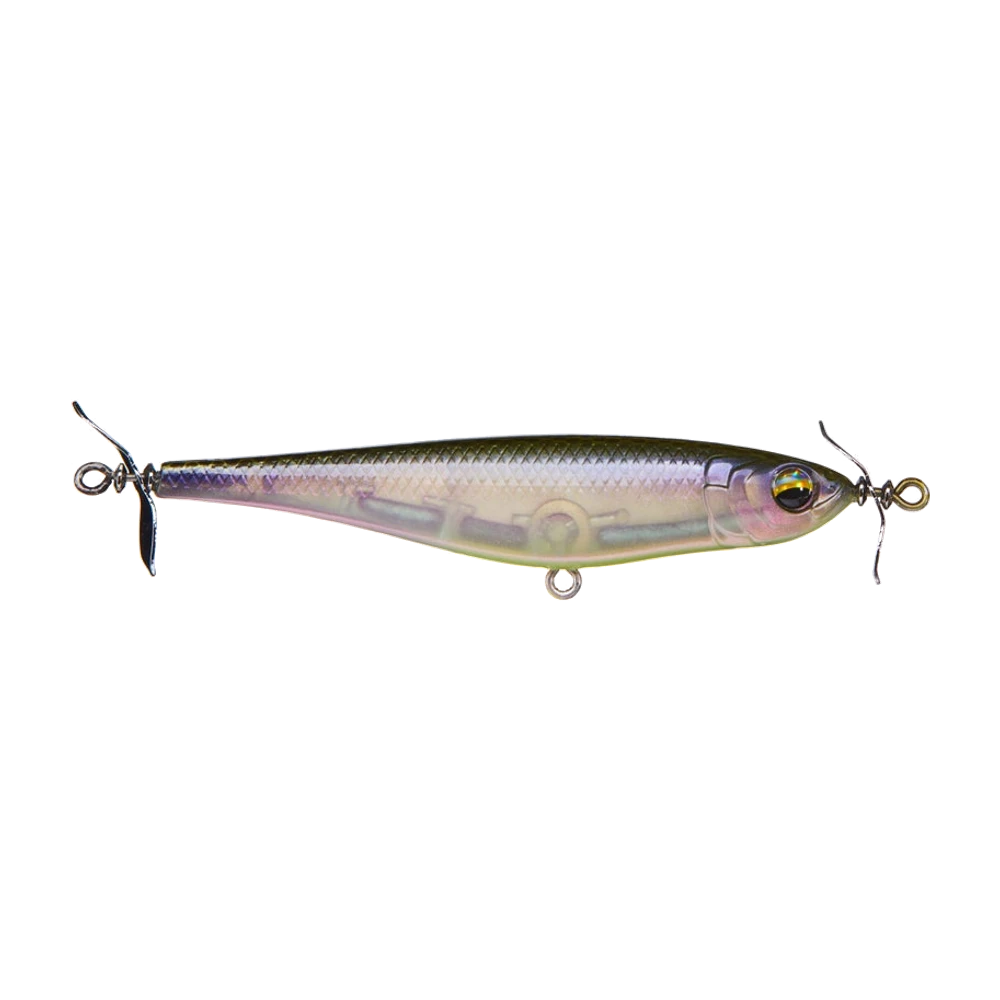
Most Japanese spybaits carry a prop at each end, but the Party Prop makes that its whole identity rather than a detail. One prop at the nose, one at the tail, and both start turning as soon as the lure moves a few inches. The point isn't noise. The point is that the props supply the signal while the body does nothing at all. The lure tracks dead straight through the water, no roll, no shimmy, and it's that contrast between a perfectly stable body and two separate points of flash and vibration that holds a wary fish.
A bass that has seen twenty lures go past in a week responds badly to a wide, loud action. It responds well to something that looks like a panicked baitfish but doesn't thrash. The Party Prop's body plays that card: a streamlined baitfish silhouette, etched scales and sculpted gill plates, 3D eyes — the finish level of a lure built for clear water, where the fish gets time to look before it decides.
It sinks, and that's the whole idea
One thing to get straight: props on a lure make most anglers think topwater. The Party Prop is not a topwater propbait. Both sizes are rated as sinking baits, and the fishing happens between roughly three and twelve feet depending on the count you give it. The internal weights are placed to keep the bait on an even keel as it falls and to let you bomb it across open water, which is the basic condition of the technique — you are never going to coax a spooky bass thirty feet off the boat.
The sequence is always the same. Cast, let it sink while you count — one number per second is precise enough — then reel at the slowest speed your reel will turn without stuttering. If you can feel the props buzzing in the rod tip, you're already going too fast for some days. The right cadence is the one where you sense the props working rather than feel them.
Actually remember the count
The habit that changes everything: when you get a bite, keep the count. Three seconds of fall is one water layer, eight seconds is a different one. Mid-column bass sit together, and repeating exactly the same count on the next cast is worth more than any color change. The 60 mm sinks more slowly than the 80 mm, so counts don't transfer between the two sizes.
If you can't slow down enough, change the reel rather than the lure. Drop to a low gear ratio and keep the rod tip low, almost in the water: the line then works flat and the bait holds its depth instead of climbing through the retrieve.
The two sizes do different jobs
The 60 mm weighs about 0.19 oz (5.4 g) at 2.36 in, the 80 mm about 0.37 oz (10.5 g) at a shade over 3 in. The weight gap is close to double, which has three practical consequences: the 80 mm casts far further, it sinks faster, and it holds up better in wind or light current. The 60 mm demands genuinely light tackle, but it's the one that cracks the hardest fish, and it's also the one that regularly picks up perch in clear water, where the 80 mm is a touch large for them.
On water you know, start with the 80 mm to cover ground on long casts, then switch to the 60 mm over the areas that gave you follows without bites. It's a standard search-then-refine logic, the same one you'd run with a jerkbait like the 6th Sense Provoke — except here you aren't trying to trigger a reflex strike, you're trying to talk a fish out of its caution.
Line and leader
Spybaiting is one of the rare techniques where tackle genuinely decides the outcome. A light or medium-light rod with a fast tip, a reel loaded with thin braid, and three to five feet of fluorocarbon leader around 0.20-0.25 mm: that's the foundation. Braid gives you the contact to register a bite that, on a spybait, usually amounts to a weight settling into the line with no distinct tap.
Tie the fluorocarbon straight to the eye, no snap. The Party Prop has no bill to free up, and a snap adds weight at the nose, which makes it fall head-down. Finally, keep an eye on the stock trebles. On a sinking bait you fish slowly and reel in hundreds of times, a point dulled against a rock costs you the only fish of the day — and on a spybait, fish come off very easily because there's no inertia in the fight to pin them.
Not sure what to tie on?
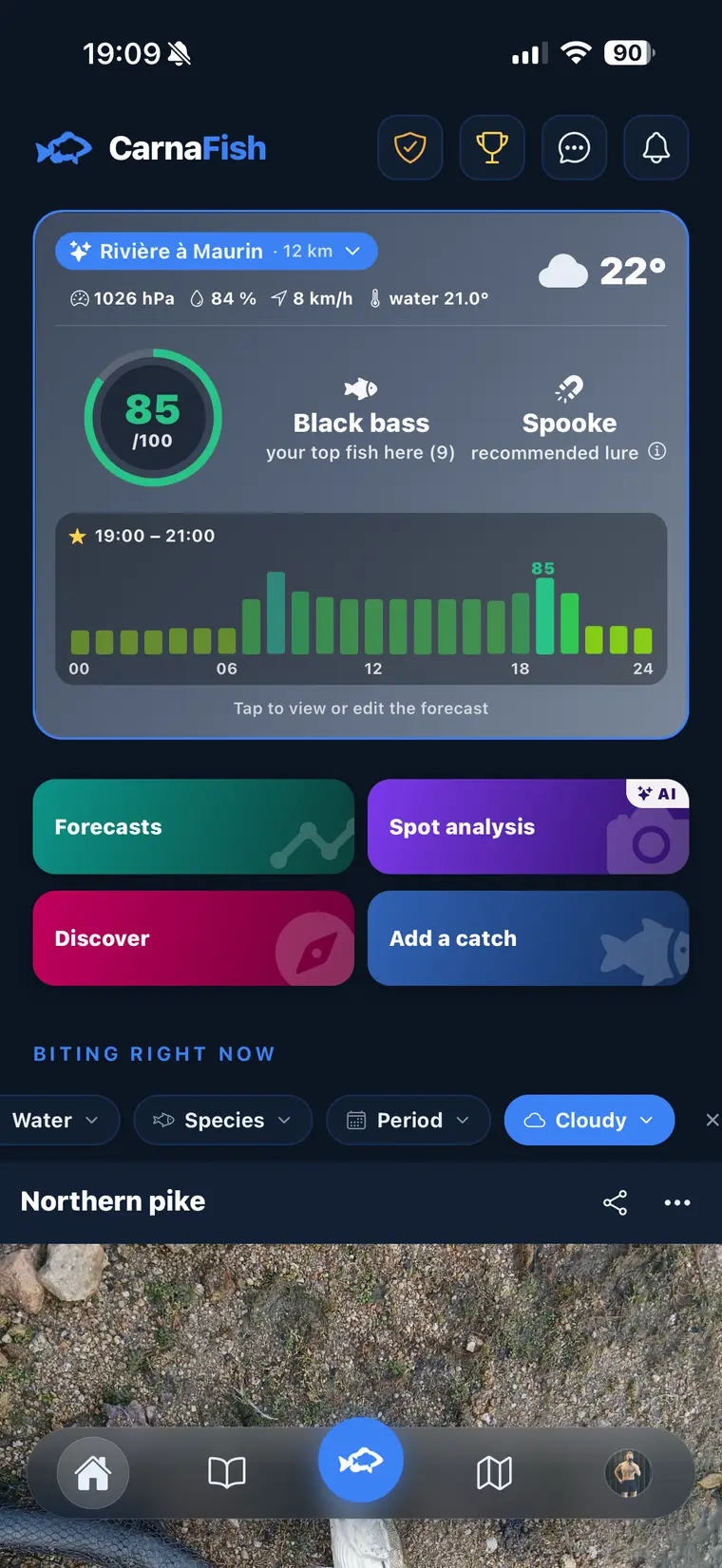
Photograph your spot: CarnaFish reads the scene, cross-checks the conditions and gives you the zone, the lure and the retrieve. Free on iOS and Android.
Colors by water clarity
- Clear water: a translucent ghost shad pattern that passes light through and doesn't contradict the props' understated work.
- Lightly stained water: a natural back over a chartreuse belly, the usual compromise between credibility and visibility in the mid-column.
- Low light or dirty water: a dark profile. At that point silhouette and vibration carry the lure, not color.
A last-resort lure, and happy to be one
A spybait is not a fast search bait and doesn't pretend to be. It's what you reach for once the fish are located and refusing everything else. In that niche the Party Prop sits alongside the Duo Realis Spinbait 80 and the Duo Realis Spinbait 90, with a slightly stronger vibration signature thanks to its two props.
That said, the best spybait in the world is useless in the wrong place. That's exactly what CarnaFish is for: a photo of the spot, and the AI suggests the zone, the depth and the kind of presentation that suit the day's conditions. To lay the groundwork, our beginner's guide to bass fishing walks through the lure families worth knowing before you get this finesse-deep.
Key takeaways
- The two props deliver flash and vibration while the body tracks straight — that contrast is what fools a fish that has seen everything.
- Sinking bait, not topwater. Fish it between three and twelve feet on a count, and remember the count that produced the bite.
- The 60 mm for the hardest fish and for perch in clear water, the 80 mm to cast far and cover water in wind.
- Too fast doesn't work. Low gear ratio, rod tip down, props barely perceptible in the blank.
FAQ
Is the 6th Sense Party Prop a topwater lure?
No, despite the props. Both versions are sinking baits fished in the water column, usually between three and twelve feet. The attraction comes from the props, not from buoyancy.
Should I pick the 60 mm or the 80 mm?
The 80 mm, around 0.37 oz, to cast far, sink quickly and cope with wind. The 60 mm, around 0.19 oz, for the wariest fish and for perch in clear water. They sink at different rates, so counts don't carry over.
How slowly should I retrieve a spybait?
As slowly as your reel will turn without stuttering. If the props buzz hard in the rod tip, you're probably going too fast. A low gear ratio and a rod tip near the water help a lot.
Do I need a fluorocarbon leader?
Yes, roughly 0.20-0.25 mm over three to five feet, tied straight to the eye. Skip the snap: it loads the nose and tips the bait head-down on the fall.
Will the Party Prop work for pike or zander?
That's not what it's for. Fine trebles, light hardware and this weight range keep it a clear-water bass and perch bait. For zander or pike, a lipless or a deep-diving crankbait makes far more sense.
How is it different from a classic Japanese spybait?
In principle it isn't: stable body, props at both ends, slow retrieve. The difference is the vibration signature, a little more present than on a Duo Realis Spinbait 80, plus two sizes spaced well apart in weight.
The full bass lure guideSeason-by-season strategy: which family of lure, when, and why.Go from theory to fish
CarnaFish reads your spot from a photo and gives you the game plan: zone, lure, retrieve. Free on iOS and Android.