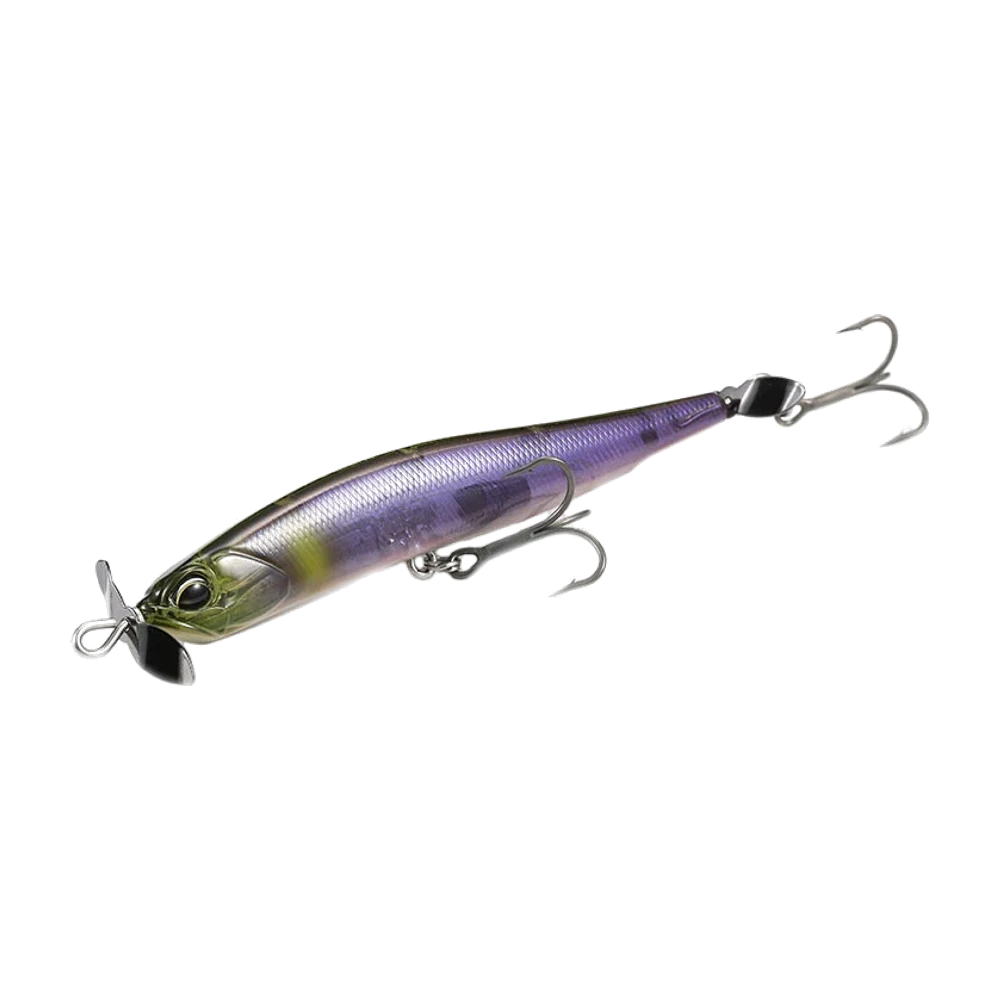
DUO Realis Spinbait 90: the spybait that reaches deep water and the sea
Rather not fish it blind? Photograph your spot — CarnaFish cross-checks the conditions and points you the right way.
You have been spybaiting for two seasons, the technique has saved you whole days, and now you are running into two very concrete limits. The first: the fish are sitting at six metres and you spend two minutes letting a light lure sink before every retrieve. The second: as soon as there is a bit of wind you can no longer reach the zone, and the line bows into an arc that makes the retrieve impossible to read.
Stepping up a size answers exactly those two problems. The spybait principle is unchanged — if you are new to it, the Spinbait 80 explains the mechanics and the basic retrieve in detail, and everything said there applies here. This page deals only with what changes.
The four differences that matter
The sink rate almost doubles. Where the small model drops around thirty centimetres per second, the 90 is noticeably faster, around 40 cm per second. In practice you reach six metres in about fifteen seconds instead of waiting twenty. Over a full day working deep water, that changes how many casts you get in.
Casting distance goes up sharply. The extra mass buys you ten metres or so on a normal cast, and a great deal more into a headwind. On a flat where the fish are a long way from the boat or the bank, that is often what decides the day.
The lure holds better in disturbed water. The 80 is built for mirror surfaces. The 90, being denser, keeps a stable path in a bit of chop and tolerates a slightly bowed line without rolling onto its side.
The profile speaks to bigger fish. The extra centimetre and the volume that comes with it filter out some of the smaller fish. On a water where you catch twenty-centimetre perch one after another with the small model, the 90 is far more selective.
Spybaiting in salt water: the use the 80 does not allow
This is the most interesting door this size opens. The spybait was designed for fresh water, but a 15 g lure with a slim profile becomes a genuinely relevant sea bass tool in one precise case: clear water, a calm sea, fish present but refusing everything.
The typical scenario turns up in late summer on rocky plateaus and around harbours: visible sea bass at mid-depth, following surface lures without taking them and ignoring shads. The spybait offers them exactly what they will accept — a straight path, no jerkiness, and a tiny flash.
The setup changes:
- 0.12-0.14 mm braid with a 0.30 mm fluorocarbon leader of at least a metre and a half. Fluoro straight through would cost too much distance.
- Rinse in fresh water every time after a session: the props and their shafts are the first things to seize up with salt.
- Check the trebles, which are fine as standard and designed for fresh water. For decent sea bass, plan on swapping them for an equivalent but stronger model.
On the water: when you move from the 80 to the 90, your sink counts are worthless. Recalibrate on the very first cast — let it drop to the bottom while counting, note the number, and then work in fractions of it. Anglers who keep their old counts spend the day fishing too deep.
Sink time reference
| Target depth | Indicative sink time | Typical use |
|---|---|---|
| 1.5 to 2 m | 4 to 5 s | Edge of a flat, high-sitting fish |
| 3 m | 7 to 8 s | Medium drop-off, standard searching |
| 5 m | 12 s | Deep flat, summer and winter |
| 7 to 8 m | 17 to 20 s | Winter fish on the bottom, neap tides at sea |
These are starting points in calm water. Add time if the fluorocarbon is thick or the line is long; take some off if there is current.
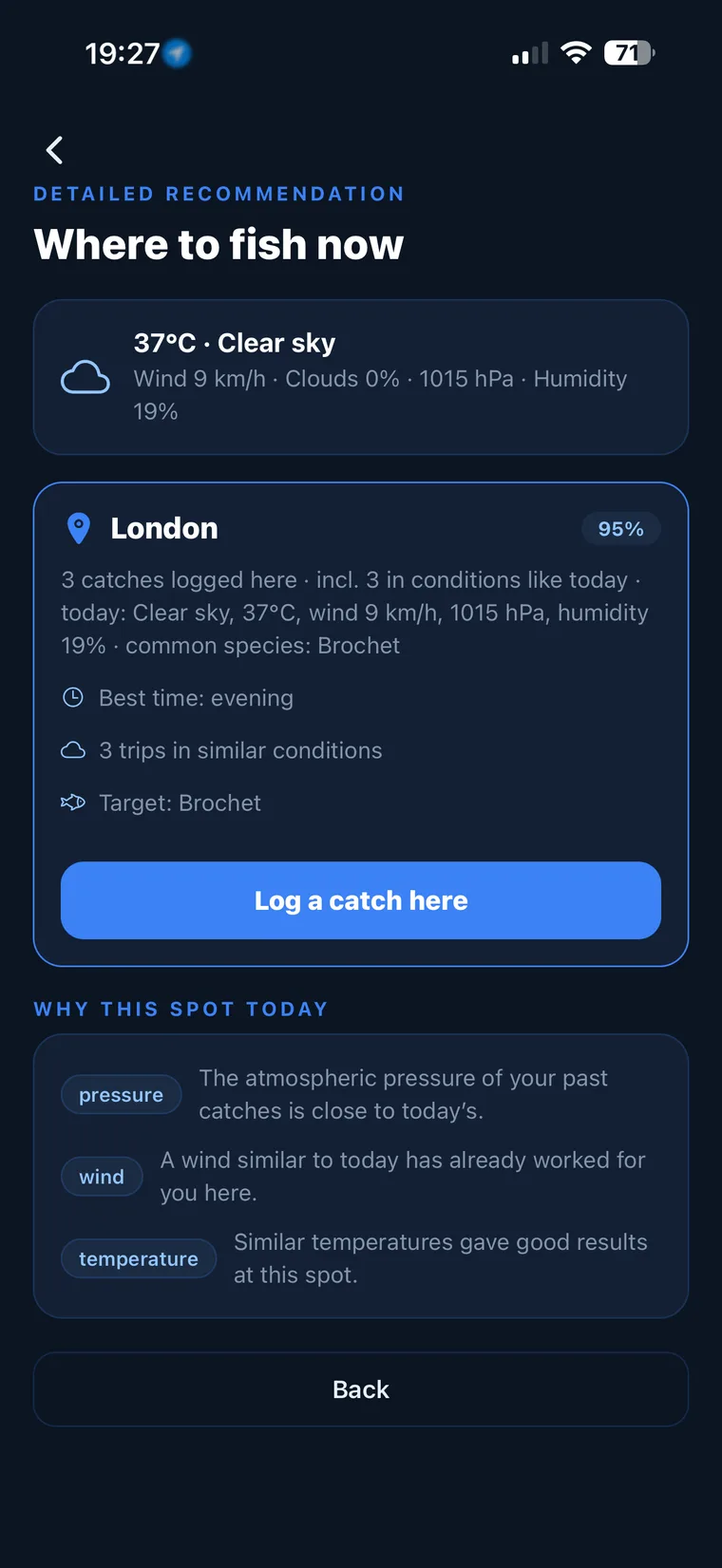
Not sure what to tie on?
Photograph your spot: CarnaFish reads the scene, cross-checks the conditions and gives you the zone, the lure and the retrieve. Free on iOS and Android.
Where the 90 beats the 80
- Big lakes and deep reservoirs, where the fish hold between four and eight metres for much of the year.
- Shore fishing over large expanses, when casting distance directly determines whether you reach the active zone.
- Days with a light breeze, which the small model cannot handle.
- Waters holding big fish, where the aim is size rather than numbers.
- The sea in calm weather, on wary sea bass in clear water.
Conversely, stay with the 80:
- In rivers and on small waters, where the depth never exceeds three metres.
- For perch, whose mouth and behaviour suit the shorter size better.
- On a dead-flat calm in fresh water, where any excess volume costs you.
Spinbait 90, jerkbait or weighted soft plastic
Against a suspending jerkbait such as the Lucky Craft Pointer 100, the spybait loses ground on covering water but gains on fish that refuse aggression: the jerkbait provokes, the spybait accompanies. On a given spot the logical order is usually to start with the jerkbait and finish with the spybait on the refusals.
Compared with a shad on a light jig head, the difference is the path: the soft plastic rises and falls, the spybait travels flat, which stays easier to read for a fish following a long way. And at sea, when the bass refuse the spybait too, a line-through lure such as the Line Thru Seeker keeps the same slow speed with a bulkier profile.
Our beginner's guide to bass fishing sets out the order to run through these approaches on the same spot. And if you cannot decide between the 80 and the 90 when you reach the water, CarnaFish analyses a photo of the spot and answers.
Key takeaways
- Same technique as the 80: very slow straight retrieve, no rod work at all.
- Sinks around 40 cm per second: recalibrate, your old counts no longer apply.
- Main gains: casting distance, access to deep layers, tolerance of light chop.
- A size that selects bigger fish and opens the door to sea bass in calm conditions.
- In rivers, on small waters or for perch, the 80 remains the right choice.
FAQ
What is the difference between the Spinbait 80 and the 90?
The 90 is longer and considerably heavier: it casts about ten metres further, sinks around 40 cm per second instead of 30, and tolerates a bit of chop. It also selects bigger fish. The retrieve itself is identical.
Does the spybait work for sea bass?
Yes, in one precise case: clear water, a calm sea, visible bass that refuse conventional lures. Fish it on fine braid with a long fluorocarbon leader, and rinse the props in fresh water after every session.
How long should you let it sink?
Count on around 40 cm per second in calm water: seven to eight seconds for three metres, twelve seconds for five. Always calibrate by letting it drop to the bottom once, then work in fractions of that time.
Should you change the hooks for salt water?
It is worth doing if you are targeting decent sea bass. The stock trebles are fine wire and calibrated for fresh water; an equivalent model in heavier wire prevents them opening out without upsetting the lure's balance too much.
Can you fish the Spinbait 90 in rivers?
It is rarely the best choice. Current upsets the counted sink and the depth seldom exceeds what the small model already covers. Keep the 90 for deep lakes, big open water and the sea.
Braid or fluorocarbon?
In fresh water, 0.20 to 0.25 mm fluorocarbon straight through remains the simplest and most effective option. At sea, distance comes first: switch to fine braid with at least a metre and a half of 0.30 mm fluorocarbon to keep the presentation discreet.
The full bass lure guideSeason-by-season strategy: which family of lure, when, and why.Go from theory to fish
CarnaFish reads your spot from a photo and gives you the game plan: zone, lure, retrieve. Free on iOS and Android.