Berkley SPY Spinbait: the compact spybait for tough clear water
Rather not fish it blind? Photograph your spot — CarnaFish cross-checks the conditions and points you the right way.
Late September, visibility is back down to two metres, the bass are sitting on a drop-off at four metres and refusing anything that vibrates. That is the opening scenario for a spybait: a hard lure that barely vibrates, never thrashes, and simply rolls very slightly on itself while throwing flashes on the way down. Berkley's SPY Spinbait, designed with Josh Bertrand, is the American reading of a technique born in Japan.
Two versions you shouldn't mix up
Berkley lists two references on the same 7 cm (2.75 in) frame, with different densities:
- SPY Spinbait 70: 9.4 g / 1/3 oz, listed as sinking. This is the searching version, the one that drops decisively and casts a long way into the wind.
- SPY Spinbait 70SS: 7.1 g / 1/4 oz, listed as slow sinking. It takes considerably longer to reach the same depth, which stretches out the fall — precisely the phase where a spybait does its best work.
Choosing between them is not about fish size, it's about presentation time. On a four-metre spot the 70 reaches the zone in about ten seconds; the 70SS takes nearly twice as long and therefore spends twice as long in front of suspended fish. On a windy lake, or to reach six metres, the 70 takes the advantage back.
What the lure actually does
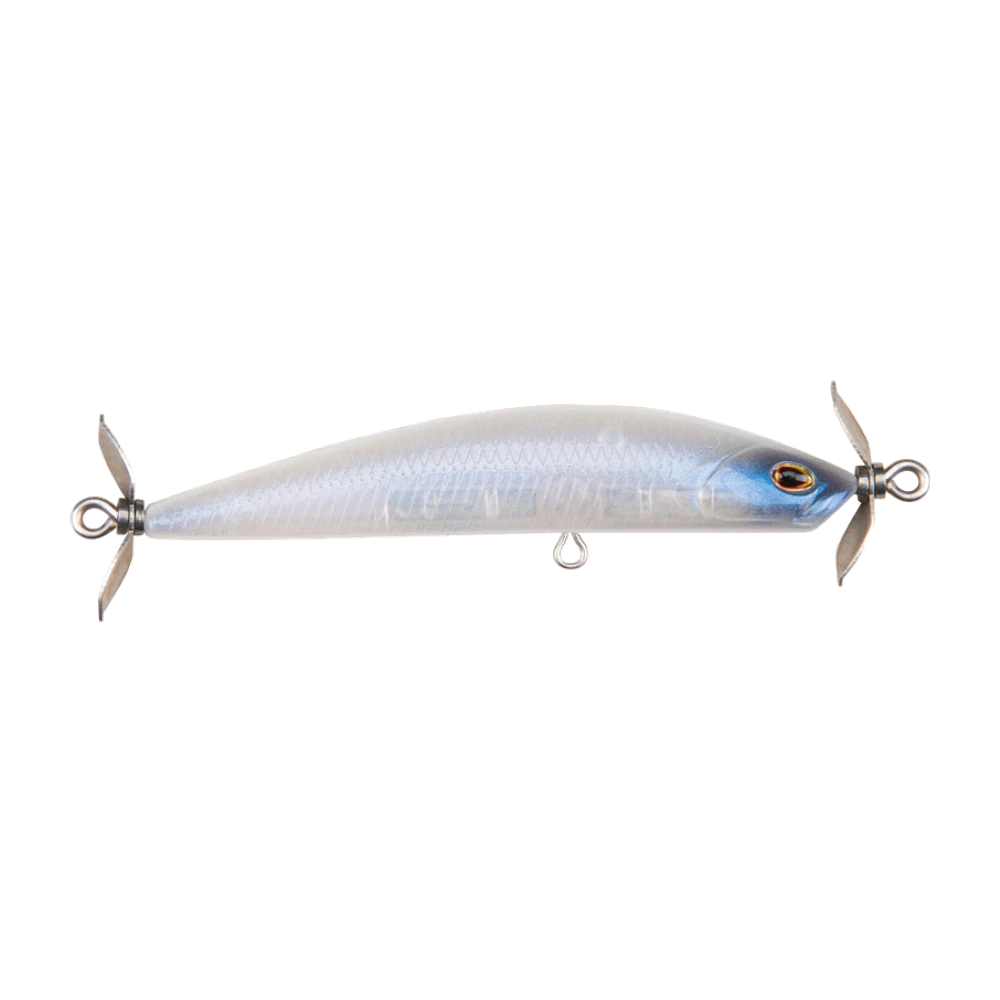
Two props, one at the nose and one at the tail, spin independently of the body. The body itself doesn't swim in the usual sense: it rolls on itself with very little amplitude, what the maker describes as a tight shimmy. There is no wobble, no wide side-to-side kick, nothing that pushes a pressure wave a lateral line can read from five metres away.
What the lure produces is light. Both props throw a flash on every turn, and the checkered scale pattern on the body adds more with every roll. On fish hunting by sight in clear water, that visual signal works exactly where vibration spooks.
The real move with a spybait is to do nothing. Cast, count it down, then turn the handle at the slowest speed you can physically hold, and never touch the rod. If you feel the urge to work it, you've picked the wrong lure for the day.
The count-down is the main adjustment
A spybait's depth isn't set by a bill, it's set by a stopwatch. Cast, let the lure sink while you count the seconds, then start the retrieve. If nothing happens, add three seconds to the count on the next cast, and keep going until you find the level the fish are holding at.
Make a mental note of the count that produced the bite: on a given spot fish are almost always stacked in a narrow depth band, and repeating that count every cast is worth more than any colour change.
The mistake that kills the technique
Retrieving too fast. It's the most common error and it's logical: at a slow speed you feel nothing in the rod, so you speed up for reassurance. The result is a lure climbing out of the depth band, props spinning too fast to produce readable flashes, and a presentation that has lost the whole point. If you can clearly feel the lure working, you're going too fast.
Line and hooks
The SPY Spinbait is listed as coming with Berkley Fusion19 trebles — the lure photographed here is shown bare, with no hook fitted, as catalogue shots often are. On the water, those small fine trebles deal with very soft bites: the fish doesn't smash it, it inhales the lure in passing. A sharp hookset pulls more hooks out than it drives in.
For line, 0.18-0.22 mm fluorocarbon tied direct or to a micro snap. Braid is best avoided: it floats, bellies and stops the lure dropping in a straight line during the count. A 2-10 g finesse rod with a soft tip cushions head-shakes and keeps those small trebles from tearing out.
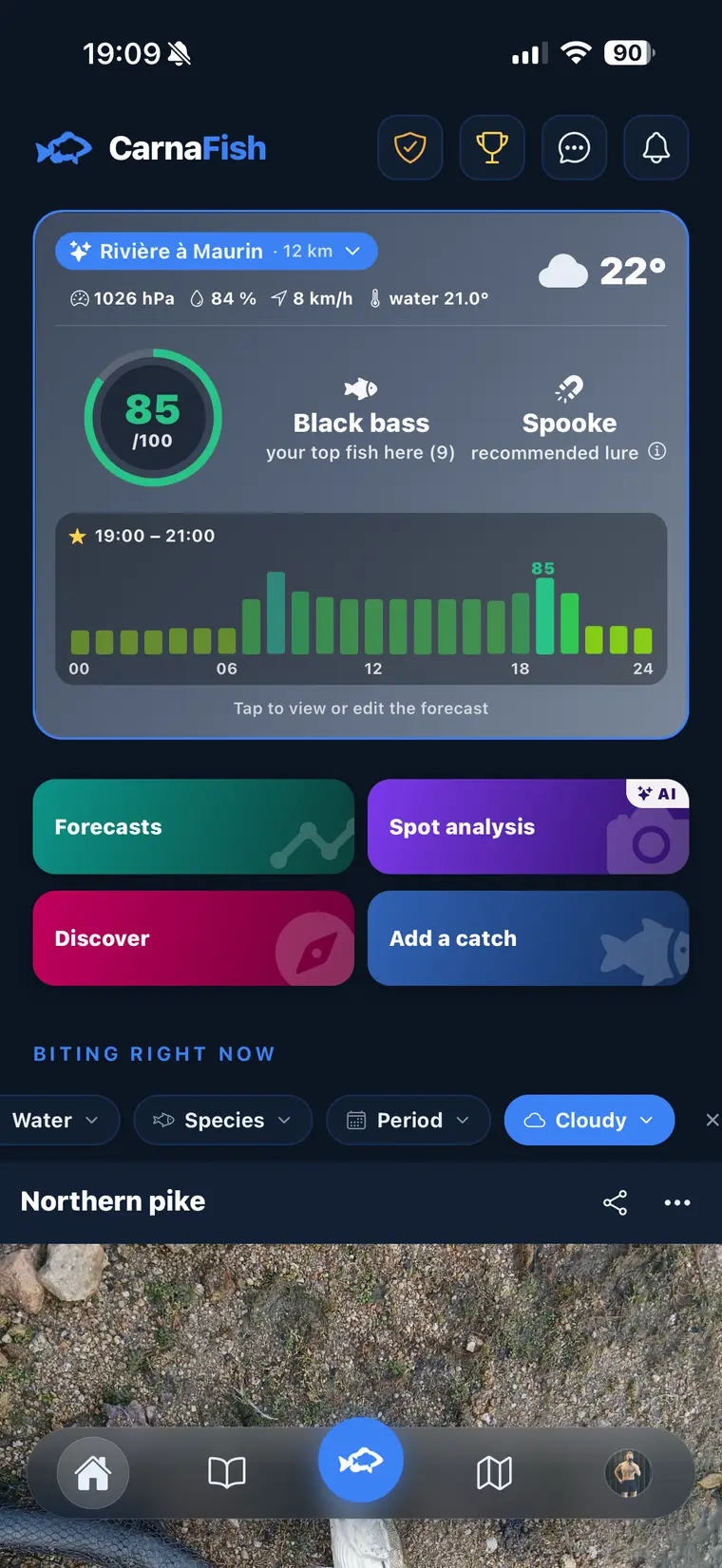
Not sure what to tie on?
Photograph your spot: CarnaFish reads the scene, cross-checks the conditions and gives you the zone, the lure and the retrieve. Free on iOS and Android.
Colors by water clarity
- Clear water: a translucent silver with a blue back, as in the photo. The checkered scale pattern and the 3D eye do the job once visibility is past two metres.
- Lightly stained water: a gold or ghost tone, which keeps contrast without going garish.
- Low light, overcast afternoons: a dark back, easier to read from below against the surface light.
Where it sits next to the Japanese benchmarks
The spybait was born in Japan, and the benchmarks remain the Duo Realis Spinbait 80 and its bigger sister the Duo Realis Spinbait 90. The SPY Spinbait plays the same game on a slightly shorter frame with two clearly separated densities, which simplifies the on-the-water decision. If what you actually want is a loud prop bait to cover water on the surface, a 6th Sense Party Prop is the tool, not this one.
In Europe the spybait finds its best ground on clear gravel pits and late-summer reservoirs, for bass as much as for big perch holding on a hump. Working out whether the water and the light justify the technique at all is exactly what CarnaFish makes easier: photograph the spot and the AI suggests the zone, the depth and the presentation type that fit. For the groundwork on holding spots and tackle, our beginner's guide to bass fishing is a solid starting point.
The short version
- Two densities on the same 7 cm frame: the 9.4 g 70 drops fast, the 7.1 g 70SS stretches out the fall.
- The lure barely vibrates: it works through prop flash and a tight roll, not through a pressure wave.
- Depth is set by the count-down, not by retrieve speed.
- Fluorocarbon is non-negotiable and braid is best avoided — it ruins the straight fall the whole technique relies on.
FAQ
What's the difference between the SPY Spinbait 70 and the 70SS?
Density. The 70 weighs 9.4 g and sinks normally; the 70SS weighs 7.1 g and sinks slowly. Both are the same 7 cm length: the 70SS simply stays in the depth band longer on every pass.
How fast should you retrieve a spybait?
As slowly as you can while keeping the props turning. You should feel almost nothing in the rod. The moment the lure starts pulling noticeably, you've gone past the right speed and it's climbing out of the band.
Should you work the SPY Spinbait with the rod?
No. It's a continuous retrieve with the rod low and still. The whole point of a spybait is being the one lure that does almost nothing, which is what makes it acceptable to a fish everything else has spooked.
Braid or fluorocarbon?
Fluorocarbon, 0.18-0.22 mm. Braid floats and bellies, which slows the fall, while the entire technique rests on a steady, repeatable count-down.
Does the spybait work for perch?
Yes, it's a very good big-perch lure in clear water on late-summer humps. Bites are often extremely soft: watch the line rather than the rod tip.
When should you leave this lure in the box?
In murky water, in strong current, or when fish are active and taking a crankbait. A spybait is a last-resort clear-water tool: if a faster presentation is working, it will always be more productive.
The full bass lure guideSeason-by-season strategy: which family of lure, when, and why.Go from theory to fish
CarnaFish reads your spot from a photo and gives you the game plan: zone, lure, retrieve. Free on iOS and Android.