DUO Realis Spinbait 80: the spybait that catches when nothing else does
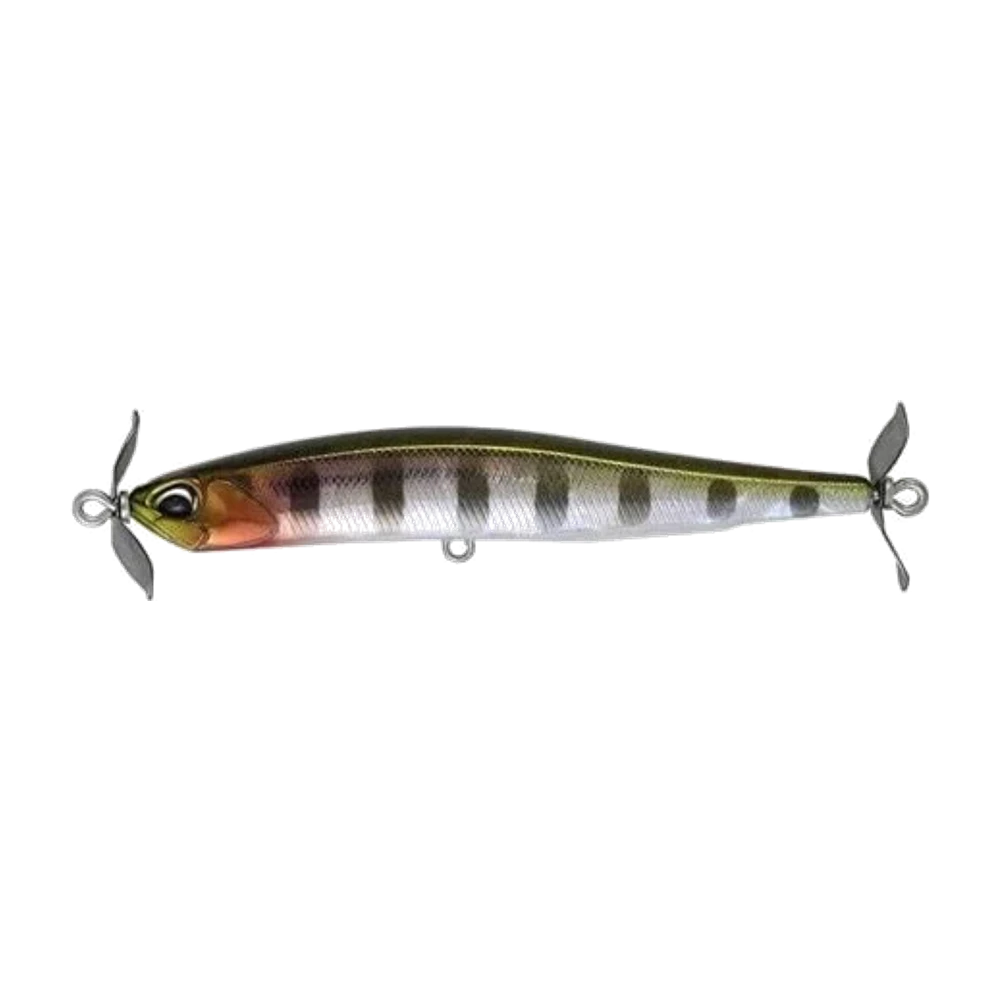
This lure shines under specific conditions. CarnaFish tells you in 10 seconds if today is one of them.
There are days when everything gets refused. The water is gin clear, there is not a breath of wind, the fish are visible and utterly indifferent. The jerkbait spooks them, the shad goes past without a reaction, the surface lure earns nothing more than a glance.
The spybait was invented for those days. And the Realis Spinbait 80 is the model that took the technique beyond Japan.
What a spybait is
A spybait looks like a small weighted baitfish with a propeller at each end. It has no lip, no buoyancy and no action of its own: it sinks, and the props turn.
That is the exact opposite of what a normal lure does. Where a crankbait shouts, a spybait whispers. The stimulus is minimal: two props barely churning, a body that does not wobble, a perfectly straight path.
On an active fish, that is too little. On a wary fish that has refused everything that moves, it is often the only thing that gets through.
The retrieve: doing nothing, very slowly
This is the most counter-intuitive technique in lure fishing. There is nothing to work.
- Cast and let it sink on a semi-tight line, counting the seconds. The Spinbait 80 drops about 30 cm per second.
- Count down to the depth you want. Five seconds for 1.5 m, ten seconds for 3 m.
- Retrieve perfectly straight and very slowly. One handle turn per second, or less. Nothing else.
- Give it no twitches at all. No pauses, no rod work. If you feel the urge to move the rod tip, you are already retrieving too fast.
On the water: if you can feel the lure buzzing through the rod, you are reeling too fast. A properly fished spybait is almost impossible to feel — that is normal, and it is exactly what makes it work.
The bite is often very subtle: a weight that settles in, a line that eases off to one side. On a rod that is too stiff, you miss it.
Why it works on educated fish
Three technical reasons, and they stack.
The signal is weak but continuous. The props produce a permanent micro-flash and micro-vibration without the aggressive peak of a hard-swimming lure. A wary fish does not feel threatened, but stays aware the lure is there.
The path is perfectly predictable. Unlike a jerkbait that darts, the spybait travels in a straight line at constant speed. A fish can follow it a long way without being startled — and end up taking it after several metres of pursuit.
It fishes a precise layer. Counting the sink lets you present the lure at exactly the depth the fish are holding at, which a floating lure cannot do.
The tackle is not optional
This is where most first attempts fail. The Spinbait does not forgive a badly matched setup.
- A light, progressive rod, L or ML power, 2.10 to 2.30 m. A fast rod pulls the hooks on these soft bites.
- Fluorocarbon of 0.16 to 0.20 mm. Fluoro sinks, which helps the descent, and stays discreet in clear water. No braid straight through: too much contact, too much stiffness, guaranteed dropped fish.
- A slow-retrieve reel, or the firm intention to wind very gently. Most anglers reel twice too fast the first time out.

Not sure what to tie on?
Photograph your spot: CarnaFish reads the scene, cross-checks the conditions and gives you the zone, the lure and the retrieve. Free on iOS and Android.
Where it excels
- Very clear water, spring and autumn, on visible but inactive fish.
- Heavily pressured waters, where the fish have seen every conventional lure go past.
- Deep, open spots: flats, drop-offs, clean margins where a slow retrieve will not snag.
- Windless days, when the surface is a mirror and everything else has failed.
Conversely, it is useless in stained water, in strong wind, or on active fish that will respond far faster to a lure with more to say.
Spinbait 80 or its close relatives
The Spinbait 90 takes the same principle up a size: it casts further, sinks faster and targets bigger fish, sea bass in particular. The 80 remains the most versatile size for perch and bass in fresh water.
If the fish refuse the spybait too, the next step down is usually finesse with soft plastics: a drop shot with a slim shad asks even less. At the other extreme, when the fish switch on again, a suspending jerkbait covers water far faster.
Our guide to perch fishing with lures places spybaiting among the other finesse approaches. And if you are unsure whether to slow down further or change approach completely, CarnaFish analyses a photo of the spot and suggests a line of attack.
Key takeaways
- A spybait is not worked: straight retrieve, very slow, without a single twitch.
- Count the sink to pick your layer — roughly 30 cm per second.
- If you can feel the lure working through the rod, you are going too fast.
- Light rod, 0.16-0.20 mm fluorocarbon, never braid straight through.
- A clear-water, wary-fish lure. Pointless in stained water or on active fish.
FAQ
What exactly is a spybait?
It is a small sinking lure with a propeller at the front and the rear, with no lip and no swimming action of its own. You fish it on a very slow straight retrieve: the props produce minimal flash and vibration, designed for fish that conventional lures scare off.
How fast should you retrieve?
As slowly as you can manage, around one handle turn per second or less. The retrieve has to be perfectly even, with no twitches and no pauses.
How do you choose the running depth?
By counting the sink time before you start retrieving. The Spinbait 80 drops around 30 cm per second: five seconds to reach 1.5 m, ten seconds for 3 m.
Can you fish a spybait on braid?
Not straight through. Braid is too stiff for these very subtle bites and causes dropped fish. Fluorocarbon of 0.16 to 0.20 mm is the right choice, or failing that a fine braid with a long fluoro leader.
Does a spybait work in coloured water?
Hardly. Its signal is deliberately weak and relies on sight in clear water. In stained water, a lure with strong vibration will be far more effective.
What is the difference between the Spinbait 80 and the 90?
The 90 is bigger and heavier: it casts further, sinks faster and targets bigger fish, especially in salt water. The 80 is the all-round size for perch and bass.
The full perch lure guideSeason-by-season strategy: which family of lure, when, and why.Go from theory to fish
CarnaFish reads your spot from a photo and gives you the game plan: zone, lure, retrieve. Free on iOS and Android.