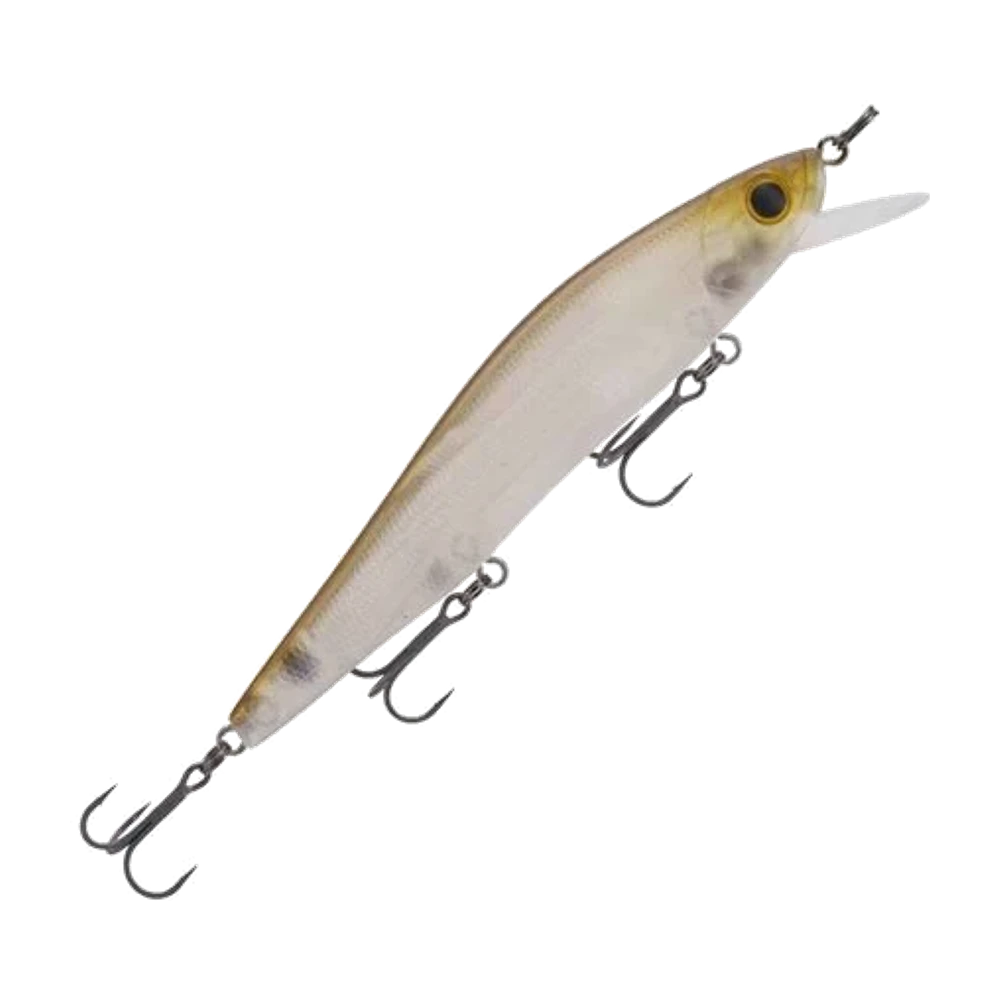
6th Sense Provoke: the jerkbait built to cover big flats
Not sure this lure fits YOUR spot today? CarnaFish tells you in 10 seconds, from a photo.
A big flat in two to three metres of water in March, with scattered schools of baitfish over it and bass following them without settling anywhere. It is a very common and very frustrating situation: there is no spot to fish, only a surface to sweep.
The jerkbait is the right tool for that, except most accurate models are also short-casting models. You fish forty metres in front of you, you retrieve slowly with pauses, and at that rate you cover a three-hectare flat in about a week.
The Provoke is built around that exact problem. It is a jerkbait that casts a long way, holds a straight line through the whole retrieve, and throws darts wide enough to be seen from a distance. It is not a finesse bait: it is a coverage bait.
The weight-transfer system, and what it costs
Like many modern jerkbaits, the Provoke carries loose weights that slide to the back of the body on the cast, then return to their low position during the retrieve. The gain is real: the lure flies nose first like an arrow and does not flutter in the air even with a quartering wind.
That system has one consequence you rarely read about: you have to give it time to reset. If you start jerking two tenths of a second after splashdown, the weights have not come back yet, the lure is unbalanced towards the rear, and the first two twitches go sideways.
The fix is simple: after the cast, take two steady turns of the handle before the first twitch. That puts the weights back in place, brings the lure to its running depth, and stops you wasting the start of the retrieve — which is often the part furthest from the bank, and therefore the least fished by everyone else.
Wide darts, deliberately erratic
The Pointer and its descendants produce a clean, symmetrical, almost mechanical kick. The Provoke does something else: its darts are wider, less regular, and it does not always kick back off the same side.
That disorder is worth something on a flat. A fish that follows a linear lure for eight metres eventually sizes it up and drops off. A lure that suddenly shoots forty-five centimetres to one side, then twenty to the other, then forty back the same way, never lets itself be sized up. The decision is made on reflex or not at all.
The trade-off is precision. In a tight spot, against a jetty or in a weed channel, the Provoke tends to wander off the line you wanted it to hold.
The retrieve: in sets, not one twitch at a time
- Cast long, down the wind line if you can, and give it two seconds before you touch the rod.
- Two turns of the handle to reset the lure and bring it to its depth band.
- Three close twitches, rod tip down, wrist only, taking up the slack between each one.
- Pause for two to four seconds. The lure settles back to horizontal.
- Start again in sets of three, all the way to the bank. Keep the rod tip low throughout: a high tip lifts the lure and kills its side darts.
- When a fish follows without biting, break the rhythm: a set of six very fast twitches, then a dead stop of five seconds.
On the water: on a big flat, do not fan your casts from one fixed point. Move ten metres after every set of three casts, always in the same direction, and cast at the same angle every time. You turn a random search into a methodical sweep, and at the end of the session you actually know what you have fished.
Standard or deep: choosing the version
| Depth of the flat | Version | Target depth |
|---|---|---|
| 1.5 to 2.5 m | Standard | 1.8 to 2.4 m |
| 2.5 to 3.5 m | Standard, 0.25 mm fluoro | 2.2 to 2.6 m |
| 3 to 4.5 m | Deep | 2.7 to 3.5 m |
| Dying weed at 3 m | Deep, higher retrieve | just above the weed |
The principle never changes: you want to pass just above the bottom or the vegetation, never through it. A jerkbait that ploughs loses its side darts and picks up weed on every pause.
Two settings noticeably change the depth reached: the diameter of your fluorocarbon (0.30 mm easily costs you twenty centimetres against 0.25 mm) and the rod angle during the retrieve.

Not sure what to tie on?
Photograph your spot: CarnaFish reads the scene, cross-checks the conditions and gives you the zone, the lure and the retrieve. Free on iOS and Android.
Where it shines, where it holds you back
Its window: late winter and early spring, large shallow areas, clear to lightly stained water, between 6 and 14 °C. That is when bass are scattered in open water and you need ground covered per hour. It is also very good in a stiff wind, where many lighter jerkbaits become uncastable.
It is poorly suited to precision work: tight spots, cluttered margins, casting under branches. It also suffers in very dirty water, where its visual darts no longer carry and a lure with a strong vibration takes over completely. Finally, its size makes it largely irrelevant for perch.
Provoke or Pointer 100
The Lucky Craft Pointer 100 and the Provoke sit in the same segment without doing the same job. The Pointer is a lure of time: perfect suspension, very long pauses, a fish that is holding, a spot you have identified. The Provoke is a lure of space: casting distance, wide darts, scattered fish, water to sweep.
The test is simple. If you know where the fish is, take the Pointer and let the lure work on the spot. If you are still looking, take the Provoke and cover water.
Against the Megabass Vision 110, the difference comes down to the nature of the movement: the Vision rolls more and glides longer, the Provoke stabs harder and resets faster. For an even sharper, tighter approach, the Jackall Rerange stays in a narrow corridor around the retrieve line.
Our beginner's guide to bass fishing covers the temperature windows where the jerkbait beats everything else. And if you do not know which version to pick in front of a flat whose depth you cannot judge, CarnaFish analyses a photo of the spot and answers.
Key takeaways
- A searching lure: it casts far and sweeps, it is not built for precision.
- Two turns of the handle after splashdown before the first twitch, to let the weights return.
- Sets of three twitches, a two to four second pause, rod tip always low.
- Standard version to 2.4 m, deep version to 3.5 m: choose by depth, not by habit.
- Best window between 6 and 14 °C, over large shallow areas in clear water.
FAQ
Why should I wait before jerking after the cast?
Because the transfer weights take a moment to return to their low position. Two turns of the handle are enough: without that, the first twitches go sideways and you waste the furthest part of your retrieve.
How deep does the Provoke run?
Between 1.8 and 2.4 m for the standard version, and down to around 3.5 m for the deep-diving one. Fluorocarbon diameter and rod angle shift those figures by twenty to thirty centimetres.
What retrieve rhythm should I use?
Sets of three close twitches separated by two to four second pauses. Below 10 °C, lengthen the pauses to five or six seconds rather than slowing the twitches themselves.
Is the Provoke suitable for tight spots?
Hardly. Its wide side darts take it off line, which is an advantage in open water and a flaw against a jetty or in a weed channel. A jerkbait with a tighter kick is easier to control.
Should I use a snap?
A small fast snap or a loop knot both work and make changing baits easier. Avoid heavy snaps, which weigh down the nose and spoil the stability on the stop.
Does it work in strong wind?
Yes, that is one of its strengths. The weight-transfer system lets it hold a flat trajectory and cast properly where a lighter jerkbait spins out.
The full bass lure guideSeason-by-season strategy: which family of lure, when, and why.Go from theory to fish
CarnaFish reads your spot from a photo and gives you the game plan: zone, lure, retrieve. Free on iOS and Android.