6th Sense Whale Swimbaits: the bulky keel-bellied shad for bigger bites
One lure, endless conditions. CarnaFish reads your spot from a photo so you are not just guessing.
Some days you string together bite after bite from average fish and never touch the one that would have made the session. The reflex is to slow down and downsize; sometimes the right move is the opposite, stepping up in bulk even if it cuts your bite count by two thirds. The Whale is exactly that bait: the biggest soft swimbait in the 6th Sense line-up, built with no illusions about numbers.
A keel belly, and everything that follows from it
The Whale's real distinguishing feature is not its size, it is its belly. Where most soft swimbaits have a rounded underside, this one carries a flat keel running along a good portion of the body. Two concrete consequences follow.
The first is mechanical: that channel takes the shank and lead of a weighted swimbait hook without the body deforming or twisting during rigging. A round-bellied shad on a weighted hook almost always ends up slightly skewed, and it spins the moment you pick up speed. The keel solves that at the source.
The second is hydrodynamic: that belly ridge acts as a fin. Combined with the moulded pectoral fins on the flanks, it stops the bait rolling over on itself when the thick paddle tail is working hard. The Whale therefore holds its swimming line even with a tail generating that much torque, which is far from a given on a bait this size.
The body also carries 3D moulded gill plates. That is a visual detail more than a swimming feature, but it matters in clear water where fish track a bait for a long time before committing.
Before you cast, watch the bait head-on over the last few metres of the retrieve. If it leans to one side, the hook point has not come out dead straight along the back. Ten seconds to straighten it, and you have a true-running bait for the rest of the session.
What speed, and more importantly what pauses
The Whale's tail is thick and wide: it takes a moment to load up, but once it does it sends out a steady thump you can clearly feel in the rod. That signal is what you are looking for on the reel handle, not any particular speed. As soon as you feel it kicking properly, you are at the right rhythm — usually a slow straight retrieve, far slower than you would guess for a bait this size.
The real lever is not speed, it is the pause. Over a grass bed, reel the bait until it is brushing the tops of the stems, then stop dead for two seconds. The Whale sinks slowly and flat, and that is almost always when the fish commits. Fish it on an unbroken straight retrieve and you leave half its potential on the table.
The two rigs that matter
The reference rig is the weighted swimbait hook, 6/0 to 8/0 depending on the size you pick, with the keel lead sitting under the body. You set running depth purely with that lead: light to stay high over grass, heavier to track down a drop-off. The point exits on the back, tucked into the plastic, so the bait stays weedless.
The second use, often overlooked, is as a swim jig trailer. Behind a swim jig head, the Whale adds bulk and above all a tail kick a silicone skirt alone will never produce. It is a simple way to get a very bulky silhouette that still goes through vegetation. A 6th Sense Divine Swim Jig takes a trailer of this size without complaint.
The classic mistake
Rigging the Whale on an open jighead out of habit. It works mechanically, but you lose both reasons to use the bait: the weed clearance, and the tracking the keel lead provides. Over clean, open bottom a smaller shad like a Keitech Swing Impact 4 will do the job better and for less money.
Where and when it earns its place
The Whale is a vegetation and structure bait. Submerged grass, lily pad edges, flooded timber, long tapering points: anything that concentrates bigger fish and where a hard bait would snag. It is especially at home in late spring and in autumn, when forage fish are large and predators are willing to spend energy on a big mouthful.
In Europe this kind of bulky swimbait also makes sense for pike, provided you rig a suitable leader: a big soft bait swum slowly over a grass bed is a deadly presentation on a holding pike. Do not count on it for perch, though — the size is simply out of reach.
Not sure what to tie on?
Photograph your spot: CarnaFish reads the scene, cross-checks the conditions and gives you the zone, the lure and the retrieve. Free on iOS and Android.
Colour by light and clarity
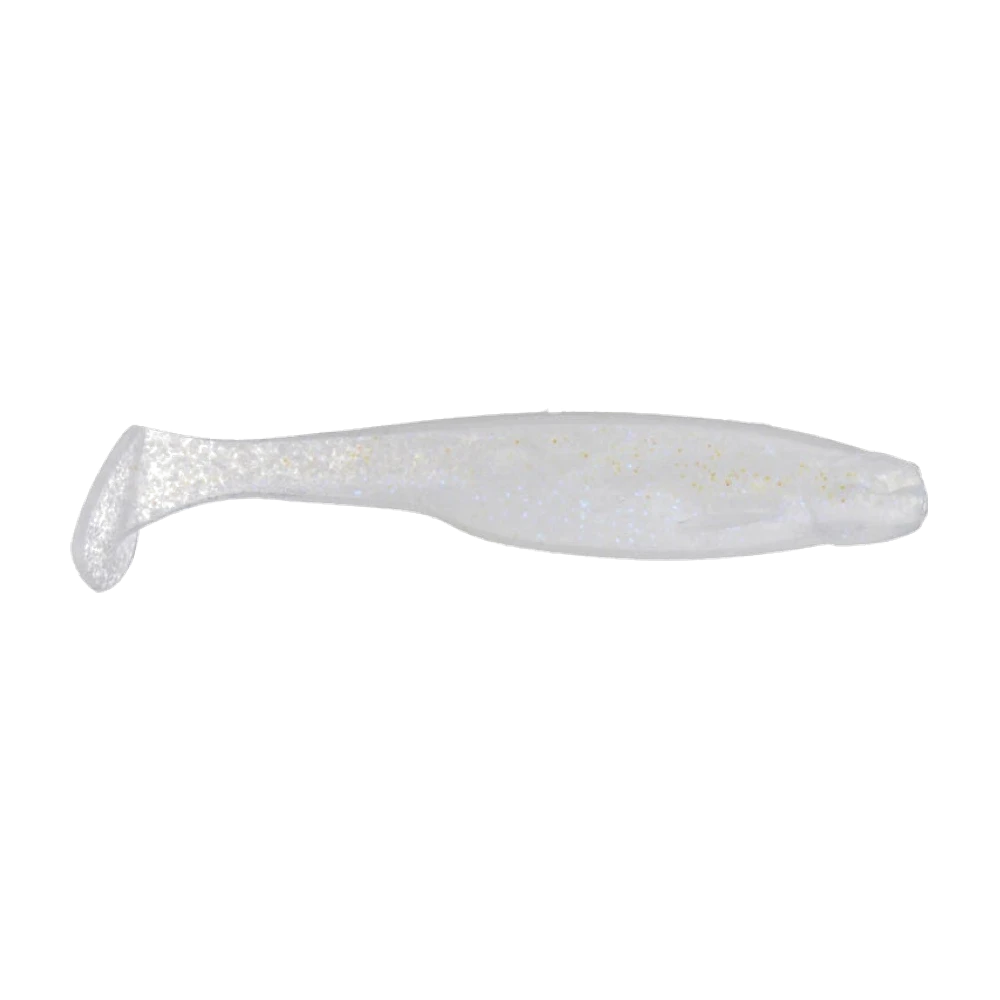
- Clear water, bright sun: pearl white with glitter, like the one pictured. The flake throws a diffuse light that reads like baitfish scales without the aggressive flash of a chrome finish.
- Stained water or a weedy bottom: green pumpkin. The silhouette stays readable against grass without standing out wrongly.
- Dark water, overcast, first light: a solid black or dark blue. In those conditions fish read a shape backlit from above, not a colour; a clean silhouette beats a detailed pattern.
The decision to go big happens before the cast
Tying on the Whale only makes sense if you have good reason to think there is a big fish on the spot. That is exactly what CarnaFish helps you settle: a photo of the spot, and the app suggests the zone to work, the depth and the lure family that fits the day's conditions — enough to know whether it is time to step up in bulk or stay on an all-round size. To build the groundwork first, our beginner's guide to bass fishing covers spots and tackle.
Key takeaways
- The belly keel is the whole point of the bait: it takes a weighted hook without twisting the body and stops the roll on the retrieve.
- Hook weight, not retrieve speed, sets the running depth.
- A pause over vegetation triggers more bites than an unbroken retrieve.
- 6th Sense does not publish dimensions for the Whale range: check the length stated on the packet before choosing your hook size.
FAQ
What hook size suits a 6th Sense Whale?
A weighted swimbait hook from 6/0 to 8/0 depending on the size you choose. Since the manufacturer does not publish lengths for the range, measure the body and pick a hook whose shank covers roughly the front third of the bait, with the point exiting straight along the back.
Does the Whale clear grass?
Yes, that is its home water. Rigged with the point tucked in on a swimbait hook, it slides over vegetation and only fouls in genuinely dense mats. For those, a hollow body frog stays cleaner.
Can it be used as a trailer?
That is one of its two intended uses. Behind a swim jig head it adds bulk and a tail kick the skirt alone does not give. Just expect to need a heavier outfit than with a standard craw trailer.
How is it different from a standard soft swimbait?
Bulk and the belly keel. A standard shad such as the 6th Sense Option Swimbait aims at versatility and bite count; the Whale accepts fewer bites in exchange for bigger fish, and it is designed around a weighted hook from the start.
Is the Whale any good for pike?
Yes, the size and the wide swimming action make it a solid shallow water pike bait, provided you add a heavy fluorocarbon or titanium leader. On a known pike spot it is a credible alternative to the big European soft baits.
Why does my Whale spin?
Almost always a rigging fault: the hook point has not exited exactly along the centreline of the back, or the body is slightly bunched on the shank. Unrig it, realign it, and check the swim over the last few metres before casting again.
The full bass lure guideSeason-by-season strategy: which family of lure, when, and why.Go from theory to fish
CarnaFish reads your spot from a photo and gives you the game plan: zone, lure, retrieve. Free on iOS and Android.