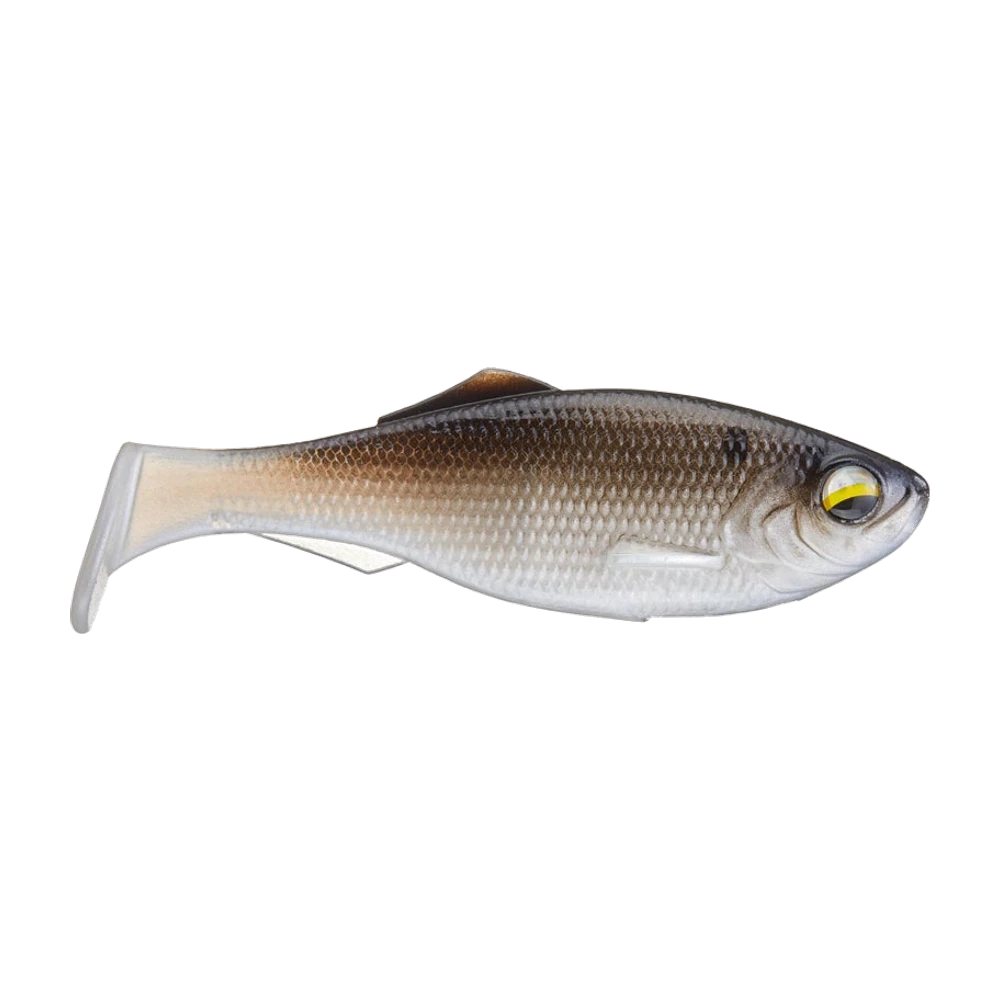
6th Sense Super Sweep: the swimbait that rolls as much as it kicks
One lure, endless conditions. CarnaFish reads your spot from a photo so you are not just guessing.
A lily pad field covering the first three metres of bank, and underneath it, bass that aren't coming out. Your options are a frog, which will never get down to them, or a shad on a jighead, which will snag on the second cast. The Super Sweep fills the middle slot: it's a boot-tail swimbait designed from the start to accept two very different hook setups, one of them genuinely weedless.
The roll, not just the tail kick
Every boot-tail swimbait kicks. Most stop there: the paddle swings side to side and the body stays more or less straight. For the Super Sweep, 6th Sense describes a new boot-tail design meant to produce a stronger kick together with a rolling motion of the body. That second component is what changes the signal being sent.
A body rolling on its axis as it moves forward alternately shows its dark back and its pale flank. To a predator watching from a distance, that isn't a silhouette gliding past any more, it's a regular flicker. In slightly stained water, where vibration alone carries poorly, that periodic flash often makes the difference against a tamer shad like a Keitech Swing Impact 4, whose action stays very concentrated in the tail.
The trade-off is that a lure which rolls demands a well-centred jighead and a straight rig. A body pinned slightly off-axis turns controlled roll into spin, and the lure starts corkscrewing. Check the alignment before you cast, not after ten minutes of fishing.
Two rigs, two jobs
The manufacturer explicitly lists two applications, and they're worth treating separately: these aren't two variants of one rig, they're two different ways of fishing.
Exposed-hook jighead, for deep water
Out deep — breaks, channel edges, timber in six to eight metres / 20 to 26 feet — hooking efficiency matters more than snag resistance. A standard jighead with the hook point exposed, nose-rigged, leaves the point entirely clear: you convert nearly every bite, including the soft ones from inactive fish that simply inhale the bait.
Pick the weight for the depth and the current, not out of impatience. Too heavy and the lure noses down and the roll disappears; too light and you swim above the fish without ever entering its field of view.
7/0 belly-weighted swimbait hook, for shallow water
This is the other half of the lure, and the half that justifies the slot moulded into the back. The manufacturer recommends a belly-weighted swimbait hook in size 7/0: the shank runs through the body, the point tucks into the slot, and the weight sits underneath the bait rather than in front of it.
Two consequences. First, the lure slides through grass, branches and pads without catching, because no point is exposed any more. Second, the centre of gravity drops below the body axis, which stabilises a horizontal swim and keeps the lure from rolling over at the slightest acceleration. This is the rig for a one to two metre / three to six foot flat carpeted in vegetation.
With the weighted hook, the back slot eventually opens up after a few fish. Rather than binning the bait, slide it half a centimetre up the shank so the point bites into fresh material, and secure the head with a short piece of heat-shrink or a soft bait keeper. You easily double the life of a body.
A shad profile, but not only
The manufacturer describes a realistic shape meant to imitate shad, small panfish and similar forage. That isn't an empty line: a pure shad has a tall, compressed body, a panfish has a rounder and wider one. An in-between profile covers both situations, which helps on a lake where bass alternate between open-water baitfish schools and bluegill tucked into the weeds.
In practice that means colour choice matters almost as much as size. In a silver shad pattern you're playing the open-water baitfish. In a perch or bluegill finish, dark barred back and coppery flanks, you're playing the cover-oriented forage — and that works a lot better over grass than a silver flank that has no business being there.
The classic mistake
Fishing this bait like a spinnerbait, on a constant retrieve from the first metre to the last. The tail starts at the lowest speed, so the point isn't to reel fast: it's to vary. Three or four turns of the handle, a one-second pause during which the lure glides and the tail keeps quivering, then pick it up again. On a Strike King Rage Swimmer rigged the same way, that alternation already changes the bite count; on a lure that rolls, it pays even better, because every restart relaunches the flash.
Another mistake, specific to the weedless rig: forcing the hook set. With a point tucked into the slot you have to let the fish load up, drop the rod slightly, then pull through on a continuous sweep — not a sharp snap upward. That's the exact opposite of the reflex you build on exposed hooks.
Not sure what to tie on?
Photograph your spot: CarnaFish reads the scene, cross-checks the conditions and gives you the zone, the lure and the retrieve. Free on iOS and Android.
Colour by water and by forage
- Clear water, open-water forage: natural shad pattern, green or blue back and silver flanks. This is the finish that exploits the roll best, since the flash comes off the flank.
- Weedy banks: perch or bluegill finish, dark back and coppery flanks. A fish hunting under the pads isn't looking for something silver.
- Stained water or post-flood: white and chartreuse. You give up realism for contrast you can read at a metre of visibility.
Bodies are listed as hand-painted with a high level of detail; colour names shift from one run to the next, so it pays to think in tone families.
Where it sits in an already crowded box
The Super Sweep isn't a substitute for a factory-weighted big swimbait like a Megabass Magdraft, which fishes straight out of the pack and targets a different class of fish. It belongs to the bare-body family you rig yourself, with one clear edge over its direct rivals: the dual compatibility is stated and designed for — exposed jighead on one side, 7/0 weighted weedless on the other, without buying two different baits.
That said, picking your swimbait tells you nothing about where to cast it. That's exactly what CarnaFish is for: a photo of the spot, and the app suggests the zone, the depth and the kind of presentation that fit the day. For tackle fundamentals and reading structure, our beginner's guide to bass fishing covers the rest.
Key takeaways
- The boot tail makes the body kick and roll, adding a periodic flash on top of the vibration signal.
- Two rigs are designed in: exposed-hook jighead for deep water, 7/0 belly-weighted swimbait hook for weedless shallow work.
- The in-between profile covers both shad and small panfish — colour is what picks a side.
- The manufacturer publishes neither an exact length nor a weight, which is why the recommended hook size is used here as the reference point.
FAQ
How long is the Super Sweep?
The manufacturer doesn't state it in the technical description. The only reliable reference is the 7/0 swimbait hook recommended for the weedless rig, which puts the body firmly in the full-size swimbait category rather than in finesse.
Which hook should I use for a weedless rig?
A belly-weighted swimbait hook in 7/0, as the manufacturer specifies. The shank runs through the body and the point tucks into the moulded back slot, leaving the lure completely snag-free.
Can it be fished on a plain jighead?
Yes, and that's the recommended rig for deep water. An exposed-hook head pinned through the nose leaves the point clear and converts soft bites far better on deep structure.
Why does my Super Sweep spin?
Almost always a body pinned slightly off-axis, or a jighead heavy enough to pull the nose down. Re-pin it straight and drop one weight increment: the roll should stay a roll, not become a spin.
Should I work it or just reel it in?
Both, but not continuously. The tail works from the minimum speed up, so the point is to alternate three or four handle turns with a short pause during which the bait glides. The bite most often comes on the restart.
Is it suitable for pike?
On the 7/0 rig, yes, in shallow grass in summer and early autumn. Add a suitable leader, because a soft body rigged weedless gets bitten off very quickly on a side-on strike.
The full bass lure guideSeason-by-season strategy: which family of lure, when, and why.Go from theory to fish
CarnaFish reads your spot from a photo and gives you the game plan: zone, lure, retrieve. Free on iOS and Android.