Abu Garcia Svartzonker McPerch: when pike eat their neighbours
One lure, endless conditions. CarnaFish reads your spot from a photo so you are not just guessing.
Late August, a clear gravel pit, a wooden jetty with three metres of water under it. Under the structure, a cloud of eight-centimetre perch circles constantly. You know there are pike, because every ten minutes the cloud explodes and reforms. You run a 15 cm white shad straight through: nothing. You drop a size: still nothing.
The problem is neither the size nor the speed. The pike is sitting on a specific larder, it watches it all day, and it no longer takes just any shape that crosses. When one prey becomes that dominant, the shape of the lure matters as much as its size.
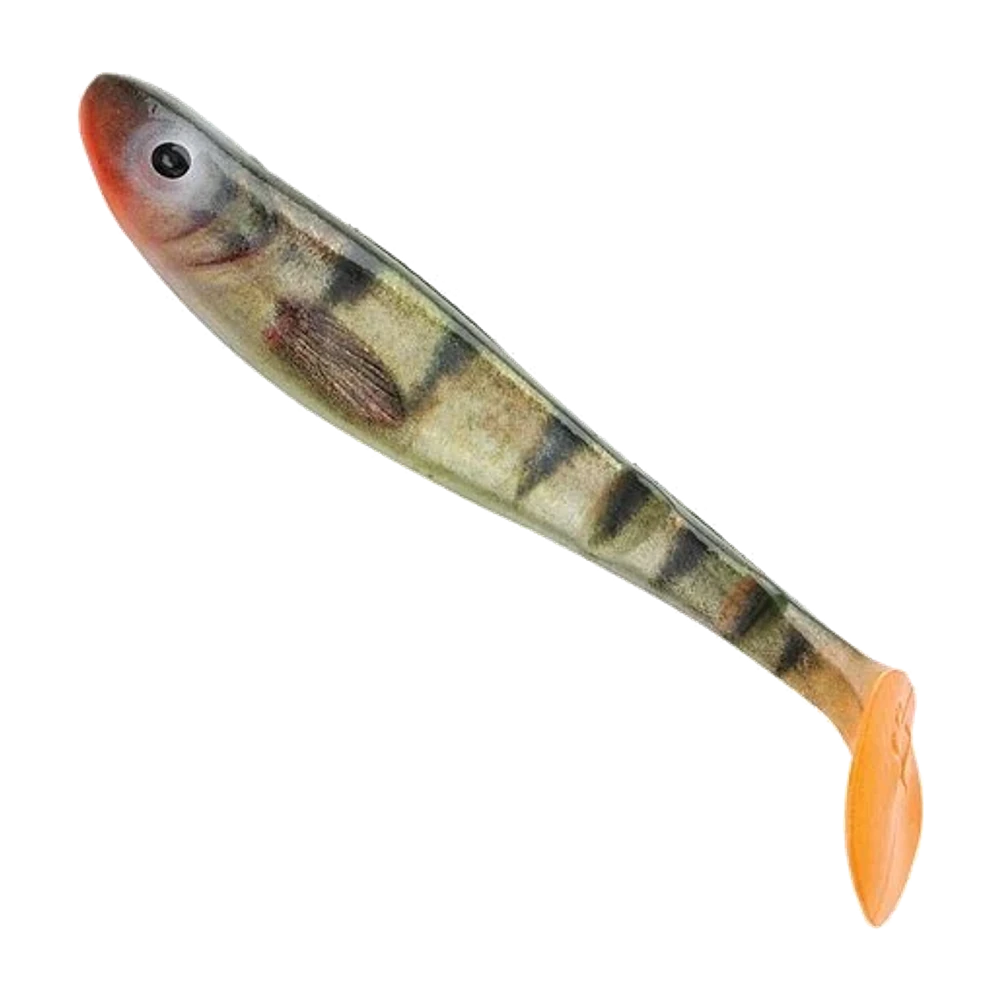
The McPerch is built for exactly that situation: a soft body, deep and short, that reads as a perch in the water rather than as a long, open-water baitfish. It is a lure for a context, not a do-everything lure.
A deep body does not read like a long one
Two 18 cm lures can send completely different signals depending on their profile.
A classic shad is long and low: seen from the side it occupies a thin horizontal band, and seen head-on it is narrow. That is the silhouette of a roach, a bleak, an open-water baitfish.
The McPerch is the opposite:
- A tall body for its length. At 18 cm long, it displaces far more visual volume than a shad of the same length. A pike seeing it side-on sees a "wide" prey, so a meal worth moving for.
- A pronounced dorsal line, echoing the spiny first dorsal of a perch. It is a silhouette detail pike have learned: they attack a perch differently from a roach, generally more from behind and more decisively.
- Vertical barring on the natural colours. In moderately clear water, vertical bars stay readable at distance far longer than a plain flank.
The direct consequence in the water: the deep body presents more surface to the pull, so it rolls more than it pitches. That slow roll is the lure's signature, and it is what you must protect in both the rig and the retrieve.
Rigging: the minimum useful weight
The usual mistake with this kind of lure is screwing on a heavy head to "get down to the bottom". On a deep body, a head that is too heavy crushes the roll and turns the lure into a dead weight being towed.
| Depth of the spot | Indicative weight | Target behaviour |
|---|---|---|
| 0.5 to 1.5 m over weed | 10 to 15 g | high swimming, almost at the surface, maximum roll |
| 1.5 to 3 m, margin or jetty | 20 to 30 g | slow descent, roughly one metre per second |
| 3 to 5 m, drop-off or hole | 35 to 50 g | firm bottom contact, worked in long lifts |
The harness is the second point. A body of this volume cannot be hooked on a single hook set at the head: pike often bite the middle or the rear. A stinger harness with one belly treble a third of the way back and a second treble at the rear third covers the zone actually bitten. Wire or titanium leader of 30 to 40 cm, always.
On the water: when you fish a perch imitation, do not look for the isolated perch, look for the edge of the shoal. The pike does not sit in the cloud, it sits below it or on its downstream edge, and it attacks a small perch that strays. So your lure has to cross the edge of the shoal, not its centre — a lure in the middle of the cloud is one more prey among many, a lure on the fringe is an isolated one.
The retrieve in five steps
The McPerch is fished slowly, but not uniformly. Here is a sequence that works on holding fish.
- Cast past the spot and let it drop on a tight line, counting. The roll during the descent is already a fishing phase: plenty of bites come there, especially under a jetty.
- Three or four slow turns of the handle to engage the action and feel the tail kicking through the rod tip.
- Dead stop. The lure noses down slightly and glides off to the side. That is the most triggering moment in the sequence.
- One wide, soft sideways sweep of the rod, to pull the lure off its line and mimic a panicking small perch.
- Go back to a slow straight retrieve and repeat the cycle to the bank. Genuinely fish the last metre: a following pike very often makes up its mind right under your feet.
On lethargic fish in cold water, drop step 4 and stretch the stops to five seconds. On active fish in summer, link steps 2 and 3 without the sweep, at a brisker pace.

Not sure what to tie on?
Photograph your spot: CarnaFish reads the scene, cross-checks the conditions and gives you the zone, the lure and the retrieve. Free on iOS and Android.
Where it shines, and where it is useless
Its windows:
- Waters where perch are the number one prey: gravel pits, reservoirs, big ponds with strong populations of small perch.
- Vertical structure: jetties, pilings, sunken timber, breakwater margins. The deep body fishes beautifully on a tight descent alongside an obstacle.
- Late summer and autumn, when the year's small perch group into compact shoals and the pike settle on them.
Its limits, which are real:
- In flowing rivers, a deep body catches the current and gets pushed off line: the action degrades fast as soon as the flow exceeds walking pace.
- In fast searching over large areas, it is too slow. You cover little ground per hour.
- On water without perch, the lure's main argument disappears. A classic shad will do as well with less bulk.
- On light gear it will not go: you need a 30-100 g casting rod and 0.30 to 0.40 mm braid.
McPerch or McRubber: two lures, two problems
Both come from the same range and many anglers confuse them. They answer different questions.
The Svartzonker McRubber is a long, high-volume shad designed to keep living at almost zero speed, worked in wide lifts and free falls over deep flats. It is a cold-water lure for slow open-water searching: its silhouette stays generic, its volume and its undulation do the work.
The McPerch plays a different card: prey recognition. It is shorter, deeper, harder to cast, and it gives its best when pike are locked onto perch, close to structure, in shallow water. If you could only take one to a big deep lake in November, take the McRubber. On a jetty-lined gravel pit in September, take the McPerch.
Another perch imitation already covered here, the Westin Percy the Perch, covers the same visual register in a different format and build: up to you which you prefer to work. Our guide to choosing a pike lure places these big profiles across a full season. And if you are unsure what size of lure to tie on when you reach a spot, CarnaFish analyses a photo of the spot and answers.
Key takeaways
- The deep body rolls more than it pitches: that is the main signal, do not crush it with too heavy a head.
- Two trebles on a stinger harness, one forward and one rear on the belly. Pike often bite the middle.
- Fish the edge of the perch shoal, never its centre.
- Its window: gravel pits or lakes with perch, vertical structure, late summer and autumn.
- The wrong choice in flowing rivers, in fast searching, or on water with no perch.
FAQ
Which McPerch size should I start with?
The middle format, around 16 to 18 cm, is the most versatile: it stays castable with a 30-100 g casting rod and works on pike of all sizes. The bigger sizes select better fish, but demand heavier gear and tire your arm.
Do I need a wire leader?
Yes, no discussion. A pike attacking a perch imitation often takes it broadside and swallows it deep. Supple wire or titanium of 30 to 40 cm prevents bite-offs and is quick to replace.
What depth can I fish it at?
From the surface down to about five metres, purely by changing the weight. Count on 10 to 15 g to swim high over weed, 20 to 30 g for a standard margin, and 35 to 50 g to work a drop-off in contact with the bottom.
Does the McPerch work in rivers?
Badly as soon as there is real current: the deep body catches the flow and the action degrades. Keep it for calm zones, back eddies and backwaters, or switch to a slimmer profile.
What is the difference with the McRubber?
The McRubber is a long, high-volume shad built for cold water and very slow lifts in open water. The McPerch bets on the perch silhouette and is fished higher, close to structure, when pike are locked onto small perch.
Why two trebles rather than one?
Because the bite point varies with the fish's mood: a committed pike takes from the front, a hesitant one nips the rear. A single head treble lets a good share of the soft autumn bites go through.
The full pike lure guideSeason-by-season strategy: which family of lure, when, and why.Go from theory to fish
CarnaFish reads your spot from a photo and gives you the game plan: zone, lure, retrieve. Free on iOS and Android.