Berkley Powerbait Gilly: the tall-profile swimbait for clear water
Before tying this one on, it helps to know if the spot actually calls for it. CarnaFish reads the scene from a photo.
A gravel pit bank in September, two metres of water, three metres of visibility. You can see the fish — and more to the point, they can see you. In that situation a paddle-tail shad beating away steadily gets followed for ten metres and refused at your feet: the movement is too regular, too mechanical, too repetitive for a fish with all the time in the world to study it. What still works is a bait that barely swims and looks like a real fish holding still.
A tall profile, not a shad profile
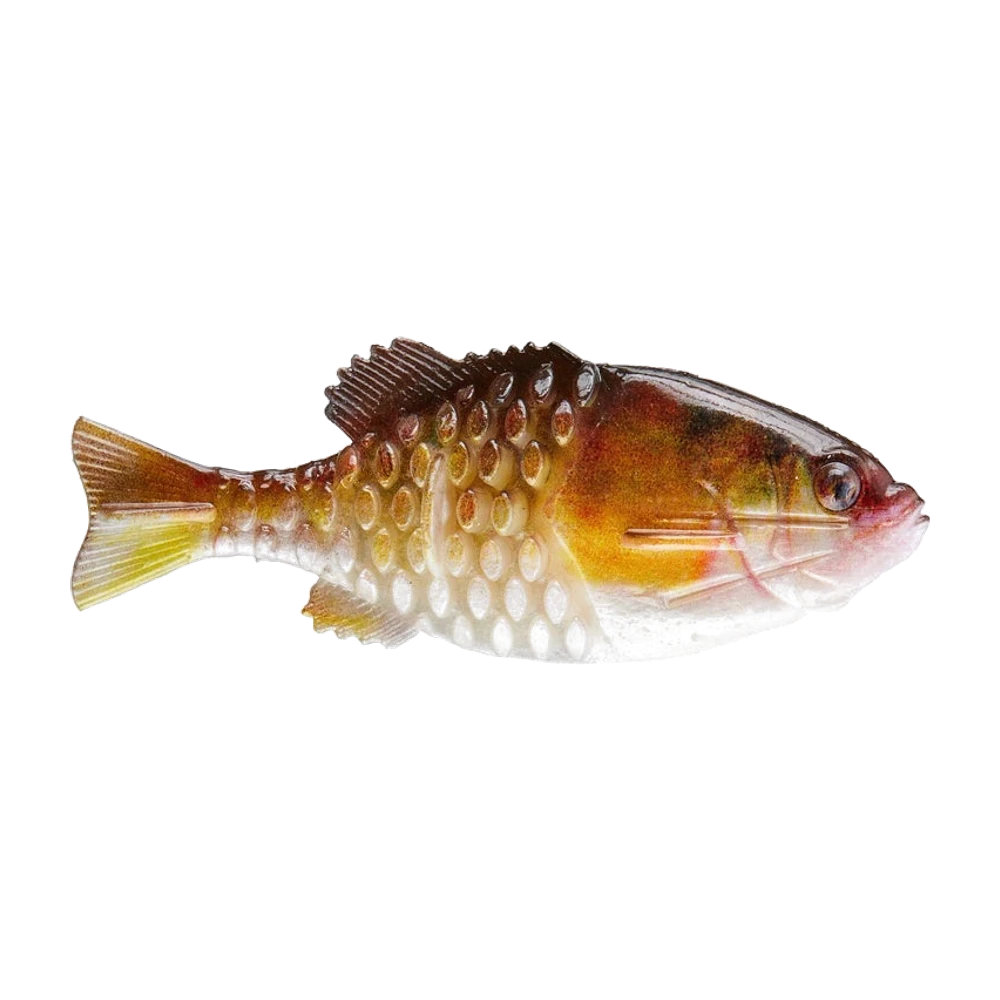
The Gilly was designed with Mike Iaconelli, a Bassmaster Classic champion, and its premise comes straight from the Japanese clear-water school: likeness before movement. Where almost every soft swimbait copies the elongated outline of a baitfish, the Gilly has a tall, laterally compressed body, that of a sunfish or a young perch — exactly what the photo shows, with its olive-brown back, red-streaked orange flanks and cream belly.
That distinction is useful. In many waters, bass and perch eat as many deep-bodied fish as slender ones: perch fry, sunfish, young deep-bodied silver fish. Showing them a tall bait in a lake where everyone throws slim shads means changing the silhouette before changing the colour — and in clear water, silhouette is the first thing a fish reads.
The scale-shaped ribs, and why Berkley avoided a segmented body
The usual way to make a soft swimbait undulate is to segment the body, cutting transverse slots that hinge it. Berkley went the other way: the rear section of the Gilly is covered in raised scale-shaped ribs, standing proud across the full depth of the flank.
The benefit is twofold. A transverse slot weakens the body and creates a clean break point, which is where a bait eventually tears. The ribs don't cut through the body: they soften it progressively from front to back without creating a hinge. The result is a tail that undulates in one continuous motion instead of folding at one fixed point.
The other effect is optical. Those raised scales catch light differently depending on the angle, which produces an irregular flicker as the bait rolls. In very clear water, that shifting reflection does more for the bait's credibility than any colour choice.
Don't try to make the Gilly's tail beat like a paddle. Its swim is built from glides and roll, not from kicking. If you feel a steady vibration in the rod, you're retrieving too fast and you've just cancelled everything that sets this bait apart.
The sideways weightless rig, and the four others
Weightless, hook run through the body sideways
This is the rig the Gilly was designed around, and by far the one that shows its behaviour best. The wide-gap hook doesn't run nose-to-tail like a standard Texas rig, but sideways through the body, perpendicular to the flank, with the point tucked into the back.
What that changes: with no lead, the bait stays close to neutral and sinks very slowly, flat. On every short twitch it slides off to one side and rolls, flashing its flank, then settles. That's a soft jerkbait action, built from darts and pauses rather than a continuous swim. On a fish holding under a tree in clear water it's deadly — but it demands thin fluorocarbon and a rod that transmits, because the bite usually comes on the pause and is barely felt.
Jighead
A light round or bullet head makes the Gilly fishable on a straight retrieve and at distance. The tall body generates real water resistance: it rolls noticeably on itself through the retrieve, which is the intended effect, but you have to stay slow or it spirals.
Weighted swimbait hook
The compromise between the two above. The lead sits on the hook shank, so it's centred under the body, and the bait keeps a flat attitude while sinking faster. This is the searching rig when you want to cover water without giving up the glide.
Texas rig and drop shot
The Texas rig earns its place in sparse vegetation, where the tall body slips through better than you'd expect. The drop shot is for deep water or for fish you've already marked: suspended, the Gilly keeps its tall profile and its pale belly clearly visible from below.
The mistake that cancels everything
Rigging too heavy a head out of a reflex for casting distance. A tall body on a heavy head stops gliding — it dives while spinning on itself and its profile is no longer readable from the side. If you absolutely need distance and speed, tie on a conventional shad like the Keitech Easy Shiner 3 and keep the Gilly for slow presentations.
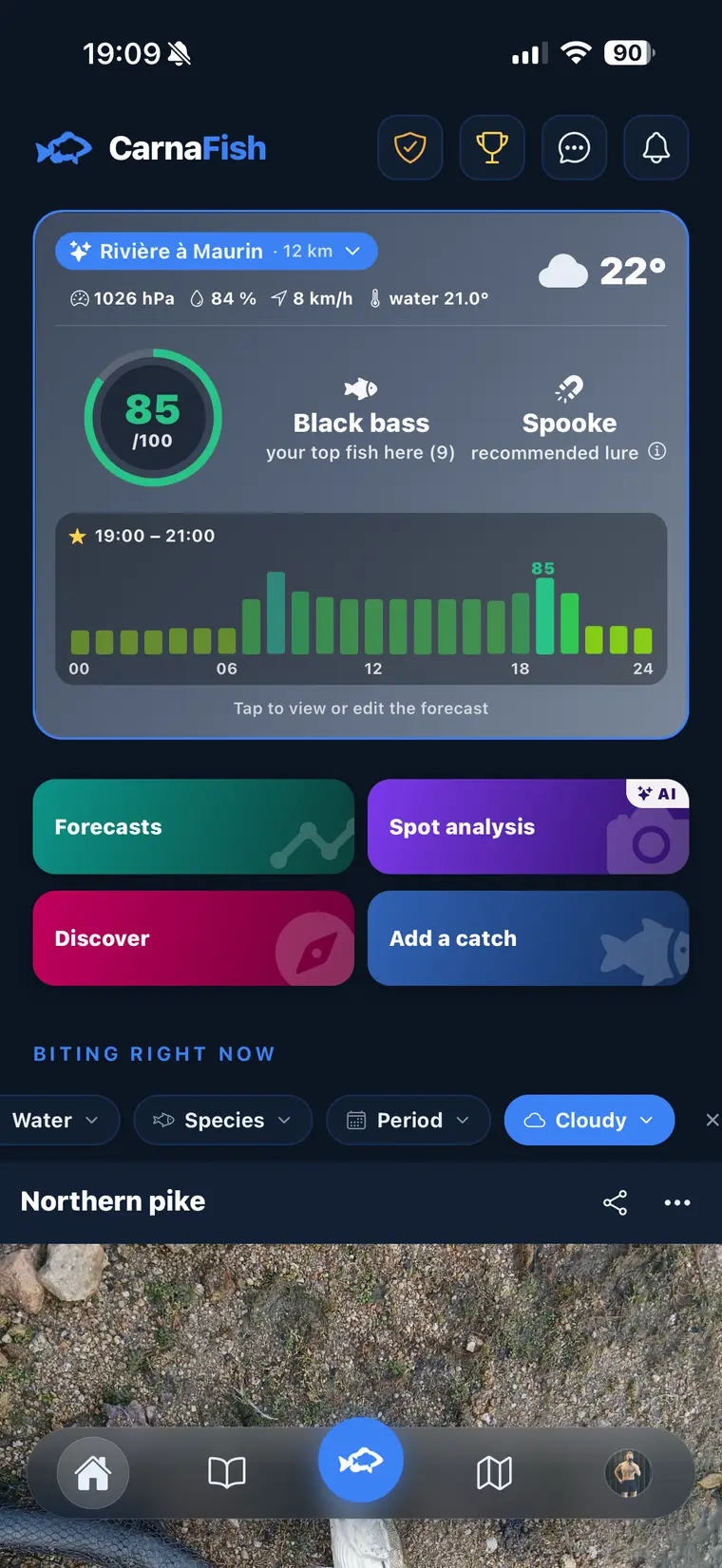
Not sure what to tie on?
Photograph your spot: CarnaFish reads the scene, cross-checks the conditions and gives you the zone, the lure and the retrieve. Free on iOS and Android.
The three sizes
Berkley lists three lengths: 90 mm, 110 mm and 130 mm — 9, 11 and 13 cm / 3.5, 4.3 and 5.1 in — packed four, three and two per bag respectively. The manufacturer publishes no weight, which is standard for a bare soft plastic.
In practice the 9 cm is the all-round size, the only one that genuinely interests perch alongside bass. The 11 cm is the clear-water bass reference: big enough to match an adult prey item, compact enough to stay fishable on a weightless hook. The 13 cm is a big-fish bait, to be pulled out when you know the size is there and you accept fewer bites.
Colour by clarity
- Clear water, visibility beyond two metres: the natural finish in the photo, olive-brown back, orange flanks and cream belly. That's the exact drawing of a sunfish, and precisely what a fish will inspect longest without finding a flaw.
- Lightly stained water: a dark back over paler flanks, which keeps a readable contrast as the light drops without turning into an artificial colour.
- Open water or over deep bottom: pearl white, which stands out from below against the lit surface.
Avoid chartreuse finishes on this bait. Its whole case rests on the realism of the silhouette; a high-visibility colour destroys the argument, and you'd be better served by a vibrating lure.
A clear-water bait is only worth something if you bring it to the right spot at the right time of day. That's exactly what CarnaFish makes easier: a photo of the spot, and the app suggests the zone, the depth and the presentation suited to the day's conditions. To lay the groundwork for bass fishing before investing in specialist baits, our beginner's guide to bass fishing remains the right way in.
Key takeaways
- A tall sunfish profile rather than the slim outline of most soft swimbaits: that's the main argument in clear water.
- Scale-shaped ribs replace a segmented body: continuous undulation, no break point, and an irregular flicker in the light.
- The reference rig is weightless with a wide-gap hook run sideways through the body, point tucked in.
- Three sizes, 9, 11 and 13 cm, and no published weight: the weight comes from your rig.
FAQ
Which Gilly size should I pick?
The 11 cm / 4.3 in is the reference size for bass in clear water. Take the 9 cm / 3.5 in if you also want to interest perch or if the forage present is small, and the 13 cm / 5.1 in only when you're targeting big fish and accept fewer bites.
How do I rig the Gilly weightless?
With a wide-gap hook run sideways through the body, perpendicular to the flank, point tucked into the back. That's the rig it was designed for: the bait keeps a flat attitude and glides off to the side on each twitch instead of swimming continuously.
Does the Gilly suit perch?
In 9 cm / 3.5 in, yes, especially for good perch in clear water over gravel. In 11 and 13 cm the profile becomes too deep for an average perch's mouth and the bait should be treated as a bass lure.
How much does this bait weigh?
Berkley publishes no weight, only the three lengths and the pack counts — four in 90 mm, three in 110 mm and two in 130 mm. As with any bare soft plastic, the fishing weight depends entirely on your hook or jighead.
Why do fish follow without striking?
Almost always because you're retrieving too fast. The Gilly isn't built to swim continuously: it's built to glide and stop. Stretch the pauses to three seconds and drop your leader diameter.
How does it differ from a conventional swimbait?
In silhouette and in how it swims. A paddle-tail swimbait like the Berkley Powerbait Cullshad works continuously with a steady vibration and covers water. The Gilly, tall-profiled and gliding, is a precision presentation for wary fish.
The full bass lure guideSeason-by-season strategy: which family of lure, when, and why.Go from theory to fish
CarnaFish reads your spot from a photo and gives you the game plan: zone, lure, retrieve. Free on iOS and Android.