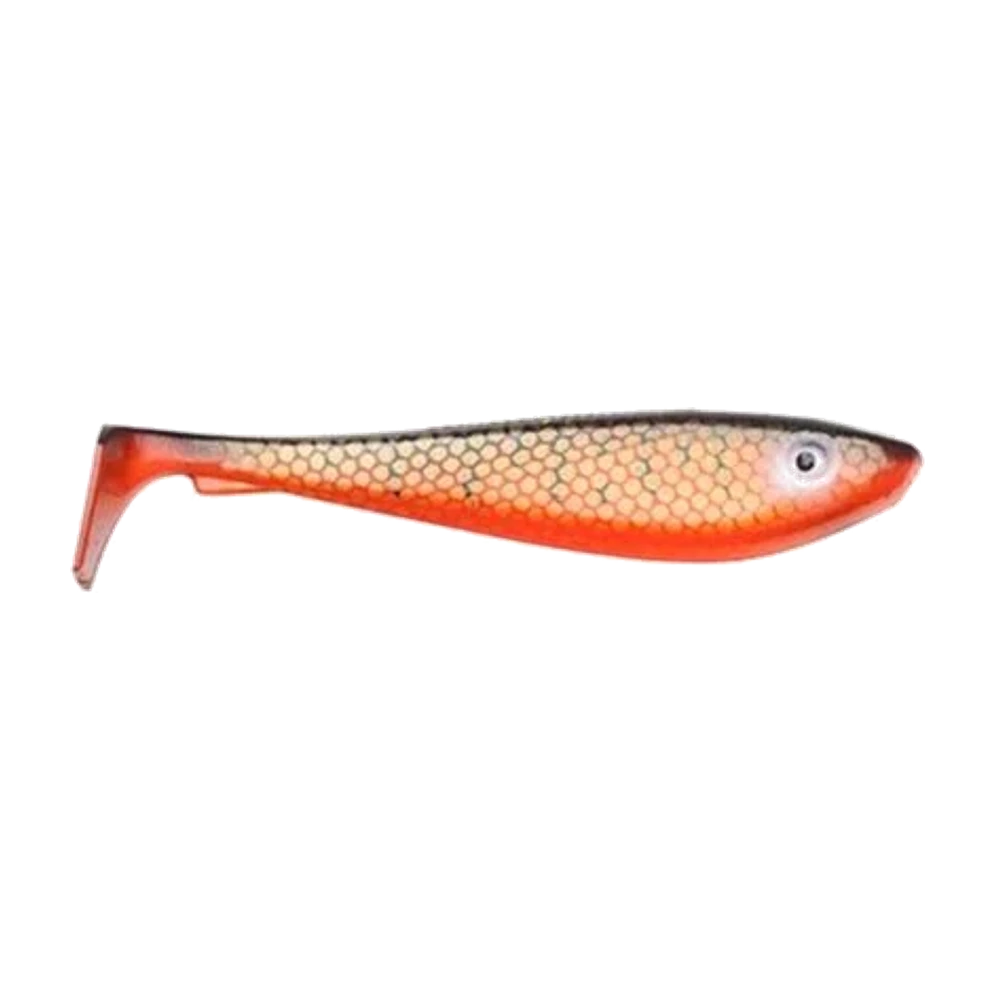
Abu Garcia Svartzonker McRubber: big volume that stays soft in the mouth
One lure, endless conditions. CarnaFish reads your spot from a photo so you are not just guessing.
November, water at 8 °C, a big four-metre flat with some flattened weed. You know there are pike. You run a 20 cm hard swimbait through: two half-hearted follows, no contact. You come back slower: the lure no longer swims, it just drags. The problem is not the size, it is that your lure needs speed to live, and the fish does not want any.
The McRubber exists for that exact window: a very big profile that keeps producing a signal at a speed where a hard bait produces nothing at all. It is a shad, not a swimbait, and that distinction is the whole article.
What the softness really changes
People usually buy a big soft plastic for its profile. On this model, the point lies elsewhere: in the rubber itself.
The start-up threshold is close to zero. The tail, broad and mounted on a thin wrist, starts kicking as soon as you move the lure a few centimetres. You can fish it at a speed where a jerkbait or a glidebait stays inert, and that is decisive on pike in cold water.
The lure also works on the drop. Pulled then released, the body slides off to the side while rolling and the tail keeps vibrating through the fall. A rigid lure, by contrast, dives straight and silent. On a holding fish looking upwards, that descent phase is often the entire attack.
It does not get spat out. That is the most concrete argument. A pike that inhales a hard lure immediately feels a block and opens its mouth. On soft plastic it holds on a fraction of a second longer — and on a big lure where the hookset takes time, that fraction of a second is the difference between a hooked fish and one that drops off two metres from the bank.
The retrieve: pull, give, wait
Never wind this lure back on a straight retrieve. You will miss the point of it.
- Cast and let it sink on a tight line, following the drop with the rod tip. Count the seconds. One bite in three comes on that first fall and shows up as line stopping too early, not as a knock.
- One wide sweep of the rod, 60 cm to 1 m, sideways rather than vertical. The lure lifts off and glides away.
- Give it back immediately, taking up the slack with the handle as the rod returns to position. The lure drops again, rolling, tail active.
- Wait one to three seconds while keeping just enough contact. That is the decision phase.
- Start again, moving forward a few metres each cycle. On a precise spot you can work it three or four times almost on the same patch.
On the water: with this kind of lure, do not strike on contact. Let half a metre of line go, take up the slack with the handle until you feel the weight of the fish, and only then set the hook with a sideways sweep. A reflex strike into thin air pulls the lure out of the mouth nine times out of ten, because the trebles have not found a hold yet.
When the water warms and pike turn active, you can switch to a slow straight retrieve broken by a stop every five turns. The lure falls away downwards on the stop, which is enough to trigger a follower.
Weight: the one setting that really matters
Sink rate governs everything. Too heavy and you lose the gliding phase. Too light and you never reach the bottom on deep spots.
| Depth | Total weight | Approximate descent | Use |
|---|---|---|---|
| 1 to 2 m, weed | 10 to 20 g | very slow, long glide | shallow flats, cold water |
| 2 to 4 m | 20 to 40 g | intermediate | the most versatile setting |
| 4 to 6 m, light current | 40 to 60 g | fast, firm contact | deep margins, drop-offs |
Two rigs are possible. The jig head puts the mass at the front: the lure noses down on the drop and lifts decisively on the pull, a very pronounced action. The internal belly weight, more centred, gives a flatter and slower descent, ideal in cold water.
On hooks, a stinger is essential on a lure of this length: one treble under the belly at the forward third, a second towards the back near the tail wrist. Without that, you strike into nothing on broadside takes, which are the majority in autumn.
Gear: do not under-size it
Rigged, this lure weighs between 55 and 120 g. A rod rated to 30 g will not cast it, will not work it and will not drive hooks through.
- Rod: 2.40 to 2.70 m, 60 to 150 g rating, semi-parabolic action. A softer tip helps absorb head shakes without pulling the hooks.
- Braid: 0.40 to 0.50 mm apparent diameter, meaning a true 20 to 30 kg. It is not about strength, it is about having no stretch when you set the hook at 30 m.
- Leader: titanium or coated wire, 40 to 50 cm. On a lure pike swallow deep, heavy fluorocarbon is not enough.
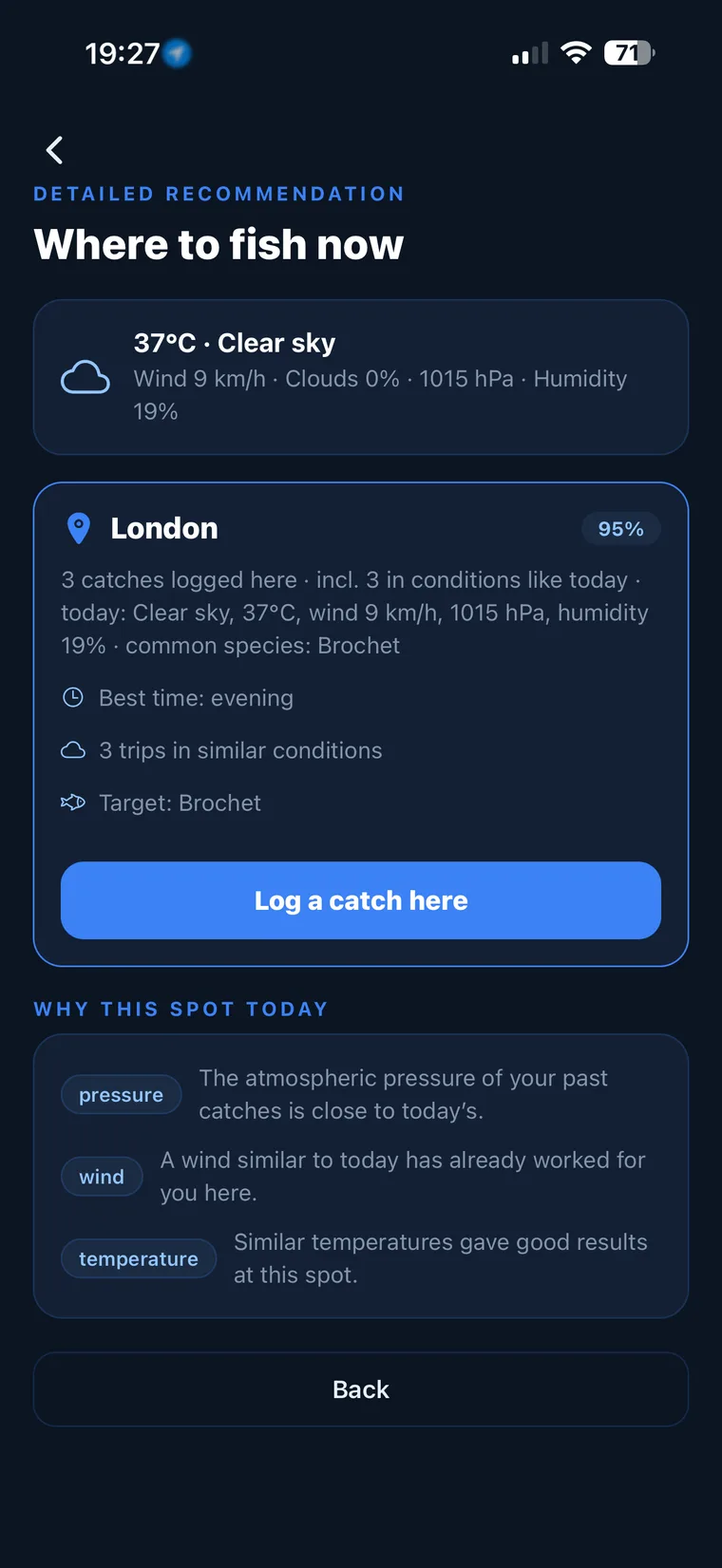
Not sure what to tie on?
Photograph your spot: CarnaFish reads the scene, cross-checks the conditions and gives you the zone, the lure and the retrieve. Free on iOS and Android.
Where it takes the lead, and where it disappoints
Its window is autumn and winter on holding pike, over big flats of 2 to 5 m, the margins of holes, weed flattened at the end of the season. Anywhere the fish is there but refuses to chase.
It disappoints in three situations. Fast searching over large expanses: too heavy to work, too slow, you cover little ground per hour — a jointed swimbait such as the Westin Mike the Pike does that better. In dense weed, the stinger trebles catch everything. And in summer on fish active at the surface, where a noisy lure or a fast glidebait triggers more.
McRubber or a rival big shad
Against a Fox Rage Big Eye Pro Shad XXL, the difference is the action: the Fox Rage has a stiffer tail and a stronger action on a straight retrieve, so it is the better searching tool. The McRubber aims at the opposite — softer rubber, very strong work on the drop, and better returns on lethargic fish.
Against a Megabass Magdraft, the rigging logic changes: the Magdraft is ready to fish, weighted and hooked out of the packet, designed for an immediate slow straight retrieve. The McRubber asks you to build your own rig, but lets you choose your sink rate to the gram, which is exactly the decisive parameter in cold water.
Our guide to choosing a pike lure places the big soft plastics against the other families through the seasons. And if you are unsure what weight to rig in front of a margin you do not know, CarnaFish analyses a photo of the spot and answers.
Key takeaways
- Soft rubber starts working at zero speed: that is what makes it effective where a hard lure is dead.
- The drop is an attack phase in its own right, not dead time.
- Set the hook late, after taking up the slack with the handle. Never on contact.
- The weight is the real setting: 10 to 60 g depending on depth and the sink rate you want.
- A poor choice for searching quickly or fishing dense weed.
FAQ
Which McRubber size should I choose for pike?
The 17-19 cm covers most situations and stays castable with a 100 g rod. The 23 cm is justified in late autumn, on spots known to hold big fish, when you accept fewer bites.
Is a stinger compulsory?
Yes at this length. A single head hook leaves the whole rear of the lure unarmed, while pike very often attack broadside or by the tail in cold water. One belly treble plus one back treble is the minimum.
What jig head weight should I use?
Between 10 and 20 g to fish a 2 m flat on a slow descent, 20 to 40 g for most spots of 2 to 4 m, and up to 60 g beyond 4 m or with current. Choose the sink rate you want first, the weight follows.
Why do I lose so many pike on big soft plastics?
Almost always because of striking too early. On a lure this size the hooks are buried in the rubber at the moment of the bite: you have to let the fish clamp down, take up the slack, then set sideways with real conviction.
Can the McRubber be fished on a straight retrieve?
It tolerates it, on a very slow retrieve with regular stops, but that is not its best use. It gives its maximum on wide lifts followed by free falls, because that is where the tail and the roll work together.
What rod for casting a 23 cm lure?
A rod of 2.40 to 2.70 m rated 60 to 150 g, with an action that is not too stiff in the tip. Below 100 g of maximum rating, casting becomes dangerous for the rod and the hookset lacks power at distance.
The full pike lure guideSeason-by-season strategy: which family of lure, when, and why.Go from theory to fish
CarnaFish reads your spot from a photo and gives you the game plan: zone, lure, retrieve. Free on iOS and Android.