Fox Rage Realistic Perch: playing the pike's taste for perch
This lure shines under specific conditions. CarnaFish tells you in 10 seconds if today is one of them.
Open the stomach of a 90 cm pike in October — or simply look at what it brings up in the net — and you will very often find a small perch. Not a roach: a perch of 12 to 15 cm, spines still up. It is an awkward prey, hard to swallow, and yet pike feed on them heavily in most waters, simply because that is what is available in quantity and because young perch stay grouped on predictable spots.
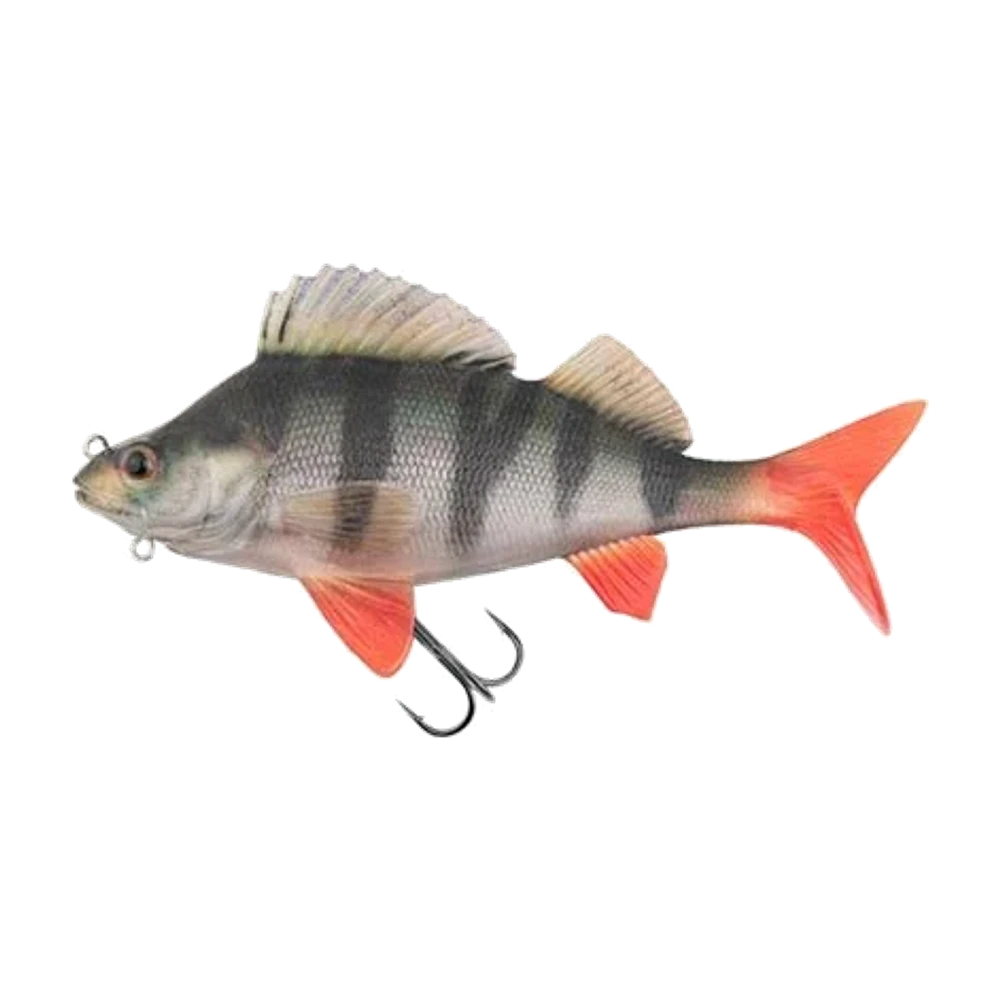
The Realistic Perch uses that fact directly. This is not a "generic baitfish" imitation: it is a small perch, with a deep silhouette, vertical bars and a dorsal fin. And that choice of prey changes two very concrete things — where you have to cast, and where you have to put your hooks.
A deep silhouette, not a roach profile
The difference between a perch imitation and a silver baitfish imitation is not cosmetic. It is hydrodynamic.
- The body is deep and laterally compressed. It offers more flank surface, so more water resistance. The action is more of a roll, slower, and the lure holds its line better on a slow retrieve without veering off.
- The vertical bars are a contrast signal, not a flash. In slightly stained water, a silver flank vanishes as the light drops. Bars stay readable far longer, because they work on pattern break-up.
- The raised dorsal breaks the line of the back. Seen from below against the light — the angle a holding pike watches from — that outline is the detail that separates a small perch from any other silhouette.
Practical consequence: this lure is fished where small perch live, not where silver baitfish pass through. Weed edges, jetty pilings, boulders and rock armour, the fringes of reed beds in late summer. Cast it into the middle of a featureless expanse and you have thrown away its main argument.
The hook question: the dorsal changes everything
This is the most important technical point on this page, and the one most anglers neglect.
A pike takes a small perch from behind or across the flank, then turns it in its mouth to swallow it head first, precisely to lay the dorsal spines flat in the direction of travel. That means two things: the initial grab is often a long way from the head, and the fish holds the lure sideways for a few seconds before turning it.
Three rigging consequences:
- A single belly hook is not enough. On a 15 cm body, a rear grab leaves the front hook outside the mouth. The rear stinger is not an option, it is the condition for converting.
- The stinger goes ahead of the dorsal, not into it. Hook a treble into the top of the back, into the moulded fin, and the point works inside a thick zone of plastic and frees itself poorly on the hookset. Put it on the flank, a third of the way up from the tail, just below the back line. Our pike stinger rig page covers wire lengths and anchor points.
- Leave some slack. A tight stinger stiffens the body and kills the rolling action. It has to be long enough to reach the rear third without putting the lure under tension.
On the water: do not set the hook on first contact. On a perch imitation, that first contact is almost always a sideways grab. Give it two seconds, feel the fish move off, then set sideways with a sweep. You will go from roughly one fish hooked in two to four in five.
Setting size and weight
| Situation | Size | Indicative weight | Pace |
|---|---|---|---|
| Shallow margins, under 2 m | 10 to 12 cm | 15 to 25 g | Slow straight retrieve, short bursts |
| Average water, 2 to 4 m | 12 to 15 cm | 25 to 45 g | Straight retrieve with 2 s pauses |
| Big lake or big fish targeted, 3 to 5 m | 15 to 18 cm | 50 to 80 g and up | Very slow retrieve, regular bottom contact |
| Late autumn, cold water | 15 to 18 cm | The heaviest you can tolerate | Long pulls, 4 to 5 s pauses |
A reliable guide: in October and November, match the lure size to that year's small perch in the water. If you can see shoals of 10 cm perch along the margin, rig a 12 cm, not an 18.
The retrieve: simple, but with a burst
This lure swims by itself, which is a trap — it makes you want to wind it straight back from start to finish.
- Cast tight to the structure: weed, jetty, boulder. Within a metre.
- Let it sink, counting the seconds to the layer you want, or to the bottom if that is what you are after.
- Retrieve slowly, just fast enough to feel the tail kick through the rod tip.
- Every five or six turns of the handle, give it a burst: a brief half-turn acceleration, then back to the same pace. The lure rises slightly and settles back into its swim.
- Mark a two-second pause after each burst. That is where the follower makes up its mind.
In cold water, replace the straight retrieve with long rod pulls and four to five second pauses, keeping bottom contact between each.
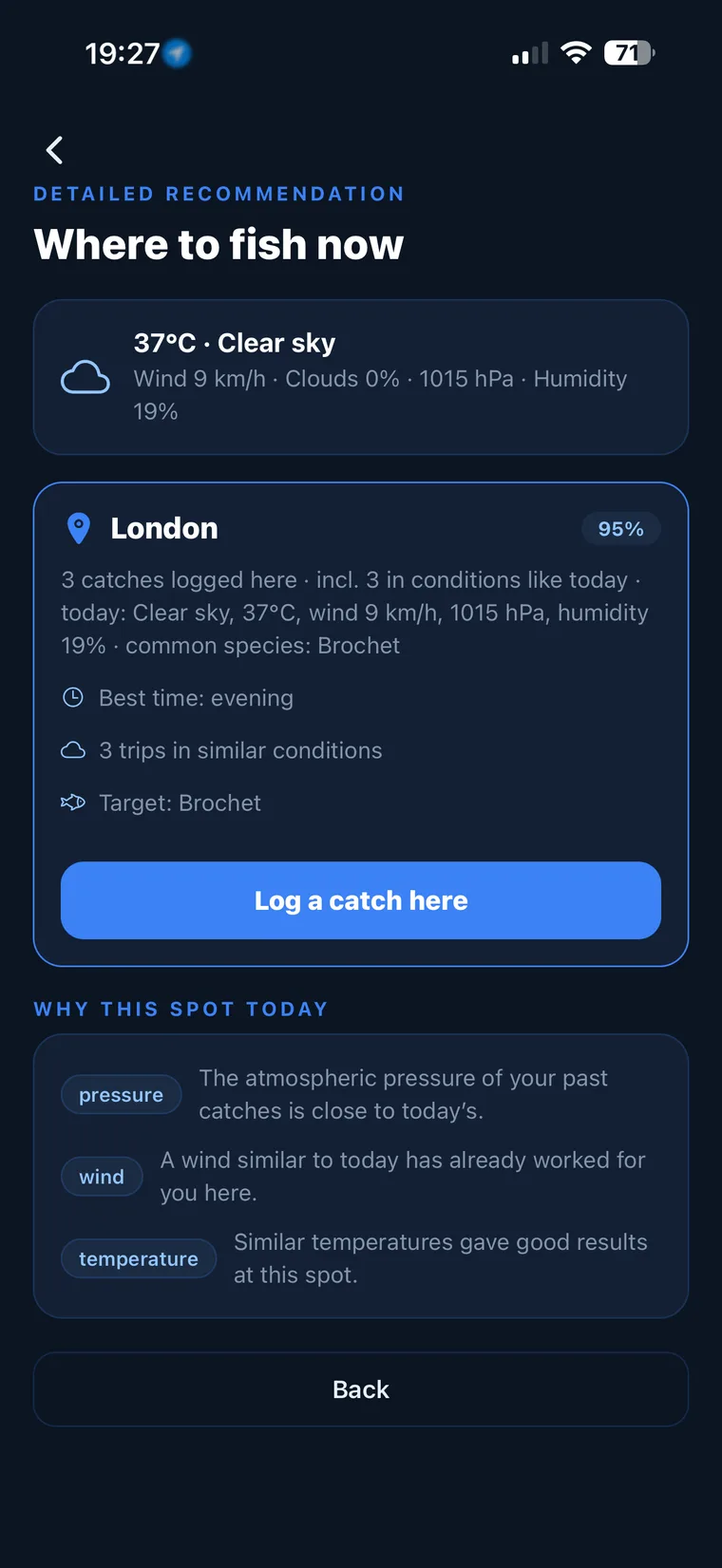
Not sure what to tie on?
Photograph your spot: CarnaFish reads the scene, cross-checks the conditions and gives you the zone, the lure and the retrieve. Free on iOS and Android.
Where it is wrong
Three cases where you are better off with something else. In open water on pike hunting shoals of active baitfish near the surface: there, a perch silhouette is a contradiction and a slim, fast lure converts better. In very murky water where only a strong vibration signal gets through: the deep body rolls but does not put out a powerful wave. And in thick weed, where the rear stinger — the very thing that is indispensable — becomes a weed magnet.
Realistic Perch or Replicant
The Fox Rage Replicant is the brand's all-round shad: more neutral silhouette, livelier tail, it works everywhere and gets away without a stinger more easily thanks to a slimmer body. It is the searching lure, the one you tie on when you do not yet know what the pike are eating.
The Realistic Perch is an answer lure. You rig it once you have established that small perch are on the spot — visible shoals, perch striking, a sounder screen full along the margin — and you accept a slower action and a heavier rig to set up in exchange. On a big imitative model like the Westin Mike the Pike you are somewhere else again: there, you are playing on pike eating their own kind, with a far longer profile.
Our guide to choosing a pike lure covers this logic of matching the dominant prey to a silhouette. And if you are unsure what size of small perch to imitate when you reach the bank, CarnaFish analyses a photo of the spot and answers.
Key takeaways
- Small perch are a major pike prey: fish this lure where perch live, not in the middle of the lake.
- Deep body and vertical bars: contrast rather than flash, a rolling action rather than a nervous one.
- The rear stinger is compulsory; put it on the flank a third of the way up from the tail, never in the moulded dorsal.
- Wait two seconds before setting: the first grab is almost always sideways.
- Wrong in very murky water, on pike hunting baitfish shoals, and in thick weed.
FAQ
Why imitate a perch rather than a roach for pike?
Because small perch are abundant and predictable prey in most waters, and they occupy precise spots you can target. When shoals of small perch are along the margins, a barred silhouette makes more sense than a silver flank.
Is a stinger really compulsory?
From 12 cm up, yes. Pike often attack from behind or across, and the belly hook alone stays outside the mouth. Without a stinger, you lose a large share of your bites.
Where should the stinger go on this lure?
On the flank, a third of the way up from the tail, just below the back line — never driven into the moulded dorsal fin, which is too thick for the point to free itself on the hookset. Keep slack in the wire so you do not restrict the action.
What head weight should I choose?
15 to 25 g along shallow margins, 25 to 45 g between 2 and 4 m, and over 50 g for the big sizes or cold water. The reliable guide is being able to feel the tail kick through the rod tip on a slow retrieve.
What size should I use in autumn?
Match the actual size of that year's small perch in your water, often 10 to 15 cm in October. Going bigger than the dominant prey reduces the number of bites without necessarily increasing the size of the fish.
Do I need a steel leader?
Yes. On a lure the pike turns in its mouth before swallowing, the line passes through the jaws along its whole length. A supple steel or titanium leader of 30 to 40 cm is the sensible minimum.
The full pike lure guideSeason-by-season strategy: which family of lure, when, and why.Go from theory to fish
CarnaFish reads your spot from a photo and gives you the game plan: zone, lure, retrieve. Free on iOS and Android.