Abu Garcia Toby: the wobbling spoon that fishes trout, perch and bass
Before tying this one on, it helps to know if the spot actually calls for it. CarnaFish reads the scene from a photo.
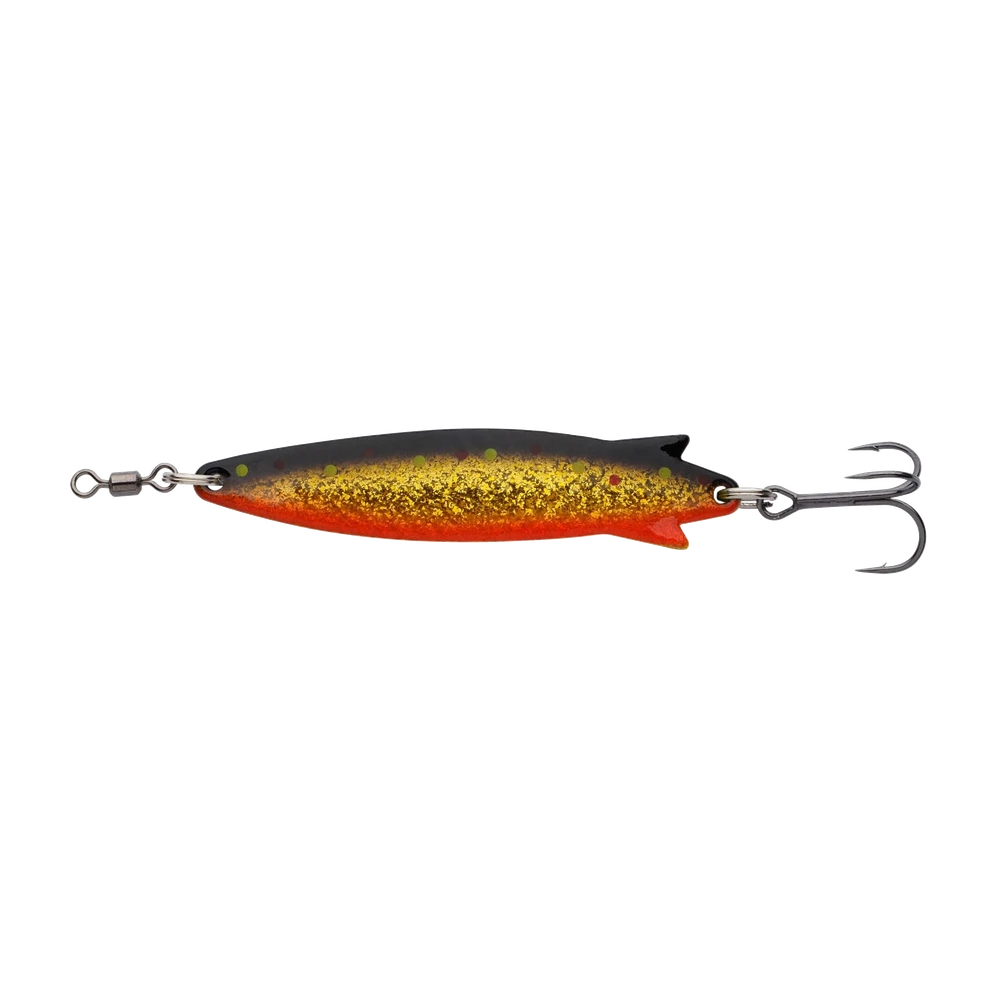
Few lures survive generations without changing shape. Abu Garcia's Toby, launched in 1956, is one of them: a curved wobbling spoon that produces an unmistakable flash and S-shaped wobble, equally at home fooling a river trout, a lake perch, or a bass from a rocky shoreline. Few lures can claim that kind of versatility without ever needing a redesign.
Why the Toby has lasted this long
The Toby's curved body generates a wide, steady wobble across almost any retrieve speed, which makes it forgiving for a beginner while staying deadly in the hands of an angler who knows how to vary the cadence. Unlike many spoons that only work well within a narrow speed range, the Toby keeps its S-shaped swim from a slow crawl to a fast retrieve — a rare quality for a spoon of this shape.
In rivers, for trout
For trout, light weights (7-12 g) suit most medium-sized rivers best. Cast across or slightly upstream, let the current work the spoon, and vary your retrieve speed to find the tempo that triggers a strike. In fast water, a slightly heavier Toby keeps bottom contact without needing to slow down excessively.
Field rule: if the spoon keeps hitting bottom, you're either too slow or too heavy for the depth — speed up a notch before switching lures.
In lakes or canals, for perch
On calm water, mid-range weights (12-18 g) let you scout open water quickly and cover a lot of ground — useful for locating an active school of perch before switching to a more finesse presentation. The Toby's flash reads very well as a small wounded baitfish fleeing in a zigzag, a classic trigger for hunting perch.
From shore, for sea bass
In saltwater, heavier models (18-28 g and beyond for long-range surfcasting) let you reach the break lines where bass patrol. It's an excellent complement to soft plastics and minnows when you need to cover a lot of water fast or cast into the wind. For more on reading tides and spots, our guide to sea bass lure fishing is a solid starting point.

Not sure what to tie on?
Photograph your spot: CarnaFish reads the scene, cross-checks the conditions and gives you the zone, the lure and the retrieve. Free on iOS and Android.
Choosing a weight
- 7-12 g: trout rivers, small lakes, fine-tuned scouting.
- 12-18 g: perch in open water, calm shallow seas, maximum versatility.
- 18-28 g: shore bass fishing, light surfcasting, moderate wind.
- Above 28 g: maximum casting range at sea, reserved for heavier rods.
Three rigging details worth checking
- The swivel: essential on any wobbling spoon, or the line twists within a handful of casts.
- The hook: a treble maximises hookups, a single hook makes releasing a trout easier.
- The leader: light fluorocarbon in rivers for stealth, heavier in saltwater to handle abrasion.
The right weight never replaces reading the spot and the day's conditions. That's exactly what CarnaFish does, reading a photo of your spot to suggest a zone and a retrieve, whether you're on a river, a lake, or facing the open sea. For trout specifically, our guide to river trout fishing covers reading spots and approach in detail.
Box-ready summary
- A universal wobbling spoon with a stable S-shaped action at any speed.
- 7-12 g for trout, 12-18 g for perch, 18-28 g and up for sea bass.
- Always use a swivel to prevent line twist.
- Match weight to depth and wind rather than to species alone.
FAQ
What weight Toby should I use for trout?
Between 7 and 12 g for most medium-sized rivers. In fast or deep water, step up slightly to keep bottom contact without changing lures.
Does the Toby work as well at sea as in a river?
Yes, provided you adjust the weight: models of 18 g and up cast far enough and handle wind well enough for the two constraints unique to shore bass fishing.
Do I need a swivel with this spoon?
Always. A wobbling spoon spins continuously during the retrieve, and without a swivel, braid or mono twists within just a few casts.
What retrieve speed gives the best S-shaped action?
The Toby wobbles at any speed, but the most pronounced S appears at a medium to fast retrieve. At a very slow crawl, the wobble is still there but more subtle.
Can you catch perch on a Toby?
Yes, it's one of its best freshwater uses. A weight of 12-18 g lets you scout a large area quickly, and the lure's flash reads well as a small fleeing baitfish.
Treble or single hook on a Toby?
The factory treble maximises hookup rate, especially at sea. A single hook, often preferred in rivers for releasing fish, makes unhooking easier without costing much effectiveness.
The full trout lure guideSeason-by-season strategy: which family of lure, when, and why.Go from theory to fish
CarnaFish reads your spot from a photo and gives you the game plan: zone, lure, retrieve. Free on iOS and Android.