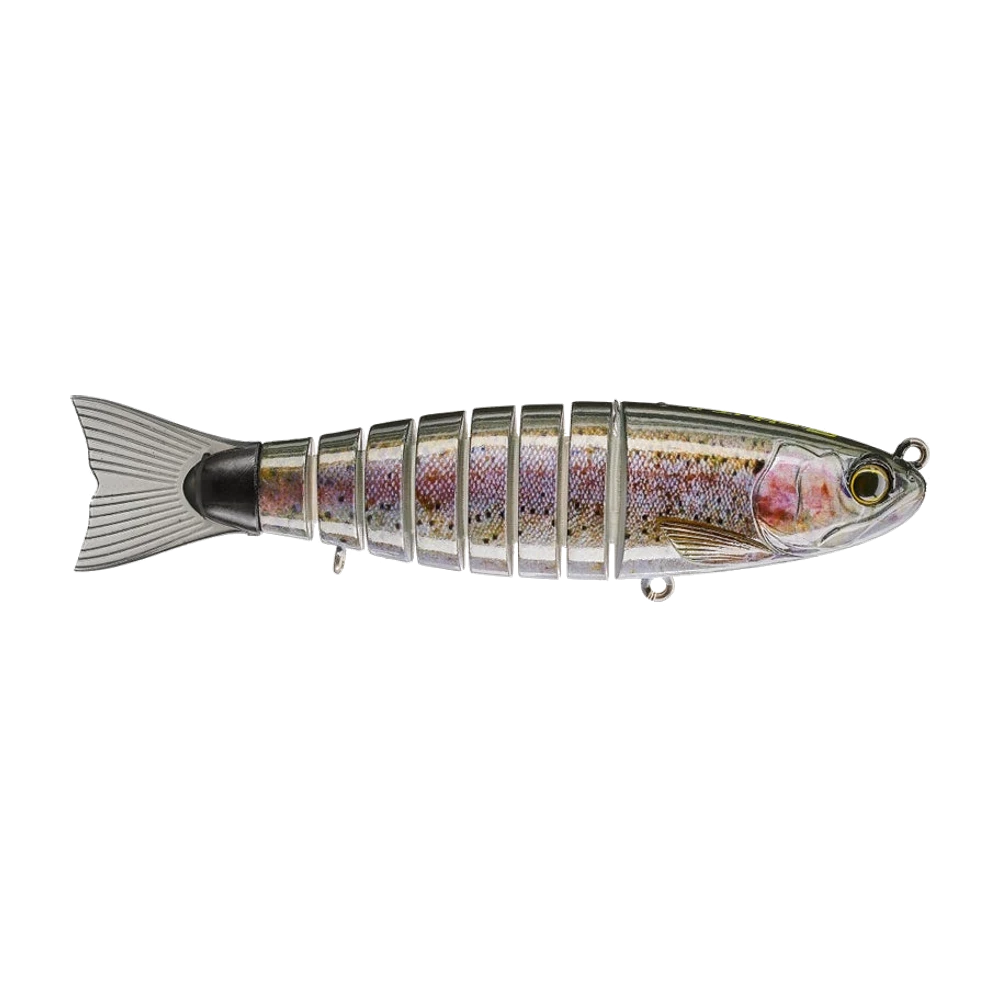
Biwaa S'Trout: the segmented swimbait that fishes on the drop
Before tying this one on, it helps to know if the spot actually calls for it. CarnaFish reads the scene from a photo.
Most jointed swimbaits are sold on a promise about the retrieve: you wind, the body undulates, it looks good. The Biwaa S'Trout is one of the few that also works while you do nothing at all. It's listed as sinking, with a fall rate of about ten inches per second, and all the way down the segments keep moving. That changes how you fish it completely — and it asks for patience.
Segments joined by woven mesh, not moulded plastic
The most interesting technical point on the S'Trout is the joint. Instead of plastic hinges or metal links, the segments are connected by a mesh-woven fabric, flexible but tough, rated at a forty-pound breaking strength — around eighteen kilos.
What that does in the water is obvious. The joint has no hard point. A swimbait on rigid hinges folds in steps, with a maximum angle set by the mechanics; a fabric link folds progressively, giving a continuous wave down the whole body. That's what produces a tight, fluid swim, far closer to a real fish than a chain of segments clacking against each other.
It's also, on this kind of bait, the usual wear point. Fabric joints get cut on pike teeth long before the body gives up. Rinse the bait in fresh water and check the joints after every good fish: a joint starting to fray is a joint that will fail at the worst possible moment.
Three sizes, with weights that demand serious tackle
The manufacturer lists three versions, all sinking and all quoted at the same fall rate:
- 14 cm for about 28 g (5.5 in, 1 oz): the most accessible, fishable on a standard medium-heavy casting rod. A good size for a big bass or a mid-size pike.
- 16.5 cm for about 51 g (6.5 in, 1.8 oz): the most versatile size on European water, and already a bait that asks for a rod rated to at least 80 g.
- 19 cm for about 85 g (7.5 in, 3 oz): reserved for big-pike work from a boat with dedicated swimbait tackle. Casting that all day on the wrong rod gets paid for in tendonitis.
The quoted sink rate, about ten inches — twenty-five centimetres — per second, is the same across all three sizes. That's a valuable and rarely published figure: it lets you count the fall precisely. Six seconds, a metre and a half; twelve seconds, three metres. No depth control is more reliable than a countdown on a bait whose maker publishes its sink rate.
How to fish it: slowly, then slower
The slow roll along an edge
The baseline retrieve is a very slow straight roll, just fast enough to feel the body working through the rod. The S'Trout doesn't need speed; it actually loses credibility if you burn it. Along a reed edge or a gravel-pit drop, a walking-pace pass two metres under the surface is often all it takes.
Stop and go with a countdown
This is where the fall earns its keep. Cast, count the seconds needed to reach the depth you want, wind three or four turns, then stop everything for two or three seconds. During the stop the bait drops back rocking and the segments keep living. A pike that's been following from ten metres back almost always commits on that dead time.
Don't set the hook on first contact with a big swimbait. Followers often slap the tail without having it in their mouth. Keep winding at the same pace for one more second: if the fish really took it, the weight arrives and you set; if not, you haven't torn the bait off its nose and it will come back on the next pass.
An imitation bait, and what that means on our water
The S'Trout is drawn as a trout, with photo-print technology and a multilayer paint process that reproduce the pink lateral band and the speckling on the back. It's a convincing imitation, but it still has to make sense on your spot.
On a reservoir fed by a trout stream, or on stocked water, the resemblance pays directly. On a canal or a gravel pit with no trout in it, what works is the silhouette, the volume and the swim, not the accuracy of the pattern. In that second case, plainer roach or silver-white finishes often produce the same results for less money.
The classic mistake
Fishing the S'Trout like a search bait, firing out fast casts to cover ground. A swimbait in this class isn't there to find fish, it's there to make up the mind of a fish you already know about. Locate first, with a faster lure or on the sonar, then bring the S'Trout out on the spot you've identified. Fifteen well-placed casts beat two hundred random ones.
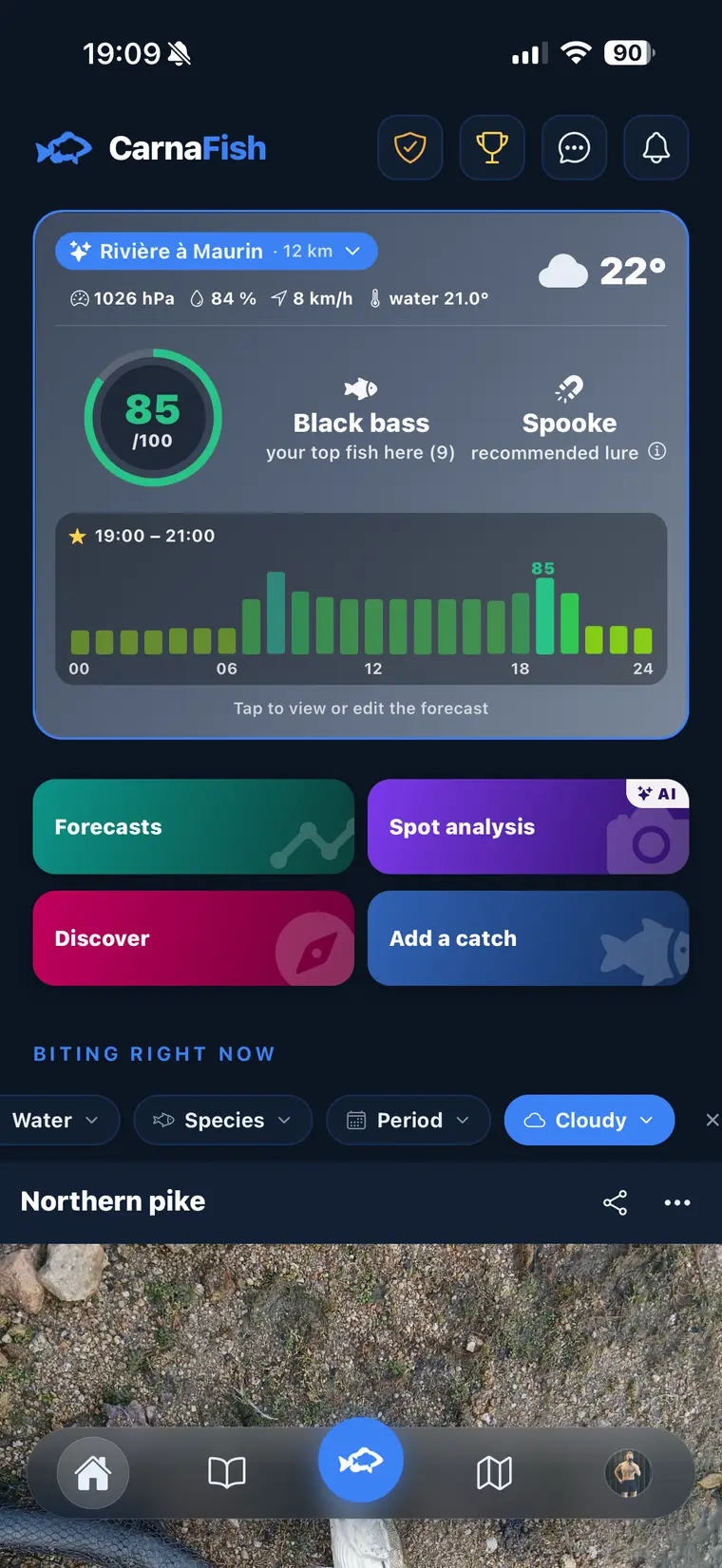
Not sure what to tie on?
Photograph your spot: CarnaFish reads the scene, cross-checks the conditions and gives you the zone, the lure and the retrieve. Free on iOS and Android.
The factory hardware
The bait comes rigged with black-nickel Zion trebles and stainless steel hardware. That's consistent with the rest: discreet black hooks, metal that won't rust in brackish water, and rings sized for the load. There's nothing you have to change as a matter of course, which is welcome at this price. Just check, as on any big swimbait, that the trebles aren't twisted after a fish — a bent treble throws the swim off immediately.
Colors by water clarity
- Clear water over trout forage: Rainbow Trout, the original pattern, at its most useful where trout are genuinely on the menu.
- Mixed water, gravel pit or canal: a roach or silver-white finish, plainer, working on silhouette rather than detail.
- Coloured water after rain: a dark tone, black or deep green back, which reads better from below than any fine pattern.
Tying on a bait this size only makes sense if you know where the fish are, and that's exactly what CarnaFish helps you work out: one photo of the water and the AI suggests the zone, the depth and the lure family that fit the conditions. To compare this jointed bait against a one-piece soft swimbait like the Megabass Magdraft or a pike-shaped jointed bait like the Savage Gear 3D Hybrid Pike, those sheets lay out different trade-offs, and our guide to choosing a pike lure puts the whole thing in perspective.
The short version
- Three sinking sizes: 14 cm for 28 g, 16.5 cm for 51 g, 19 cm for 85 g.
- The same quoted sink rate across all three, about 25 cm per second, which makes a countdown genuinely reliable.
- Segments joined by woven fabric rated at 18 kg: a fluid swim, but a wear point to check after every pike.
- This is not a search bait: you bring it out on a spot you've already located.
FAQ
Does the S'Trout sink or float?
It sinks. The manufacturer lists all three sizes as sinking, with a fall rate of about ten inches — twenty-five centimetres — per second. That fall, during which the segments keep moving, is what draws a good share of the strikes.
Which size should I pick for pike?
The 16.5 cm at 51 g is the best compromise on most European water. The 19 cm at 85 g only earns its place if you're genuinely targeting big fish and you own a proper swimbait rod.
What rod do I need to cast it?
From 51 g upward you want a casting rod rated to at least 80 g, in 1.95 to 2.20 m. With the 85 g model you're into dedicated swimbait tackle, rated 150 g and above.
Do I need a wire leader?
Yes, as soon as pike might be around. Sixty to eighty-hundredths fluorocarbon is enough on a pure bass spot, but on a bait pike often take sideways, a wire or titanium leader is the only real guarantee.
How long does a segmented swimbait like this last?
It depends entirely on the joints. The body and the paint last a long time; it's the fabric at the articulations that wears, especially on pike teeth. A check after every good fish and a fresh-water rinse extend the life noticeably.
Can you catch bass on it?
Yes, especially in 14 cm, on waters that hold big fish. It's selective fishing: you'll get far fewer bites than with a standard paddle tail, but the average size will be clearly higher.
The full pike lure guideSeason-by-season strategy: which family of lure, when, and why.Go from theory to fish
CarnaFish reads your spot from a photo and gives you the game plan: zone, lure, retrieve. Free on iOS and Android.