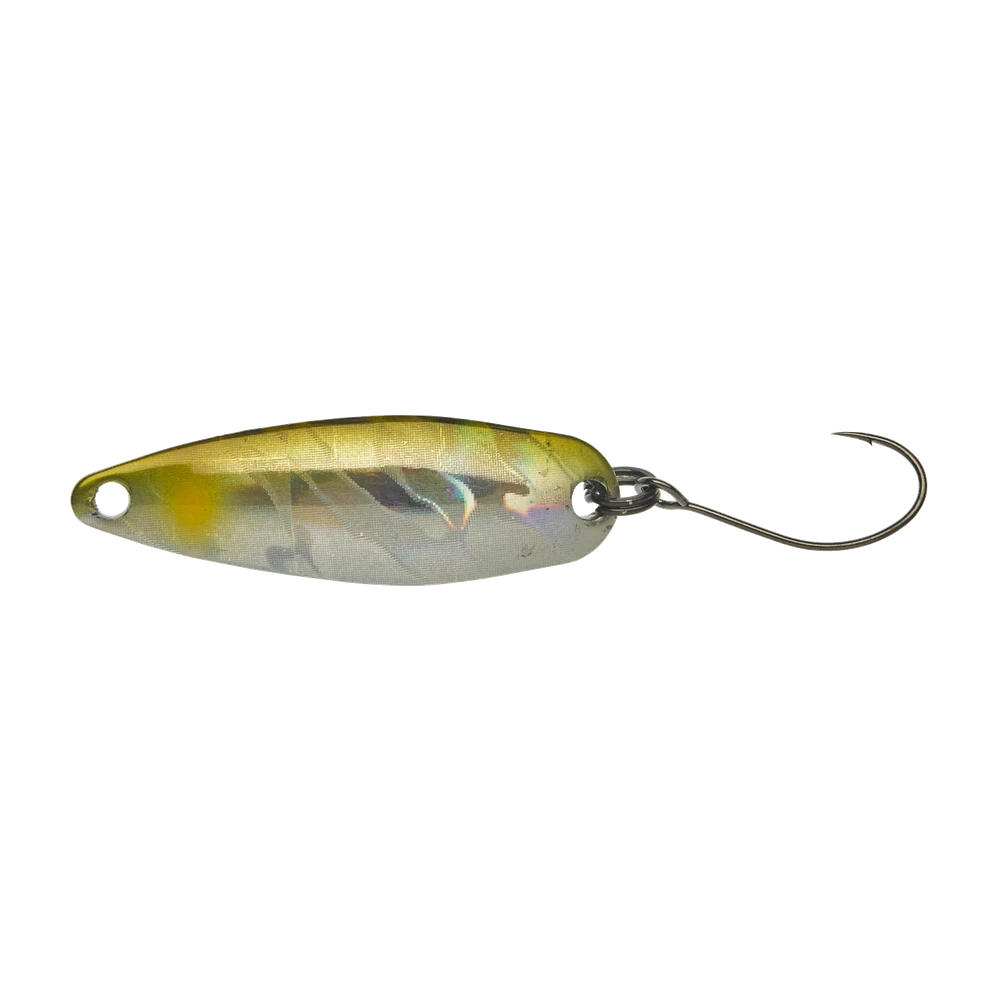
Illex Native Spoon: the light wobbler that rescues tiny streams
This lure shines under specific conditions. CarnaFish tells you in 10 seconds if today is one of them.
On a two-metre-wide trout stream choked with low branches and gravel margins, most modern lures are oversized. That's exactly where the light wobbling spoon earns its keep — and the Illex Native Spoon has become one of the most reliable options for that kind of tight spot.
A lure built for small water
Unlike an inline spinner such as a Mepps Aglia or a Blue Fox Vibrax, which produces flash and vibration through a spinning blade, a wobbling spoon has no moving parts at all: it's the shape of the slightly curved metal body itself that generates a wide-amplitude wobble on the retrieve. That distinctive swim — wide but low-intensity — mimics the erratic movement of a small injured fish, a silhouette trout read as easy prey.
The Native Spoon applies this across five weights: 3.5 g, 5 g, 7 g, 9 g and 14 g. The two lightest sizes are the most useful in small streams or first-category rivers, where a heavier spoon dives too fast and drags bottom before it even gets swimming properly.
Why not just use a soft lure
A well-chosen soft plastic covers a lot of ground, but it has a weak spot in small streams: its swim often depends on a fairly steady retrieve, hard to maintain in current that changes speed every couple of metres. The Native Spoon keeps swimming correctly even through the uneven retrieves the riverbed forces on you — a real edge when a spot demands zigzagging between boulders.
A light wobbling spoon doesn't need a clever retrieve — its ability to swim well through an imperfect retrieve is exactly what makes it a small-stream tool.
How to fish it
The basic technique is simple: cast slightly upstream or across the current, let it drift down with barely any braking, then retrieve slow to medium, adjusting for current strength. In calm spots (pools, back-eddies), a very slow retrieve with short bursts mimics an injured fish trying to swim again. In faster water, a slightly brisker speed is enough to hold the characteristic wobble without the spoon rising too fast toward the surface.
Weight by spot
3.5 g and 5 g
The go-to pair for narrow streams or shallow first-category rivers. Slow fall, swim kicks in within the first few inches of retrieve.
7 g and 9 g
The mid-range option, suited to slightly wider rivers and depths of 1 to 1.5 m, or to wind that makes casting a lighter spoon harder.
14 g
Reserved for deep spots or strong current, more for stillwater trout or as a backup when fishing perch in wider water.
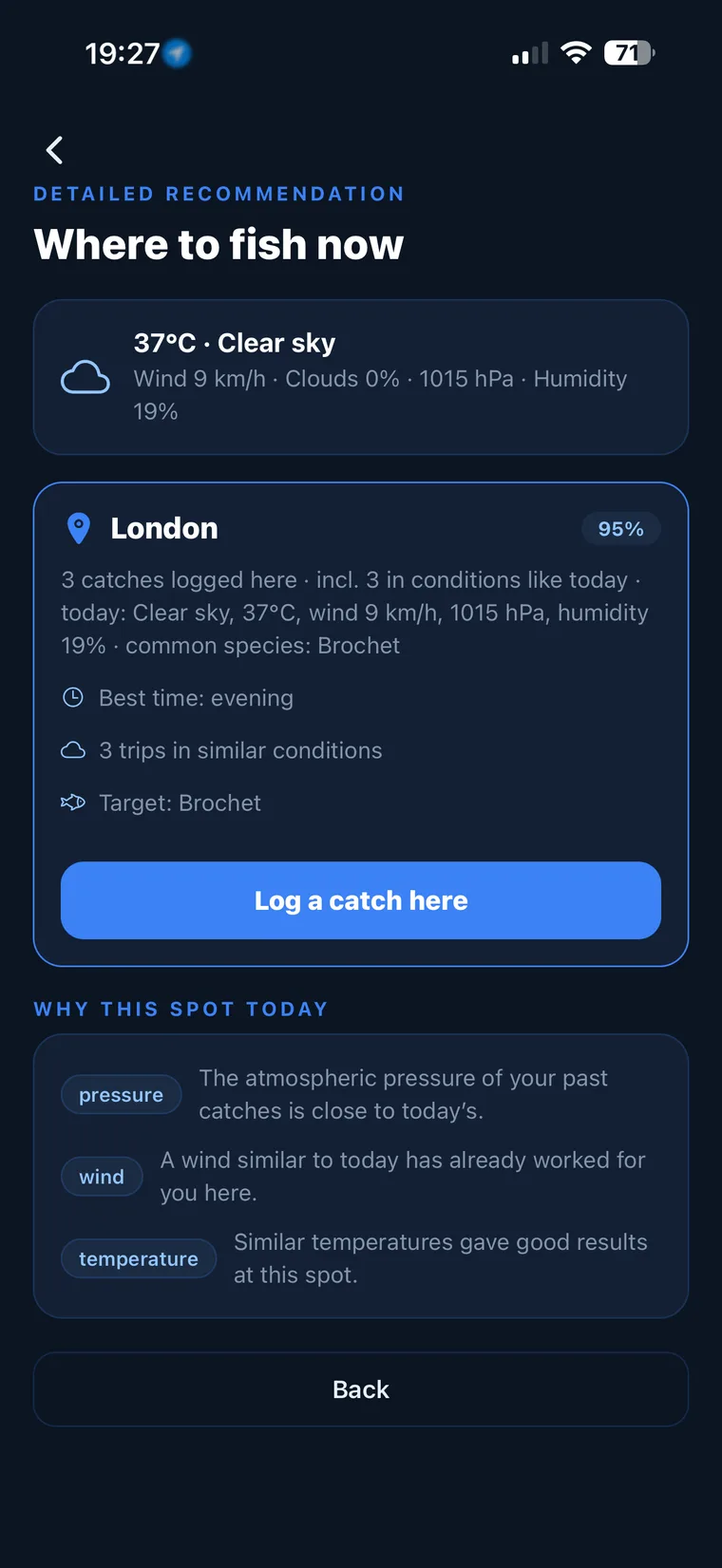
Not sure what to tie on?
Photograph your spot: CarnaFish reads the scene, cross-checks the conditions and gives you the zone, the lure and the retrieve. Free on iOS and Android.
Colour: subtlety wins, with one exception
In clear water, a natural finish (trout-back, bleak, silver) is more than enough — the wobble does the work, not the colour. In low, bright water, those same tones avoid spooking already-wary fish. It's only in murky water, after a spate or recent rain, that a fluoro tone (orange, chartreuse) becomes useful to stay visible.
Where it falls short
The Native Spoon isn't the right tool for spots choked with submerged branches: its standard treble hook snags constantly. In that case, a weedless-rigged soft plastic is the better call. It's also not the strongest option in deep, calm open water, where a spinner like the Blue Fox Vibrax covers more ground thanks to its vibration.
Knowing when to reach for a light wobbling spoon instead of a soft plastic or a spinner comes down to reading the spot. CarnaFish was built for exactly that: one photo of the spot is enough for the AI to read the water's layout and point you to the right lure type. To go further on river trout, our guide to river trout fishing also covers which spots to prioritise by season.
Three things to remember before you go
- 3.5 g and 5 g for small streams, 7-9 g for wider rivers, 14 g for deep spots.
- Its swim tolerates an uneven retrieve, which makes it a good pick when current speed keeps changing.
- Natural colours by default, fluoro only in murky water.
FAQ
What weight Illex Native Spoon should I use for a small stream?
The 3.5 g and 5 g versions suit it best: they fall slowly and start swimming within the first few inches of retrieve, without dragging bottom in a shallow bed.
What's the difference between a wobbling spoon and a spinner?
A wobbling spoon has no moving parts — its body shape produces a wide-amplitude wobble. A spinner, like a Mepps Aglia, uses a blade spinning around a shaft to produce flash and vibration. They work differently and complement each other well in a box.
Does the Native Spoon work for perch?
Yes, especially in shallow lakes or canals, with the 7 g and 9 g sizes casting further and covering more water than in a stream.
Do I need a swivel with a wobbling spoon?
It's less critical than with a spinner, since a wobbler doesn't spin on itself the same way. A swivel is still a reasonable precaution, especially on thin braid.
Does this spoon work in murky water after a spate?
Yes, provided you switch to a fluoro colour (orange, chartreuse) that stays visible despite the turbidity. In those conditions, a slightly slower retrieve gives the fish more time to spot the lure.
What's the alternative for a spot choked with branches?
In that case, the Native Spoon's standard treble hook snags too often. Reach for a weedless-rigged soft plastic instead, better suited to that kind of cover.
The full perch lure guideSeason-by-season strategy: which family of lure, when, and why.Go from theory to fish
CarnaFish reads your spot from a photo and gives you the game plan: zone, lure, retrieve. Free on iOS and Android.