Bass Assassin Split Tail Shad: the forked tail that does not vibrate
Rather not fish it blind? Photograph your spot — CarnaFish cross-checks the conditions and points you the right way.
The water is clear, the sun is high, and you can watch fish track your paddle tail for three metres before turning away at the last second. That scenario does not get solved by changing colour: it gets solved by removing the signal that puts them on alert. The Bass Assassin Split Tail Shad does exactly that — a 10 cm bait that has given up on vibration.
A tail that does not kick, by design
Most soft shads end in a paddle, a flat surface set across the body that grabs water and makes the rear of the bait beat. That produces a vibration fish detect at distance through the lateral line. It is efficient for covering water and far less subtle when the fish is already there and wary.
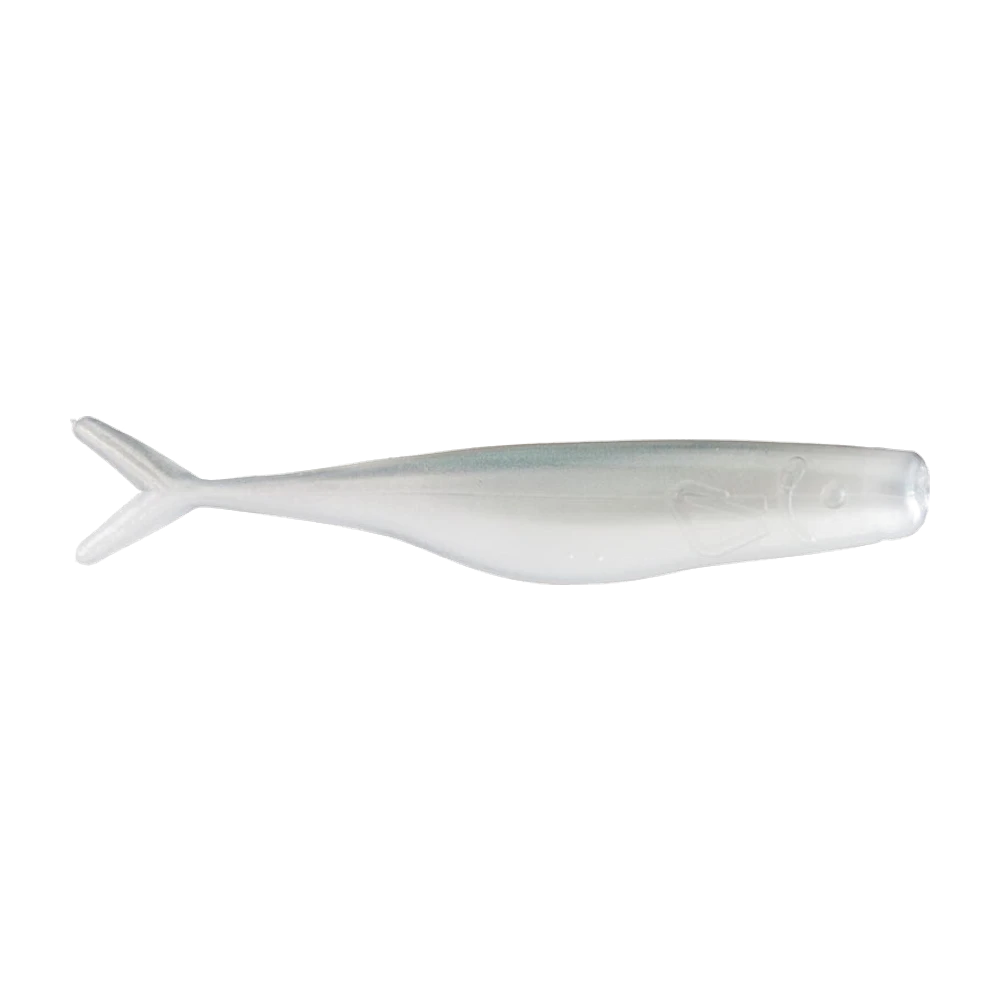
Bass Assassin moulds its Split Tail Shad with a tail split vertically into two soft prongs. Those prongs create no meaningful resistance: they trail behind the body, spread slightly on the retrieve and close on the pause. Viewed head on, a live minnow cruising quietly has exactly that V-shaped tail profile. The lure is not trying to be detected, it is trying to be accepted.
The practical consequence is simple: this is not a search bait. If you need to cover a large flat to find fish, a paddle tail such as the Keitech Easy Shiner 4 will do it faster. The Split Tail Shad comes afterwards, once you have located them and need to convert.
The moulded detail, and what it is really worth
The manufacturer moulds eyes, fins and gill plates into the body. They are clearly visible in the photo, and they contribute to the overall silhouette more than to realism as such: a fish does not count scales. They do, however, slightly alter the flow of water along the flanks and break up the uniform shine of a smooth body, which shows in very clear water.
The point worth noting lies elsewhere: the manufacturer publishes no weight for this bait. The pack holds ten pieces at 4 in, that is 10 cm, and that is all. If you need a precise casting weight — to match a light rod, say — you will have to weigh one yourself, and in any case the jighead or bladed jig will determine the total weight of the rig.
Four rigs, four different ways to fish
The scrounger head
This is the rig the manufacturer lists first, and that is no accident. A scrounger head carries a small soft lip that swings the bait side to side on the retrieve. It gives the Split Tail Shad the movement its tail does not produce — but a whole-body movement, very different from a paddle's vibration. On a slow retrieve along a bank, it is deadly.
As a bladed-jig trailer
Behind a vibrating blade, the bait adds volume and a credible silhouette without contributing any vibration of its own. Plenty of anglers run a paddle-tail trailer behind a bladed jig and end up with a muddled signal. A forked tail lets the blade do its job alone.
Plain ball head
The simplest rig: a round head of 3 to 7 g depending on depth, a slow straight retrieve or a lift-and-drop. The bait swims straight, without vibration, and that is precisely what you want from it in clear water.
Drop shot
Nose-hooked above a weight, the Split Tail Shad exploits the slightest movement of the line. The two prongs respond to current and to micro-twitches of the rod tip with no input from you. It is the finesse end of the four.
If you run it as a bladed-jig trailer, thread it dead straight on the shank. A bait rigged slightly crooked is invisible to the eye but makes the whole rig spiral after ten metres, and you will spend the day wondering why nothing bites.
Not sure what to tie on?
Photograph your spot: CarnaFish reads the scene, cross-checks the conditions and gives you the zone, the lure and the retrieve. Free on iOS and Android.
Colour by water clarity
- Clear water: the translucent pearl white of the photo, with its faint bluish sheen along the back. It is the most logical finish for this bait, because it extends the discretion of the tail.
- Lightly stained water: an ayu or a green back over a pale belly, keeping a readable silhouette without overselling.
- Dirty water: chartreuse, though honestly that is the point where a paddle tail becomes the better tool again. A subtle lure in water where fish cannot see 50 cm works against itself.
A converting bait, not a searching one
The Split Tail Shad fills the same slot as a Megabass Hazedong Shad or a Basstrix Flash Trix: a baitfish profile with no pronounced action, aimed at fish you have already located and that refuse noisy presentations. The difference comes down mostly to price and pack count — ten pieces, which makes it a bait you accept losing in branches.
Knowing when to switch from the lure that searches to the lure that converts is one of the most profitable decisions of a fishing day. That is exactly the kind of read CarnaFish makes easier: a photo of the spot, and the app suggests the zone, the depth and the presentation type suited to conditions. To sharpen your reference points on banks and structure, our guide to reading a fishing spot lays out the method.
Key takeaways
- Forked tail: no vibration, a baitfish profile that swims normally rather than announcing itself.
- 10 cm, ten pieces per pack; the manufacturer does not publish a per-bait weight.
- The scrounger head is the rig that restores the most movement without betraying its discretion.
- In dirty water it loses its advantage: go back to a paddle tail.
FAQ
Why pick a split tail over a paddle tail?
Because a paddle produces vibration that fish detect from a distance — useful for covering water but counterproductive on a wary fish in clear water. The split tail removes that signal and lets the bait pass for a fish swimming normally.
How much does the Split Tail Shad weigh?
The manufacturer does not say: it publishes only a length of 4 in, that is 10 cm, and ten pieces per pack. In practice the casting weight depends mainly on the jighead or bladed jig you pair it with.
Is it a good bladed-jig trailer?
Yes, and that is one of its best uses. It adds volume and a credible silhouette without producing vibration of its own, which keeps it from muddling the signal the blade already provides.
Does it work for perch?
At 10 cm it mostly interests big perch and spots where they share water with other predators. For average-size perch, a shorter format remains more suitable.
Does it need rod action?
Not necessarily. On a scrounger or a ball head, a slow straight retrieve is enough — the movement comes from the rig. On a drop shot, let current and micro-twitches of the rod tip do the work instead.
How does it compare to a Japanese finesse shad?
The principle is close to a Megabass Hazedong Shad: realistic profile, minimal action. The difference is mostly price and packaging, with ten pieces per bag that let you fish tight to cover without counting the cost.
The full bass lure guideSeason-by-season strategy: which family of lure, when, and why.Go from theory to fish
CarnaFish reads your spot from a photo and gives you the game plan: zone, lure, retrieve. Free on iOS and Android.