Zoom Shimmer Shad: the forked trailer that settles a bladed jig
This lure shines under specific conditions. CarnaFish tells you in 10 seconds if today is one of them.
Some days a bladed jig only produces followers: the fish rises behind the lure, escorts it for two or three metres, then peels off at the bank. Nine times out of ten the blade is not the problem — what sits behind it is. The Shimmer Shad was built for exactly that slot: a slim baitfish body threaded down the shank, turning a noisy chunk of hardware into a credible silhouette. You just have to understand what it does, and above all what it does not.
A forked tail is not a paddle
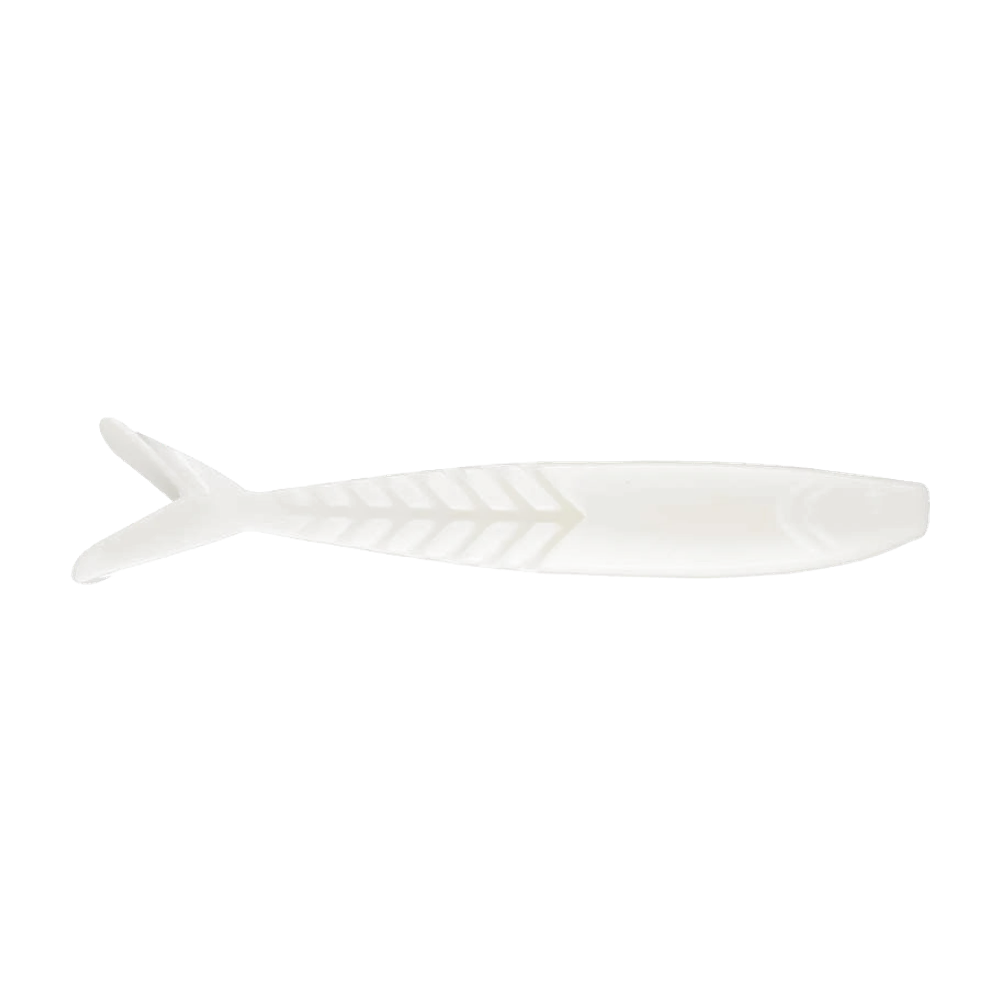
This has to be settled before anything else, because it governs every use of the lure. The Shimmer Shad's tail is a fork with two thin points, not a flat paddle. A paddle presents a surface to the water, which creates alternating resistance, therefore a thump, therefore a pressure wave the fish picks up through its lateral line. A fork presents almost nothing: it lets the flow pass through and simply quivers — Zoom says as much in its own words.
The practical consequence is straightforward: this bait generates no signal on its own. Rigged bare on a jighead and reeled straight, it does not thump, it does not vibrate, it glides. That is not a flaw, it is a choice of camp: the Shimmer Shad belongs with the quiet bodies, alongside the Zoom Super Fluke, not with paddle-tail shads like the Keitech Easy Shiner 3. If you want a bait that covers water by pumping out vibration, you are in the wrong aisle.
The flank is ribbed across the whole middle section, in chevrons angled backwards and clearly visible on the product photo. Those ribs do two real things: they soften the body at that exact point, creating a hinge that lets the rear end swing, and they add surface that grips the water. Zoom talks about a back-and-forth swimming action added to the host lure. The wording is a sales line, but the mechanism behind it holds up — a soft body hinged in the middle deflects wider than a solid one.
Its real place: behind a lure that already works
Zoom's own description is explicit here and worth taking at face value: you thread the Shimmer Shad down the shank of a bladed jig, a spinnerbait, a buzzbait or a jighead. This lure is not designed as a standalone answer, it is designed as the visible half of an assembly.
Behind a bladed jig it replaces or supplements the silicone skirt. The gain is not noise — the blade handles that — but profile: a skirt alone gives a vague mass that flares on the pause, while a soft body keeps a fish shape even at a standstill. On a fish that follows without committing, that detail often decides the last second. A ChatterBait JackHammer dressed with a slim body can also be reeled slightly faster without blowing out, because the trailer's drag stabilises the whole thing.
Behind a spinnerbait the job changes: you are after bulk and a slow rise. The Shimmer Shad adds lift at the back of the frame, which lets you slow the retrieve down without the lure nosing over. Behind a buzzbait, Zoom pushes a casting argument — a more compact, better streamlined mass than a skirt. That is a brand claim, but it checks out on the water: a skirt brakes, a solid body does not.
Threading it decides everything
This is where most failed rigs are lost. Lay the hook alongside the body before piercing anything, note where the point has to exit, then enter dead centre through the nose. A bait threaded even two millimetres off-axis will helicopter on the first fast retrieve: it spins on itself, twists the leader and stops fishing. If the body hangs loose or bunches along the shank, pull it off and start again — a bunched trailer never fixes itself while fishing.
A drop of cyanoacrylate glue on top of the shank, applied just before you push the bait into place, and the trailer stops sliding down towards the hook after ten casts. That single habit is the difference between five fish and an empty pack by lunchtime, especially on a bladed jig that shakes non-stop.
On a jighead, on its own
The Shimmer Shad fishes alone too, as long as you switch registers: you leave searching behind and move to presentation. A light round head of 3 to 7 g, a slow retrieve broken by two sharp twitches, and the body slides sideways before settling — the fork quivering through the whole dead time. That presentation works on educated fish, in clear water, when everything that vibrates has already been shown three times. On a weedless Texas rig, wide-gap hook driven into the back with the point buried, it clears light to moderate vegetation.
One honest caveat belongs here: Zoom publishes no weight for this bait and no buoyancy class. The dealer's size table comes down to the length and the number of pieces per pack — five — not to a weight. There is therefore no way to state a sink rate. The only serious way to find out is the bucket test: drop the bait on the head you intend to use, time it over one metre, and you will know what to count on at the spot.
Where and when, in Europe
The most productive window is late spring, when the water warms and bait schools form along the margins: a bladed jig dressed this way, run along a shallow break or the edge of a weedbed, covers ground fast. In summer the same rig shifts to shaded areas and the outside edges of vegetation.
Bass is the core target and the lure makes no secret of it. The slim 10.8 cm / 4.25 in profile also interests zander on a jighead with a slow straight retrieve, and a good perch when the fork quivers just above the bottom. There is no point considering it on a pike spot without a suitable leader, though: a soft body this fine does not survive one strike.
Not sure what to tie on?
Photograph your spot: CarnaFish reads the scene, cross-checks the conditions and gives you the zone, the lure and the retrieve. Free on iOS and Android.
Colours and water clarity
Zoom names no specific colour, only a range of its own natural patterns — so there is no reference to quote. The sample photographed is opaque white, almost pearl, with no flake and no contrasting back: that is an observation from a product photo, not a specification.
- Clear water: pearl white or translucent with a sheen, exactly the finish visible in the photo. It imitates a young baitfish without piling on glare.
- Lightly stained water: natural greens and browns, which keep a readable silhouette without shining.
- Dirty water or low light: a dark back, or a pale body with a touch of chartreuse at the tail, to give an aiming point to a fish hunting at short range.
What this lure will not do for you
The first mistake is buying it to replace a paddle-tail shad. The second is expecting more vibration on a bladed jig: the trailer does not add noise, it adds a shape and some drag. The third is reeling it too fast on its own — past a certain speed, a body with no lifting surface starts to roll and loses all credibility.
Picking the right trailer is worthless if the spot has been read wrong, and that is exactly what CarnaFish makes easier: a photo of the swim, and the AI suggests the zone, the depth and the kind of presentation that suit the day's conditions. To lay the groundwork on tackle and typical swims before getting lost in rigging details, our beginner's guide to bass fishing is still the right way in.
What to remember
- Forked tail, not a paddle: this bait quivers, it does not vibrate, and it does not search water on its own.
- Its real place is threaded down the shank of a bladed jig, spinnerbait or buzzbait, where it brings a profile and a drag no silicone skirt provides.
- Zoom publishes neither weight nor buoyancy class: run the bucket test before betting on a sink rate.
- Threading it two millimetres off centre is enough to make the whole rig spin — that is the step to get right.
FAQ
Does the Shimmer Shad fish alone or only as a trailer?
Both, but not for the same job. As a trailer it dresses a bladed jig or spinnerbait and brings a baitfish profile. Alone on a jighead it becomes a slow presentation bait, to keep for wary fish in clear water.
How much does a Shimmer Shad weigh?
Zoom does not publish a weight: the size table stops at the 4.25 in length and the pack count of five pieces. Put one on a kitchen scale if you need the figure to choose a jighead.
How is it different from a standard paddle-tail shad?
A paddle creates alternating resistance, so a vibration the fish detects from a distance. The Shimmer Shad's forked tail quivers without producing that signal. One searches, the other convinces.
How do I stop the trailer sliding down the hook?
A drop of cyanoacrylate glue on top of the shank before threading the bait is enough to lock it for the day. Without it, the shaking of a bladed jig walks it back towards the bend within ten casts.
Is it a good lure for zander?
On a jighead, retrieved slowly near the bottom, yes: the slim profile and low resistance suit a fish that dislikes chasing. It was not designed for that species, but it does the job.
Does a Texas rig need a particular hook?
A wide-gap hook sized to the body, driven into the back with the point buried in the plastic. The body is thin: too heavy a wire tears the back on the very first missed hookset.
The full bass lure guideSeason-by-season strategy: which family of lure, when, and why.Go from theory to fish
CarnaFish reads your spot from a photo and gives you the game plan: zone, lure, retrieve. Free on iOS and Android.